Yu Shengnan, Li Anping, Liu Qian, Li Tengfei, Yuan Xun, Han Xinwei, Wu Kongming
Department of Oncology, Tongji Hospital of Tongji Medical College, Huazhong University of Science and Technology, Wuhan, 430030, China.
Department of Interventional Radiology, The First Affiliated Hospital of Zhengzhou University, Zhengzhou, 450052, China.
J Hematol Oncol. 2017 Mar 29;10(1):78. doi: 10.1186/s13045-017-0444-9.
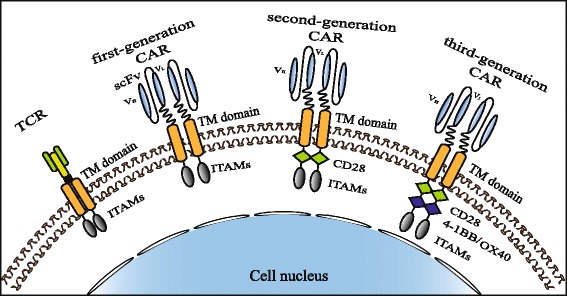
The chimeric antigen receptor T (CAR-T) cell therapy is a newly developed adoptive antitumor treatment. Theoretically, CAR-T cells can specifically localize and eliminate tumor cells by interacting with the tumor-associated antigens (TAAs) expressing on tumor cell surface. Current studies demonstrated that various TAAs could act as target antigens for CAR-T cells, for instance, the type III variant epidermal growth factor receptor (EGFRvIII) was considered as an ideal target for its aberrant expression on the cell surface of several tumor types. CAR-T cell therapy has achieved gratifying breakthrough in hematological malignancies and promising outcome in solid tumor as showed in various clinical trials. The third generation of CAR-T demonstrates increased antitumor cytotoxicity and persistence through modification of CAR structure. In this review, we summarized the preclinical and clinical progress of CAR-T cells targeting EGFR, human epidermal growth factor receptor 2 (HER2), and mesothelin (MSLN), as well as the challenges for CAR-T cell therapy.
嵌合抗原受体T(CAR-T)细胞疗法是一种新开发的过继性抗肿瘤治疗方法。理论上,CAR-T细胞可通过与肿瘤细胞表面表达的肿瘤相关抗原(TAA)相互作用,特异性地定位并消除肿瘤细胞。目前的研究表明,多种TAA可作为CAR-T细胞的靶抗原,例如,III型变异表皮生长因子受体(EGFRvIII)因其在多种肿瘤类型的细胞表面异常表达而被视为理想靶点。如各种临床试验所示,CAR-T细胞疗法在血液系统恶性肿瘤中取得了令人满意的突破,在实体瘤治疗中也展现出了良好前景。第三代CAR-T通过对CAR结构的修饰,表现出增强的抗肿瘤细胞毒性和持久性。在本综述中,我们总结了靶向表皮生长因子受体(EGFR)、人表皮生长因子受体2(HER2)和间皮素(MSLN)的CAR-T细胞的临床前和临床进展,以及CAR-T细胞疗法面临的挑战。