Sun Yuelian, Gregersen Hans, Yuan Wei
Department of Clinical Epidemiology, Aarhus University Hospital, Aarhus, Denmark.
GIOME, Department of Surgery, Chinese University of Hong Kong, Hong Kong.
Clin Epidemiol. 2017 Mar 16;9:167-178. doi: 10.2147/CLEP.S106258. eCollection 2017.
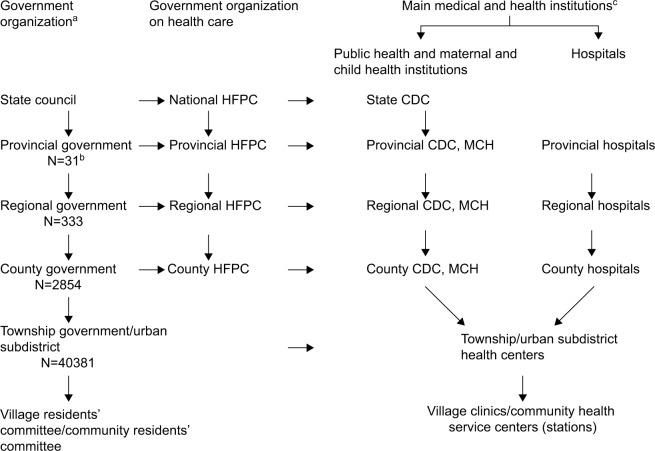
China has gone through a comprehensive health care insurance reform since 2003 and achieved universal health insurance coverage in 2011. The new health care insurance system provides China with a huge opportunity for the development of health care and medical research when its rich medical resources are fully unfolded. In this study, we review the Chinese health care system and its implication for medical research, especially within clinical epidemiology. First, we briefly review the population register system, the distribution of the urban and rural population in China, and the development of the Chinese health care system after 1949. In the following sections, we describe the current Chinese health care delivery system and the current health insurance system. We then focus on the construction of the Chinese health information system as well as several existing registers and research projects on health data. Finally, we discuss the opportunities and challenges of the health care system in regard to clinical epidemiology research. China now has three main insurance schemes. The Urban Employee Basic Medical Insurance (UEBMI) covers urban employees and retired employees. The Urban Residence Basic Medical Insurance (URBMI) covers urban residents, including children, students, elderly people without previous employment, and unemployed people. The New Rural Cooperative Medical Scheme (NRCMS) covers rural residents. The Chinese Government has made efforts to build up health information data, including electronic medical records. The establishment of universal health care insurance with linkage to medical records will provide potentially huge research opportunities in the future. However, constructing a complete register system at a nationwide level is challenging. In the future, China will demand increased capacity of researchers and data managers, in particular within clinical epidemiology, to explore the rich resources.
自2003年以来,中国经历了全面的医疗保险改革,并于2011年实现了全民医保覆盖。新的医疗保险体系为中国提供了巨大机遇,使丰富的医疗资源得以充分发挥,推动医疗保健和医学研究的发展。在本研究中,我们回顾了中国的医疗体系及其对医学研究的影响,尤其是在临床流行病学领域。首先,我们简要回顾了人口登记系统、中国城乡人口分布以及1949年后中国医疗体系的发展。在接下来的部分,我们描述了中国当前的医疗服务体系和现行的医疗保险体系。然后,我们重点关注中国健康信息系统的建设以及一些现有的健康数据登记册和研究项目。最后,我们讨论了医疗体系在临床流行病学研究方面的机遇和挑战。中国目前有三种主要的保险计划。城镇职工基本医疗保险覆盖城镇职工和退休人员。城镇居民基本医疗保险覆盖城镇居民,包括儿童、学生、无业老人和失业人员。新型农村合作医疗制度覆盖农村居民。中国政府已努力建立健康信息数据,包括电子病历。建立与病历相关联的全民医疗保险将在未来提供潜在的巨大研究机会。然而,在全国范围内构建一个完整的登记系统具有挑战性。未来,中国将需要研究人员和数据管理人员,特别是临床流行病学领域的人员,提升能力以挖掘这些丰富资源。