Baltruškevičienė Edita, Mickys Ugnius, Žvirblis Tadas, Stulpinas Rokas, Pipirienė Želvienė Teresė, Aleknavičius Eduardas
Radiation and Medical Oncology Center, National Cancer Institute, Vilnius, Lithuania.
National Center of Pathology, Affiliate of Vilnius University Hospital Santariškių Clinics, Vilnius, Lithuania.
Acta Med Litu. 2016;23(1):24-34. doi: 10.6001/actamedica.v23i1.3267.
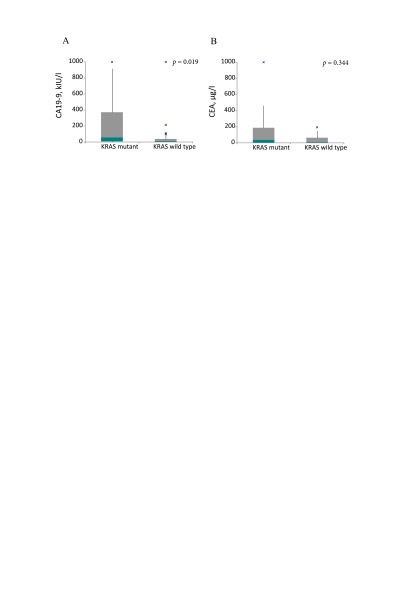
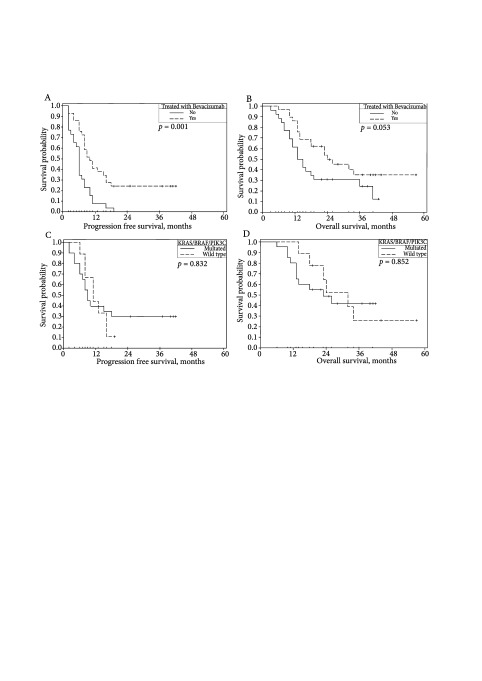
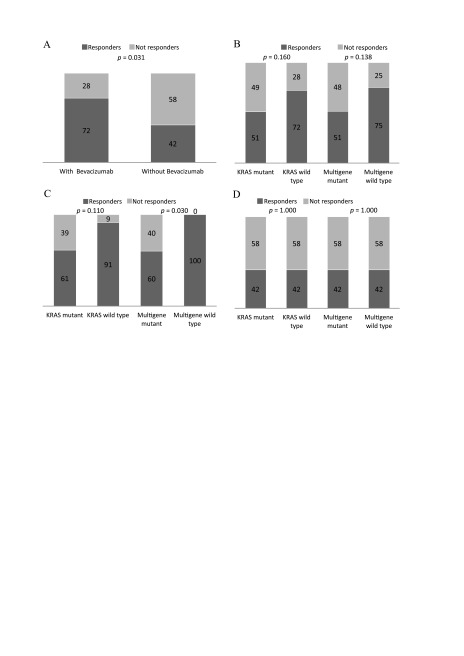
KRAS mutation is an important predictive and prognostic factor for patients receiving anti-EGFR therapy. An expanded KRAS, NRAS, BRAF, PIK3CA mutation analysis provides additional prognostic information, but its role in predicting bevacizumab efficacy is unclear. The aim of our study was to evaluate the incidence of KRAS, NRAS, BRAF and PIK3CA mutations in metastatic colorectal cancer patients receiving first line oxaliplatin based chemotherapy with or without bevacizumab and to evaluate their prognostic and predictive significance. 55 patients with the first-time diagnosed CRC receiving FOLFOX ± bevacizumab were involved in the study. Tumour blocks were tested for KRAS mutations in exons 2, 3 and 4, NRAS mutations in exons 2, 3 and 4, BRAF mutation in exon 15 and PIK3CA mutations in exons 9 and 20. The association between mutations and clinico-pathological factors, treatment outcomes and survival was analyzed. KRAS mutations were detected in 67.3% of the patients, BRAF in 1.8%, PIK3CA in 5.5% and there were no NRAS mutations. A significant association between the high CA 19-9 level and KRAS mutation was detected (mean CA 19-9 levels were 276 and 87 kIU/l, respectively, = 0.019). There was a significantly higher response rate in the KRAS, NRAS, BRAF and PIK3CA wild type cohort receiving bevacizumab compared to any gene mutant type (100 and 60%, respectively, = 0.030). The univariate Cox regression analysis did not confirm KRAS and other tested mutations as prognostic factors for PFS or OS. Our study revealed higher KRAS and lower NRAS, BRAF and PIK3CA mutation rates in the Lithuanian population than those reported in the literature. KRAS mutation was associated with the high CA 19-9 level and mucinous histology type, but did not show any predictive or prognostic significance. The expanded KRAS, NRAS, BRAF and PIK3CA mutation analysis provided additional significant predictive information.
KRAS突变是接受抗表皮生长因子受体(EGFR)治疗患者的重要预测和预后因素。扩展的KRAS、NRAS、BRAF、PIK3CA突变分析可提供更多预后信息,但其在预测贝伐单抗疗效方面的作用尚不清楚。我们研究的目的是评估接受一线含奥沙利铂化疗(联合或不联合贝伐单抗)的转移性结直肠癌患者中KRAS、NRAS、BRAF和PIK3CA突变的发生率,并评估其预后和预测意义。55例首次诊断为结直肠癌并接受FOLFOX方案±贝伐单抗治疗的患者参与了本研究。检测肿瘤组织块中第2、3和4外显子的KRAS突变、第2、3和4外显子的NRAS突变、第15外显子的BRAF突变以及第9和20外显子的PIK3CA突变。分析突变与临床病理因素、治疗结果及生存之间的关联。67.3%的患者检测到KRAS突变,1.8%检测到BRAF突变,5.5%检测到PIK3CA突变,未检测到NRAS突变。检测到高CA 19-9水平与KRAS突变之间存在显著关联(平均CA 19-9水平分别为276和87 kIU/l,P = 0.019)。与任何基因突变类型相比,接受贝伐单抗治疗的KRAS、NRAS、BRAF和PIK3CA野生型队列的缓解率显著更高(分别为100%和60%,P = 0.030)。单因素Cox回归分析未证实KRAS及其他检测到的突变是无进展生存期(PFS)或总生存期(OS)的预后因素。我们的研究显示,立陶宛人群中KRAS突变率较高,NRAS、BRAF和PIK3CA突变率低于文献报道。KRAS突变与高CA 19-9水平及黏液组织学类型相关,但未显示出任何预测或预后意义。扩展的KRAS、NRAS、BRAF和PIK3CA突变分析提供了额外的重要预测信息。