Cao Hua, Liu Xinyi, Chen Yixin, Yang Pan, Huang Tanxiao, Song Lele, Xu Ruilian
Department of Oncology, Shenzhen People's Hospital, The 2nd Clinical Medical School of Ji'nan University, The First Affiliated Hospital of Southern University of Science and Technology, Shenzhen, China.
HaploX Biotechnology, Co., Ltd., Shenzhen, China.
Front Oncol. 2020 Apr 7;10:466. doi: 10.3389/fonc.2020.00466. eCollection 2020.
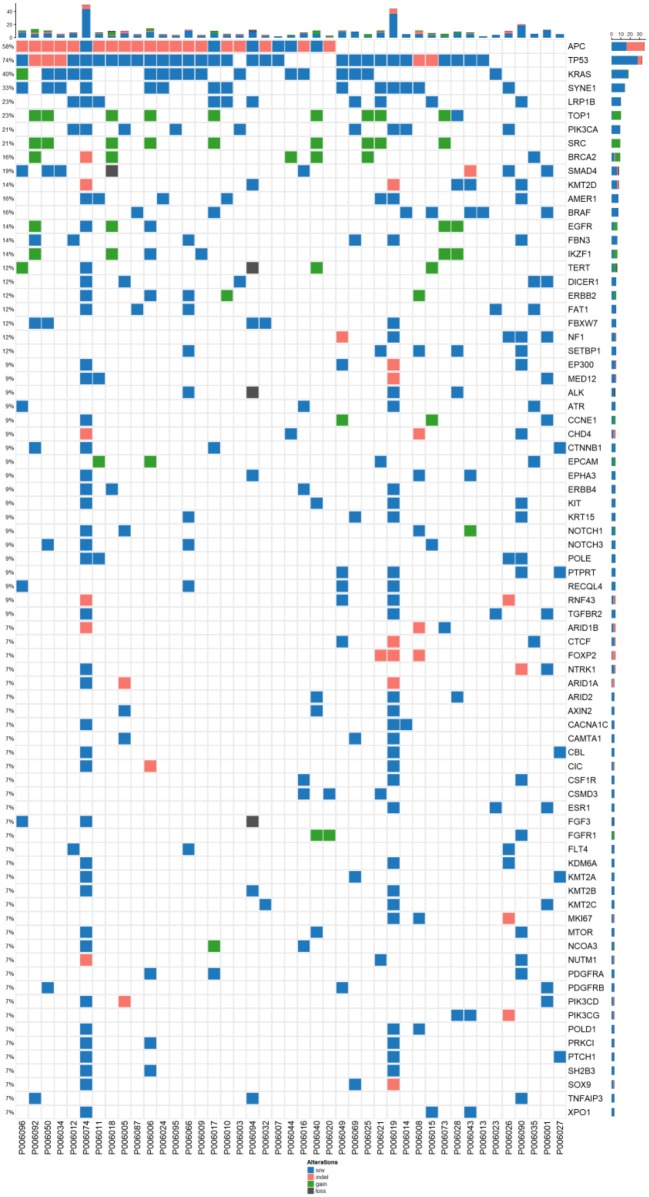
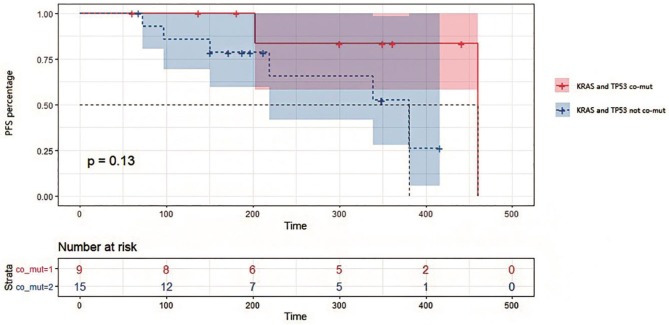
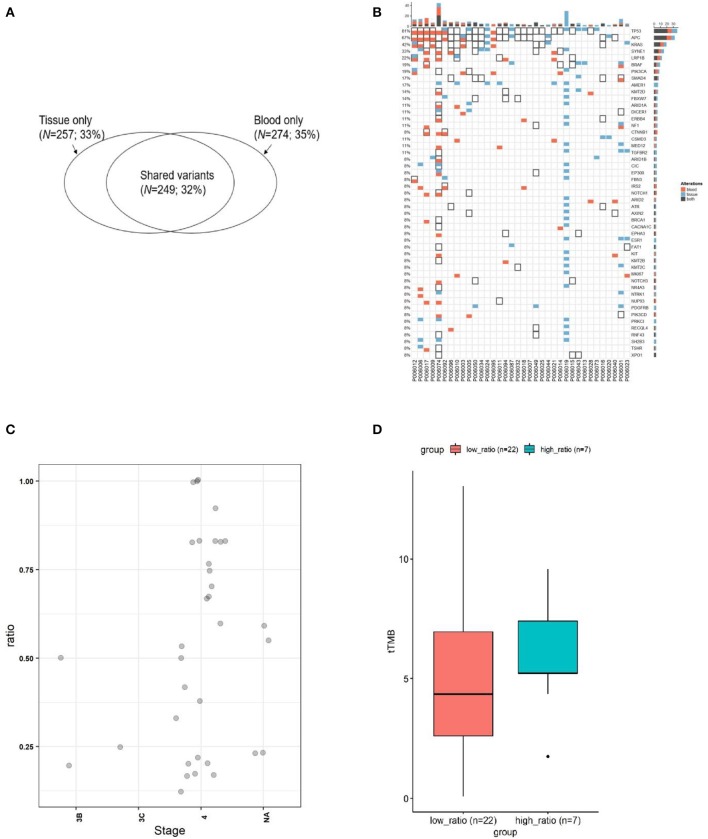
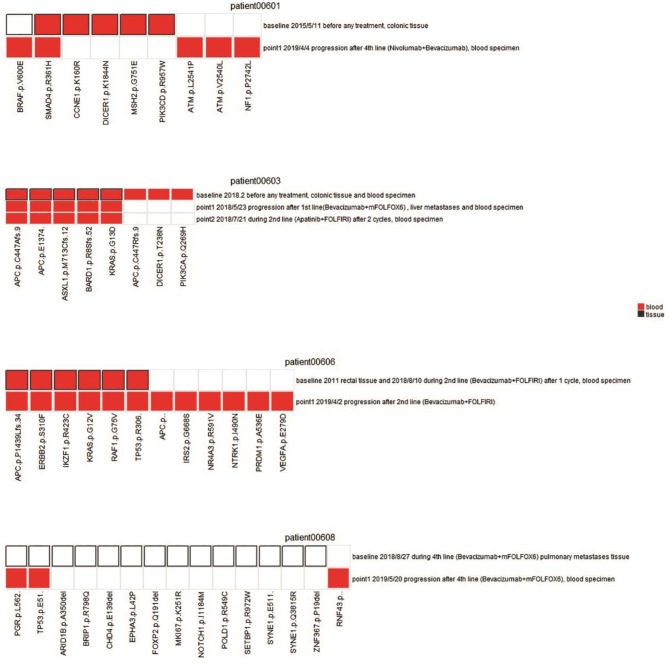
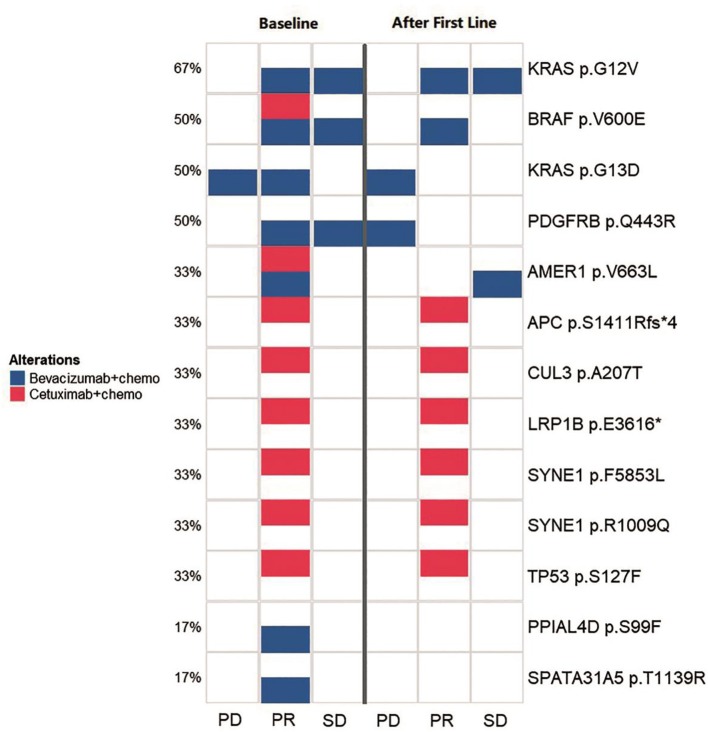
Colorectal cancer (CRC) is a highly lethal disease worldwide. The majority of patients receiving targeted therapy or chemotherapy develop drug resistance, while its molecular mechanism remains to be elucidated. The plasma circulating tumor DNA (ctDNA) exhibited the potential in identifying gene variations and monitoring drug resistance in CRC treatment. In this study, we monitored the ctDNA mutational changes in advanced CRC patients underwent first-line therapy with bevacizumab and cetuximab combined with chemotherapy. The mutation spectrum of 43 patients was established by a 605-gene next-generation sequencing (NGS) panel. The baseline measurement shows that genes with the highest mutation frequency were TP53 (74%), APC (58%), KRAS (40%), SYNE1 (33%), LRP1B (23%), TOP1 (23%), and PIK3CA (21%). Mutations in TP53, APC, and KRAS were detected in 29 paired plasma and tissue samples with the consistency of 81, 67, and 42%, respectively. Clinically targetable gene mutations, such as APC, RNF43, SMAD4, BRAD1, KRAS, RAF1, and TP53, were also identified in ctDNA. The overall consistency between ctDNA and tissue samples was 54.6%. Alleviation of mutational burden in BRAF, KRAS, AMER1, and other major driving genes was observed following the first-line therapy. Patients with KRAS and TP53 mutations in tissues appeared to benefit more than the wild-type counterpart. The dynamic change of plasma mutation status was consistent with the tissue tumor burden and was closely correlated with disease progression. In conclusion, ctDNA monitoring is a useful method for molecular genotyping of colorectal cancer patients. Dynamic changes in resistance can be sensitively monitored by gene variation status, which potentially helps to develop treatment strategy.
结直肠癌(CRC)在全球范围内是一种致死率很高的疾病。大多数接受靶向治疗或化疗的患者会产生耐药性,但其分子机制仍有待阐明。血浆循环肿瘤DNA(ctDNA)在结直肠癌治疗中具有识别基因变异和监测耐药性的潜力。在本研究中,我们监测了接受贝伐单抗和西妥昔单抗联合化疗一线治疗的晚期结直肠癌患者的ctDNA突变变化。通过一个605基因的二代测序(NGS)面板确定了43例患者的突变谱。基线测量显示,突变频率最高的基因是TP53(74%)、APC(58%)、KRAS(40%)、SYNE1(33%)、LRP1B(23%)、TOP1(23%)和PIK3CA(21%)。在29对血浆和组织样本中检测到TP53、APC和KRAS的突变,一致性分别为81%、67%和42%。在ctDNA中也鉴定出了临床上可靶向的基因突变,如APC、RNF43、SMAD4、BRAD1、KRAS、RAF1和TP53。ctDNA与组织样本之间的总体一致性为54.6%。一线治疗后观察到BRAF、KRAS、AMER1和其他主要驱动基因的突变负担减轻。组织中KRAS和TP53突变的患者似乎比野生型患者受益更多。血浆突变状态的动态变化与组织肿瘤负荷一致,且与疾病进展密切相关。总之,ctDNA监测是结直肠癌患者分子基因分型的一种有用方法。通过基因变异状态可以灵敏地监测耐药性的动态变化,这可能有助于制定治疗策略。