Olson Keith M, Lei Wei, Keresztes Attila, LaVigne Justin, Streicher John M
Department of Pharmacology, College of Medicine, University of Arizona, Tucson, AZ; Department of Chemistry and Biochemistry, College of Science, University of Arizona, Tucson, AZ.
Department of Pharmacology, College of Medicine, University of Arizona, Tucson, AZ.
Yale J Biol Med. 2017 Mar 29;90(1):97-110. eCollection 2017 Mar.
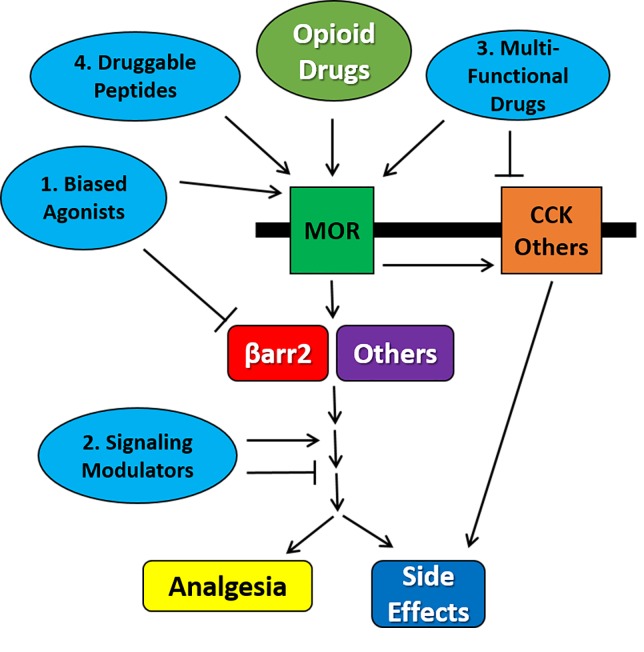
Opioid drugs like morphine and fentanyl are the gold standard for treating moderate to severe acute and chronic pain. However, opioid drug use can be limited by serious side effects, including constipation, tolerance, respiratory suppression, and addiction. For more than 100 years, we have tried to develop opioids that decrease or eliminate these liabilities, with little success. Recent advances in understanding opioid receptor signal transduction have suggested new possibilities to activate the opioid receptors to cause analgesia, while reducing or eliminating unwanted side effects. These new approaches include designing functionally selective ligands, which activate desired signaling cascades while avoiding signaling cascades that are thought to provoke side effects. It may also be possible to directly modulate downstream signaling through the use of selective activators and inhibitors. Separate from downstream signal transduction, it has also been found that when the opioid system is stimulated, various negative feedback systems are upregulated to compensate, which can drive side effects. This has led to the development of multi-functional molecules that simultaneously activate the opioid receptor while blocking various negative feedback receptor systems including cholecystokinin and neurokinin-1. Other novel approaches include targeting heterodimers of the opioid and other receptor systems which may drive side effects, and making endogenous opioid peptides druggable, which may also reduce opioid mediated side effects. Taken together, these advances in our molecular understanding provide a path forward to break the barrier in producing an opioid with reduced or eliminated side effects, especially addiction, which may provide relief for millions of patients.
吗啡和芬太尼等阿片类药物是治疗中度至重度急慢性疼痛的金标准。然而,阿片类药物的使用可能会受到严重副作用的限制,包括便秘、耐受性、呼吸抑制和成瘾。100多年来,我们一直试图开发能减少或消除这些不良反应的阿片类药物,但收效甚微。最近在理解阿片受体信号转导方面的进展提出了新的可能性,即激活阿片受体以产生镇痛作用,同时减少或消除不必要的副作用。这些新方法包括设计功能选择性配体,其激活所需的信号级联反应,同时避免被认为会引发副作用的信号级联反应。也有可能通过使用选择性激活剂和抑制剂直接调节下游信号。与下游信号转导不同,还发现当阿片系统受到刺激时,各种负反馈系统会上调以进行补偿,这可能会引发副作用。这导致了多功能分子的开发,其在激活阿片受体的同时阻断包括胆囊收缩素和神经激肽-1在内的各种负反馈受体系统。其他新方法包括靶向可能引发副作用的阿片类和其他受体系统的异二聚体,以及使内源性阿片肽具有药物活性,这也可能减少阿片介导的副作用。总之,我们在分子理解方面的这些进展为打破生产副作用减少或消除(尤其是成瘾性)的阿片类药物的障碍提供了一条前进的道路,这可能为数百万患者带来缓解。