Peterson Sean M, Pack Thomas F, Caron Marc G
Department of Cell Biology, Duke University Medical Center, Durham, North Carolina, United States of America.
Department of Cell Biology, Duke University Medical Center, Durham, North Carolina, United States of America; Department of Neurobiology, Duke University Medical Center, Durham, North Carolina, United States of America; Department of Medicine, Duke University Medical Center, Durham, North Carolina, United States of America.
PLoS One. 2015 Oct 30;10(10):e0141637. doi: 10.1371/journal.pone.0141637. eCollection 2015.
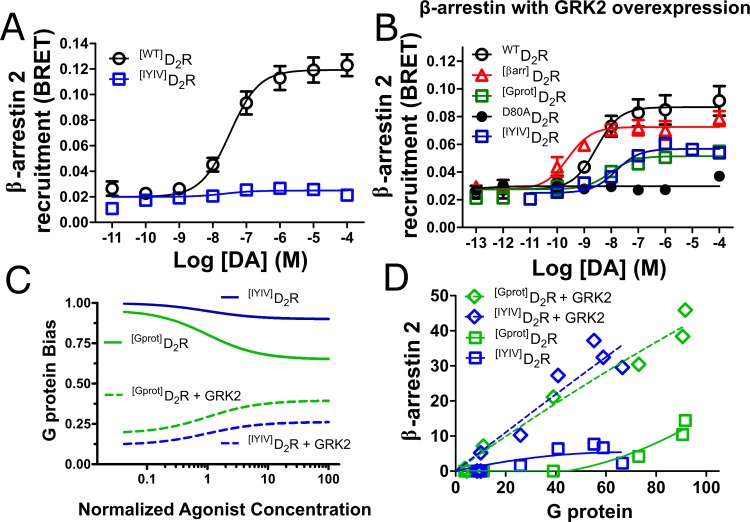
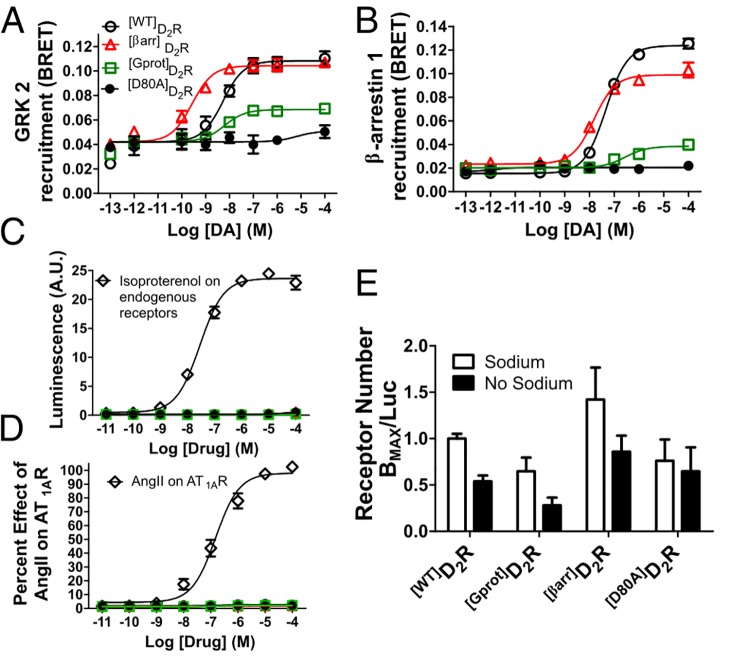
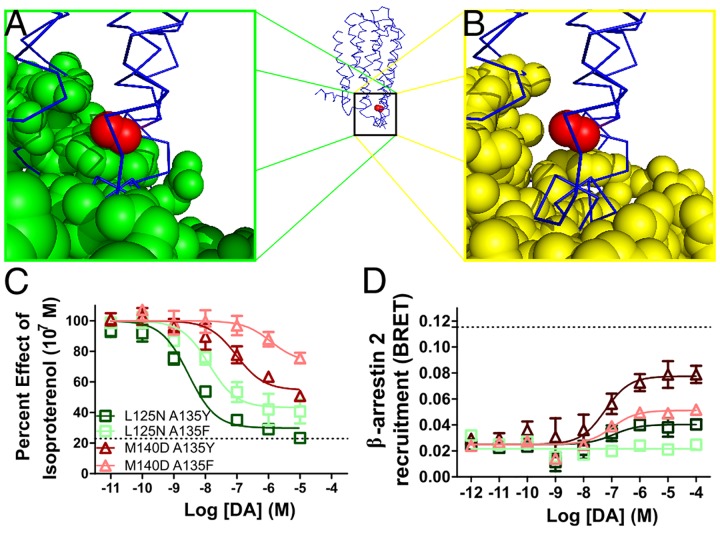
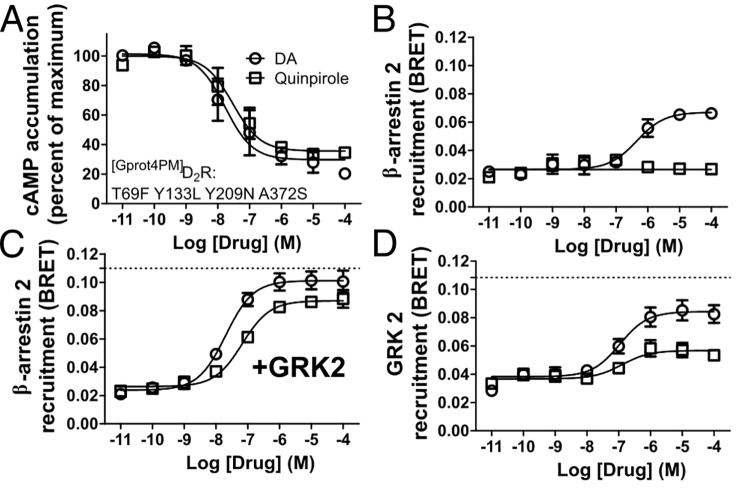
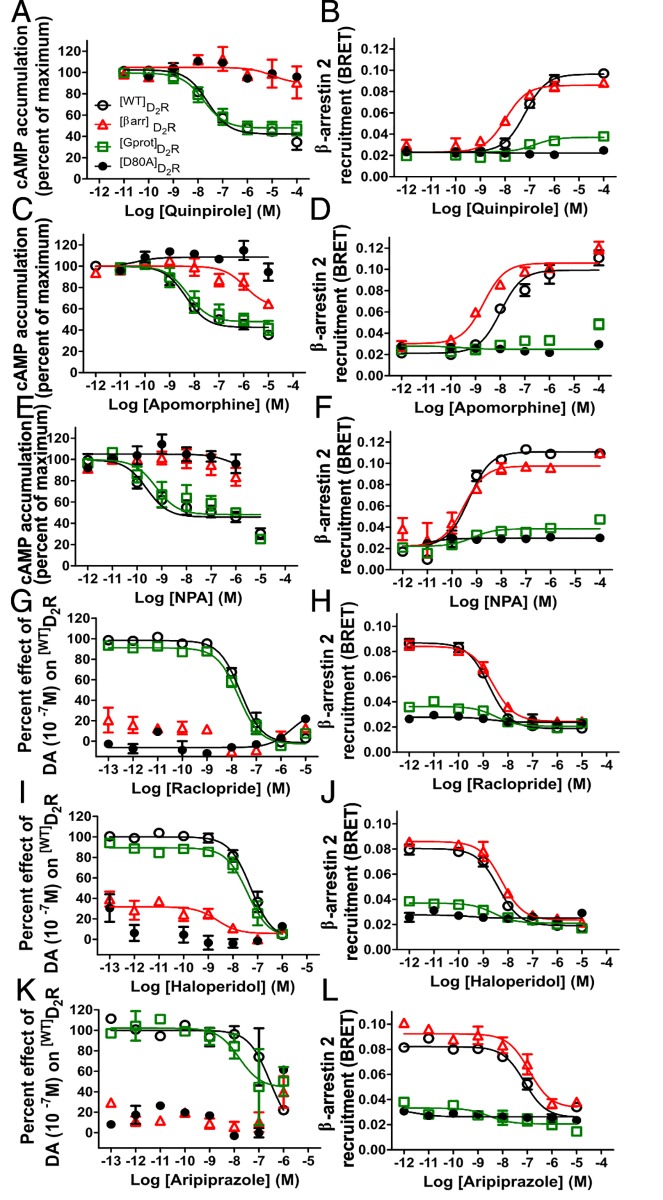
Functional selectivity (or biased agonism) is a property exhibited by some G protein-coupled receptor (GPCR) ligands, which results in the modulation of a subset of a receptor's signaling capabilities and more precise control over complex biological processes. The dopamine D2 receptor (D2R) exhibits pleiotropic responses to the biogenic amine dopamine (DA) to mediate complex central nervous system functions through activation of G proteins and β-arrestins. D2R is a prominent therapeutic target for psychological and neurological disorders in which DA biology is dysregulated and targeting D2R with functionally selective drugs could provide a means by which pharmacotherapies could be developed. However, factors that determine GPCR functional selectivity in vivo may be multiple with receptors, ligands and transducers contributing to the process. We have recently described a mutagenesis approach to engineer biased D2R mutants in which G protein-dependent ([Gprot]D2R) and β-arrestin-dependent signaling ([βarr]D2R) were successfully separated (Peterson, et al. PNAS, 2015). Here, permutations of these mutants were used to identify critical determinants of the D2R signaling complex that impart signaling bias in response to the natural or synthetic ligands. Critical residues identified in generating [Gprot]D2R and [βarr]D2R conferred control of partial agonism at G protein and/or β-arrestin activity. Another set of mutations that result in G protein bias was identified that demonstrated that full agonists can impart unique activation patterns, and provided further credence to the concept of ligand texture. Finally, the contributions and interplay between different transducers indicated that G proteins are not aberrantly activated, and that receptor kinase and β-arrestin activities are inextricably linked. These data provide a thorough elucidation of the feasibility and malleability of D2R functional selectivity and point to means by which novel in vivo therapies could be modeled.
功能选择性(或偏向性激动作用)是某些G蛋白偶联受体(GPCR)配体所具有的一种特性,它能调节受体信号传导能力的一个子集,并对复杂的生物过程进行更精确的控制。多巴胺D2受体(D2R)对生物胺多巴胺(DA)表现出多效性反应,通过激活G蛋白和β-抑制蛋白来介导复杂的中枢神经系统功能。D2R是心理和神经疾病的一个重要治疗靶点,在这些疾病中DA生物学功能失调,用功能选择性药物靶向D2R可为开发药物疗法提供一种手段。然而,体内决定GPCR功能选择性的因素可能多种多样,受体、配体和转导分子都参与了这一过程。我们最近描述了一种诱变方法来构建偏向性D2R突变体,其中G蛋白依赖性([Gprot]D2R)和β-抑制蛋白依赖性信号传导([βarr]D2R)成功分离(彼得森等人,《美国国家科学院院刊》,2015年)。在此,这些突变体的排列被用于识别D2R信号复合物的关键决定因素,这些因素赋予了对天然或合成配体的信号偏向性。在产生[Gprot]D2R和[βarr]D2R过程中鉴定出的关键残基赋予了对G蛋白和/或β-抑制蛋白活性的部分激动作用的控制。还鉴定出另一组导致G蛋白偏向性的突变,这些突变表明完全激动剂可以赋予独特的激活模式,并为配体结构概念提供了进一步的可信度。最后,不同转导分子之间的贡献和相互作用表明,G蛋白不会被异常激活,并且受体激酶和β-抑制蛋白的活性是紧密相连的。这些数据全面阐明了D2R功能选择性的可行性和可塑性,并指出了可以模拟新型体内疗法的方法。