Caragata Eric Pearce, Dutra Heverton Leandro Carneiro, Moreira Luciano Andrade
Mosquitos Vetores: Endossimbiontes e Interação Patógeno-Vetor, Centro de Pesquisas René Rachou - Fiocruz, Belo Horizonte, MG, Brazil.
Microb Cell. 2016 Jun 27;3(7):293-295. doi: 10.15698/mic2016.07.513.
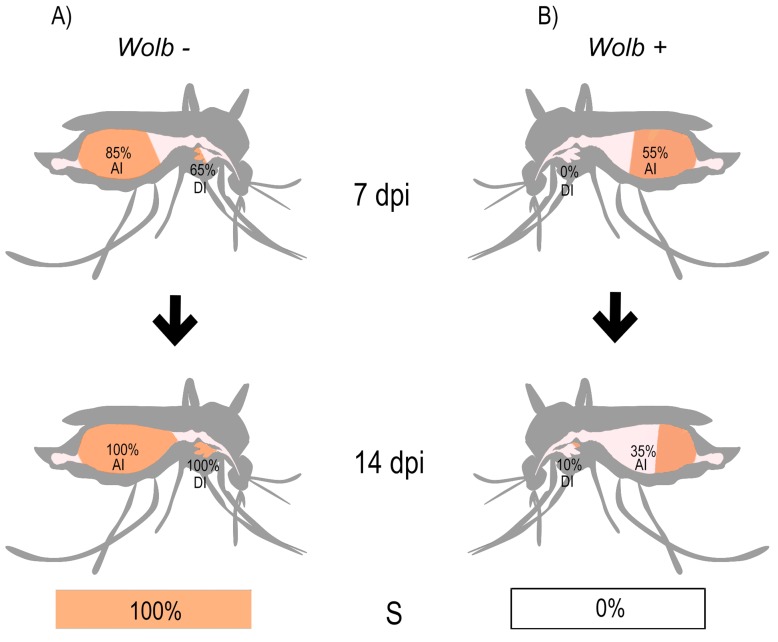
Through association with cases of microcephaly in 2015, Zika virus (ZIKV) has transitioned from a relatively unknown mosquito-transmitted pathogen to a global health emergency, emphasizing the need to improve existing mosquito control programs to prevent future disease outbreaks. The response to Zika must involve a paradigm shift from traditional to novel methods of mosquito control, and according to the World Health Organization should incorporate the release of mosquitoes infected with the bacterial endosymbiont . In our recent paper [Dutra, HLC , Cell Host & Microbe 2016] we investigated the potential of infections in to restrict infection and transmission of Zika virus recently isolated in Brazil. is now well known for its ability to block or reduce infection with a variety of pathogens in different mosquito species including the dengue (DENV), yellow fever, and chikungunya viruses, and malaria-causing , and consequently has great potential to control mosquito-transmitted diseases across the globe. Our results demonstrated that the Mel strain in Brazilian is a strong inhibitor of ZIKV infection, and furthermore appears to prevent transmission of infectious viral particles in mosquito saliva, which highlights the bacterium's suitability for more widespread use in Zika control.
通过与2015年的小头畸形病例相关联,寨卡病毒(ZIKV)已从一种相对不为人知的蚊媒传播病原体转变为全球卫生紧急事件,这凸显了改进现有蚊虫控制计划以预防未来疾病爆发的必要性。应对寨卡病毒必须涉及从传统蚊虫控制方法到新型方法的范式转变,并且根据世界卫生组织的建议,应纳入释放感染了细菌内共生体的蚊子。在我们最近的论文[杜特拉,HLC,《细胞宿主与微生物》2016年]中,我们研究了在[某种蚊虫]中[某种感染]限制最近在巴西分离出的寨卡病毒感染和传播的潜力。[这种蚊虫]现在因其能够在包括登革热(DENV)、黄热病和基孔肯雅病毒以及疟原虫在内的不同蚊虫物种中阻断或减少多种病原体的感染而闻名,因此在全球控制蚊媒传播疾病方面具有巨大潜力。我们的结果表明,巴西[某种蚊虫]中的Mel[某种菌株]是寨卡病毒感染的强力抑制剂,而且似乎能阻止感染性病毒颗粒在蚊虫唾液中的传播,这凸显了这种细菌在更广泛用于寨卡病毒控制方面的适用性。