Gonzalez Javier T, Fuchs Cas J, Betts James A, van Loon Luc J C
Department for Health, University of Bath, Bath BA2 7AY, UK.
Department of Human Biology and Movement Sciences, NUTRIM School of Nutrition and Translational Research in Metabolism, Maastricht University Medical Centre+ (MUMC+), P.O. Box 616, 6200 MD Maastricht, The Netherlands.
Nutrients. 2017 Mar 30;9(4):344. doi: 10.3390/nu9040344.
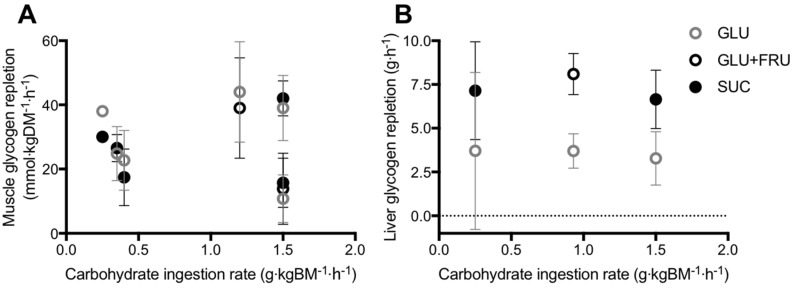
Carbohydrate availability in the form of muscle and liver glycogen is an important determinant of performance during prolonged bouts of moderate- to high-intensity exercise. Therefore, when effective endurance performance is an objective on multiple occasions within a 24-h period, the restoration of endogenous glycogen stores is the principal factor determining recovery. This review considers the role of glucose-fructose co-ingestion on liver and muscle glycogen repletion following prolonged exercise. Glucose and fructose are primarily absorbed by different intestinal transport proteins; by combining the ingestion of glucose with fructose, both transport pathways are utilised, which increases the total capacity for carbohydrate absorption. Moreover, the addition of glucose to fructose ingestion facilitates intestinal fructose absorption via a currently unidentified mechanism. The co-ingestion of glucose and fructose therefore provides faster rates of carbohydrate absorption than the sum of glucose and fructose absorption rates alone. Similar metabolic effects can be achieved via the ingestion of sucrose (a disaccharide of glucose and fructose) because intestinal absorption is unlikely to be limited by sucrose hydrolysis. Carbohydrate ingestion at a rate of ≥1.2 g carbohydrate per kg body mass per hour appears to maximise post-exercise muscle glycogen repletion rates. Providing these carbohydrates in the form of glucose-fructose (sucrose) mixtures does not further enhance muscle glycogen repletion rates over glucose (polymer) ingestion alone. In contrast, liver glycogen repletion rates are approximately doubled with ingestion of glucose-fructose (sucrose) mixtures over isocaloric ingestion of glucose (polymers) alone. Furthermore, glucose plus fructose (sucrose) ingestion alleviates gastrointestinal distress when the ingestion rate approaches or exceeds the capacity for intestinal glucose absorption (~1.2 g/min). Accordingly, when rapid recovery of endogenous glycogen stores is a priority, ingesting glucose-fructose mixtures (or sucrose) at a rate of ≥1.2 g·kg body mass·h can enhance glycogen repletion rates whilst also minimising gastrointestinal distress.
以肌肉和肝糖原形式存在的碳水化合物可用性是中高强度长时间运动期间运动表现的重要决定因素。因此,当在24小时内多次以有效耐力表现为目标时,内源性糖原储备的恢复是决定恢复的主要因素。本综述探讨了长时间运动后同时摄入葡萄糖和果糖对肝脏和肌肉糖原补充的作用。葡萄糖和果糖主要通过不同的肠道转运蛋白吸收;将葡萄糖与果糖同时摄入,两种转运途径都能得到利用,从而增加了碳水化合物的总吸收能力。此外,在摄入果糖时添加葡萄糖通过目前尚不清楚的机制促进肠道果糖吸收。因此,同时摄入葡萄糖和果糖比单独摄入葡萄糖和果糖的吸收速率之和能提供更快的碳水化合物吸收速度。通过摄入蔗糖(葡萄糖和果糖的二糖)也能实现类似的代谢效应,因为肠道吸收不太可能受蔗糖水解的限制。每小时每千克体重摄入≥1.2克碳水化合物的碳水化合物摄入量似乎能使运动后肌肉糖原补充率最大化。以葡萄糖 - 果糖(蔗糖)混合物形式提供这些碳水化合物,与单独摄入葡萄糖(聚合物)相比,并不会进一步提高肌肉糖原补充率。相比之下,与单独等热量摄入葡萄糖(聚合物)相比,摄入葡萄糖 - 果糖(蔗糖)混合物时肝脏糖原补充率大约会提高一倍。此外,当摄入速率接近或超过肠道葡萄糖吸收能力(约1.2克/分钟)时,同时摄入葡萄糖加果糖(蔗糖)可减轻胃肠道不适。因此,当优先考虑内源性糖原储备的快速恢复时,以每小时每千克体重≥1.2克的速率摄入葡萄糖 - 果糖混合物(或蔗糖)可以提高糖原补充率,同时还能将胃肠道不适降至最低。