Bredemeier Maren, Kasimir-Bauer Sabine, Kolberg Hans-Christian, Herold Thomas, Synoracki Sarah, Hauch Siegfried, Edimiris Philippos, Bankfalvi Agnes, Tewes Mitra, Kimmig Rainer, Aktas Bahriye
Department of Gynecology and Obstetrics, University Hospital Essen, University of Duisburg‑Essen, D‑45122 Essen, Germany.
Department of Gynecology and Obstetrics, Marienhospital Bottrop, D‑46236 Bottrop, Germany.
Mol Med Rep. 2017 May;15(5):2957-2968. doi: 10.3892/mmr.2017.6415. Epub 2017 Mar 30.
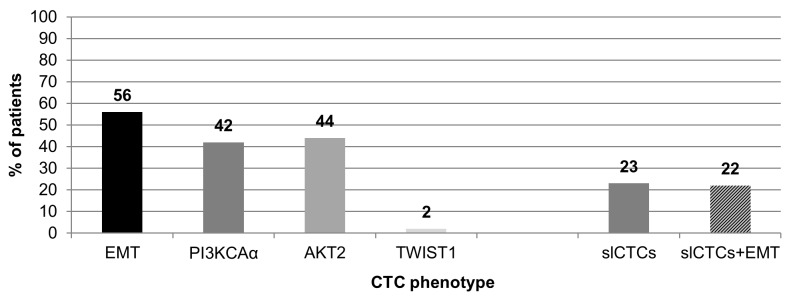
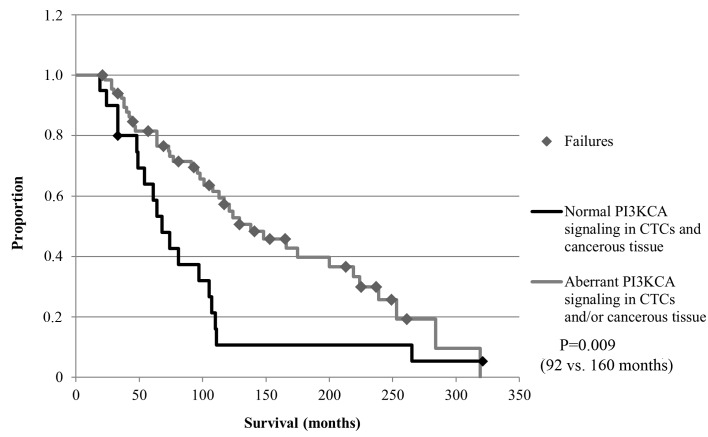
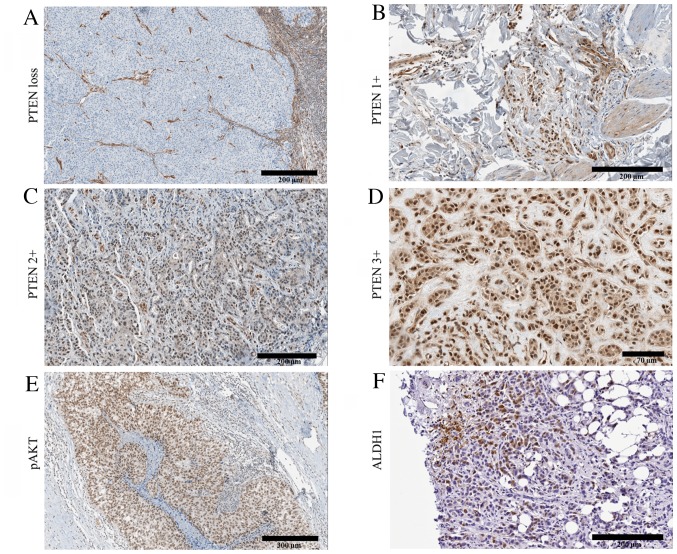
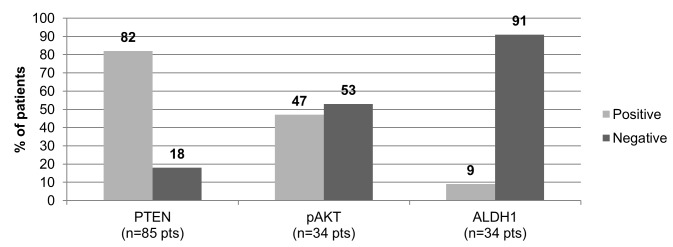
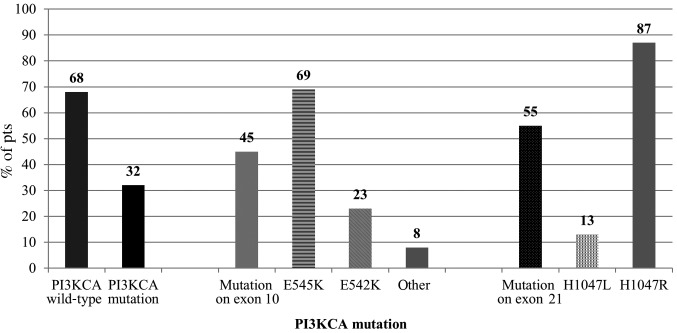
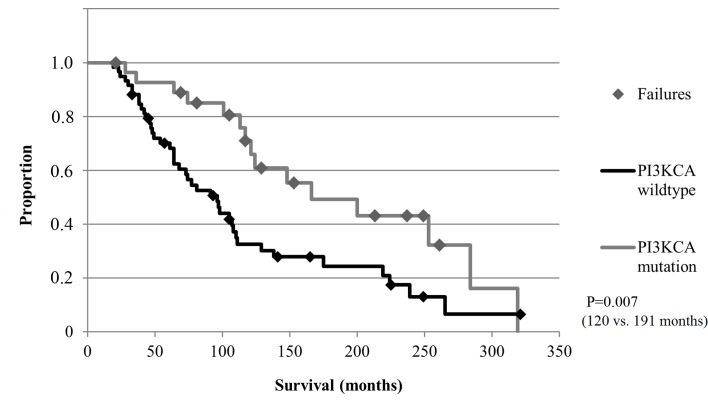
The aim of the present study was to compare the phosphatidylinositol 3-kinase (PI3KCA)-AKT serine/threonine kinase (AKT) pathway in circulating tumor cells (CTCs) and corresponding cancerous tissues. Stemness‑like circulating tumor cells (slCTCs) and CTCs in epithelial-mesenchymal transition (EMT) have been implicated as the active source of metastatic spread in breast cancer (BC). In this regard, the PI3KCA‑AKT signaling pathway was demonstrated to be implicated in and to be frequently mutated in BC. The present study compared this pathway in slCTCs/CTCs in EMT and the corresponding tumor tissues of 90 metastatic BC patients (pts). slCTCs and CTCs in EMT were isolated using the AdnaTest EMT-1/StemCell for the detection of aldehyde dehydrogenase 1 family member A1 (ALDH1) (singleplex PCR) and PI3KCA, AKT2 and twist family bHLH transcription factor 1 (multiplex PCR). Tumor tissue was investigated for PI3KCA hotspot mutations using Sanger sequencing of genomic DNA from micro‑dissected formalin‑fixed paraffin‑embedded tissue, and for the expression of ALDH1 and phosphorylated AKT (pAKT), and phosphatase and tensin homolog (PTEN) loss, by immunohistochemistry. slCTCs were identified in 23% of pts (21/90 pts) and CTCs in EMT in 56% (50/90 pts) of pts. pAKT and ALDH1 positivity in tumor tissue was identified in 47 and 9% of cases, respectively, and a PTEN loss was observed in 18% of pts. A significant association was detected between pAKT expression in cancerous tissue and AKT2 expression in CTCs (P=0.037). PI3KCA mutations were detected in 32% of pts, most frequently on exons 21 (55%) and 10 (45%). Pts with PI3KCA mutations in tumor tissue had a significantly longer overall survival than pts with wild-type PI3KCA expression (P=0.007). Similar results were obtained for pts with aberrant PI3KCA signaling in CTCs and/or aberrant signaling in cancerous tissue (P=0.009). Therapy‑resistant CTCs, potentially derived from the primary tumor or metastatic tissue, may be eliminated with specific PI3K pathway inhibitors, alone or in combination, to improve the prognosis of metastatic BC pts.
本研究的目的是比较循环肿瘤细胞(CTC)和相应癌组织中的磷脂酰肌醇3激酶(PI3KCA)-AKT丝氨酸/苏氨酸激酶(AKT)信号通路。具有干细胞样特性的循环肿瘤细胞(slCTC)和处于上皮-间质转化(EMT)状态的CTC被认为是乳腺癌(BC)转移扩散的活跃来源。在这方面,PI3KCA-AKT信号通路被证明与BC有关且在BC中经常发生突变。本研究比较了90例转移性BC患者的处于EMT状态的slCTC/CTC及其相应肿瘤组织中的该信号通路。使用AdnaTest EMT-1/StemCell分离处于EMT状态的slCTC和CTC,以检测醛脱氢酶1家族成员A1(ALDH1)(单重PCR)以及PI3KCA、AKT2和 twist家族bHLH转录因子1(多重PCR)。通过对显微切割的福尔马林固定石蜡包埋组织的基因组DNA进行桑格测序来研究肿瘤组织中的PI3KCA热点突变,并通过免疫组织化学研究ALDH1和磷酸化AKT(pAKT)的表达以及磷酸酶和张力蛋白同源物(PTEN)缺失情况。在23%的患者(21/90例患者)中检测到slCTC,在56%(50/90例患者)的患者中检测到处于EMT状态的CTC。肿瘤组织中pAKT和ALDH1阳性分别在47%和9%的病例中被检测到,并且在18%的患者中观察到PTEN缺失。在癌组织中的pAKT表达与CTC中的AKT2表达之间检测到显著相关性(P = 0.037)。在32%的患者中检测到PI3KCA突变,最常见于外显子21(55%)和10(45%)。肿瘤组织中具有PI3KCA突变的患者的总生存期明显长于PI3KCA表达为野生型的患者(P = 0.007)。对于CTC中PI3KCA信号异常和/或癌组织中信号异常的患者也获得了类似结果(P = 0.009)。对治疗耐药的CTC可能源自原发性肿瘤或转移组织,可单独或联合使用特定的PI3K通路抑制剂将其清除,以改善转移性BC患者的预后。