Fattori Giovanni, Safai Sairos, Carmona Pablo Fernández, Peroni Marta, Perrin Rosalind, Weber Damien Charles, Lomax Antony John
Center for Proton Therapy, Paul Scherrer Institut, 5232, Villigen, PSI, Switzerland.
Radiation Oncology Department, Inselspital Universitätsspital Bern, 3010, Bern, Switzerland.
Radiat Oncol. 2017 Mar 31;12(1):63. doi: 10.1186/s13014-017-0797-9.
Motion monitoring is essential when treating non-static tumours with pencil beam scanned protons. 4D medical imaging typically relies on the detected body surface displacement, considered as a surrogate of the patient's anatomical changes, a concept similarly applied by most motion mitigation techniques. In this study, we investigate benefits and pitfalls of optical and electromagnetic tracking, key technologies for non-invasive surface motion monitoring, in the specific environment of image-guided, gantry-based proton therapy.
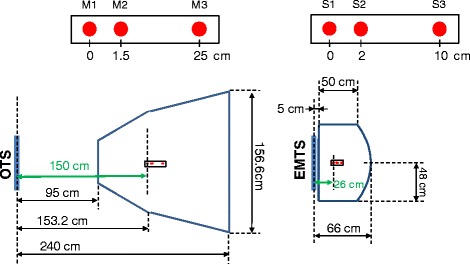
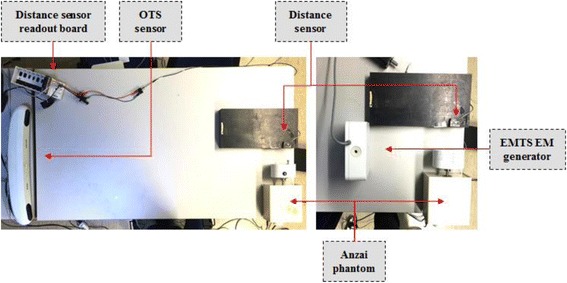
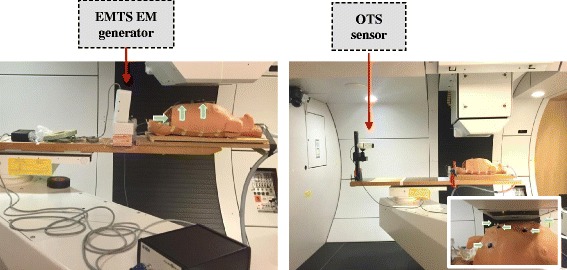
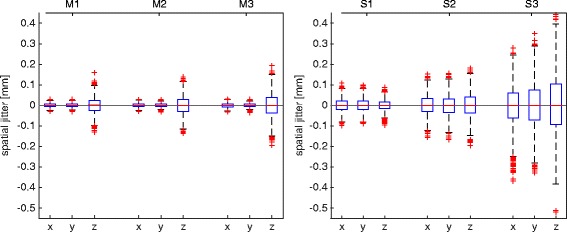
Polaris SPECTRA optical tracking system and the Aurora V3 electromagnetic tracking system from Northern Digital Inc. (NDI, Waterloo, CA) have been compared both technically, by measuring tracking errors and system latencies under laboratory conditions, and clinically, by assessing their practicalities and sensitivities when used with imaging devices and PBS treatment gantries. Additionally, we investigated the impact of using different surrogate signals, from different systems, on the reconstructed 4D CT images.
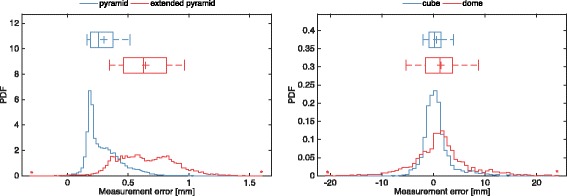
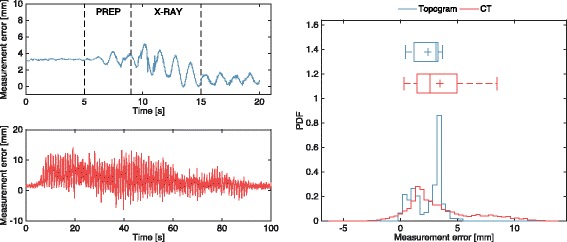
Even though in controlled laboratory conditions both technologies allow for the localization of static fiducials with sub-millimetre jitter and low latency (31.6 ± 1 msec worst case), significant dynamic and environmental distortions limit the potential of the electromagnetic approach in a clinical setting. The measurement error in case of close proximity to a CT scanner is up to 10.5 mm and precludes its use for the monitoring of respiratory motion during 4DCT acquisitions. Similarly, the motion of the treatment gantry distorts up to 22 mm the tracking result.
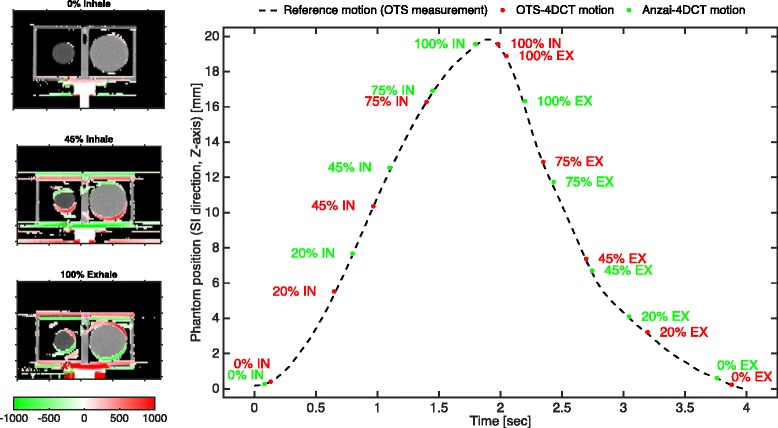
Despite the line of sight requirement, the optical solution offers the best potential, being the most robust against environmental factors and providing the highest spatial accuracy. The significant difference in the temporal location of the reconstructed phase points is used to speculate on the need to apply the same monitoring system for imaging and treatment to ensure the consistency of detected phases.
在用笔形束扫描质子治疗非静态肿瘤时,运动监测至关重要。4D医学成像通常依赖于检测到的体表位移,将其视为患者解剖结构变化的替代指标,大多数运动缓解技术也采用类似概念。在本研究中,我们在图像引导的基于龙门架的质子治疗的特定环境下,研究了光学和电磁跟踪这两种非侵入性表面运动监测关键技术的优缺点。
对来自加拿大滑铁卢的北方数字公司(NDI)的Polaris SPECTRA光学跟踪系统和Aurora V3电磁跟踪系统进行了技术比较,即在实验室条件下测量跟踪误差和系统延迟,并在临床方面评估它们与成像设备和笔形束扫描(PBS)治疗龙门架一起使用时的实用性和灵敏度。此外,我们研究了使用来自不同系统的不同替代信号对重建的4D CT图像的影响。
尽管在受控的实验室条件下,这两种技术都能以亚毫米级抖动和低延迟(最坏情况为31.6±1毫秒)对静态基准进行定位,但显著的动态和环境失真限制了电磁方法在临床环境中的潜力。在靠近CT扫描仪的情况下,测量误差高达10.毫米,这使得它无法用于在4D CT采集期间监测呼吸运动。同样,治疗龙门架的运动会使跟踪结果失真达22毫米。
尽管存在视线要求,但光学解决方案具有最佳潜力,对环境因素最具鲁棒性且提供最高的空间精度。重建相点时间位置的显著差异被用于推测是否需要对成像和治疗应用相同的监测系统,以确保检测相位的一致性。