Zhang Shao-Bo, Zhang Yi-Bao, Wang Sheng-Hong, Zhang Hua, Liu Peng, Zhang Wei, Ma Jing-Lin, Wang Jing
Department of Orthopedics, Key Laboratory of Orthopedics, Second Hospital of Lanzhou University, Lanzhou 730030, China.
Department of Orthopedics, Key Laboratory of Orthopedics, Second Hospital of Lanzhou University, Lanzhou 730030, China.
Chin J Traumatol. 2017 Apr;20(2):94-98. doi: 10.1016/j.cjtee.2016.06.012. Epub 2017 Feb 24.
To compare the clinical efficacy and complications of limited internal fixation combined with external fixation (LIFEF) and open reduction and internal fixation (ORIF) in the treatment of Pilon fracture.
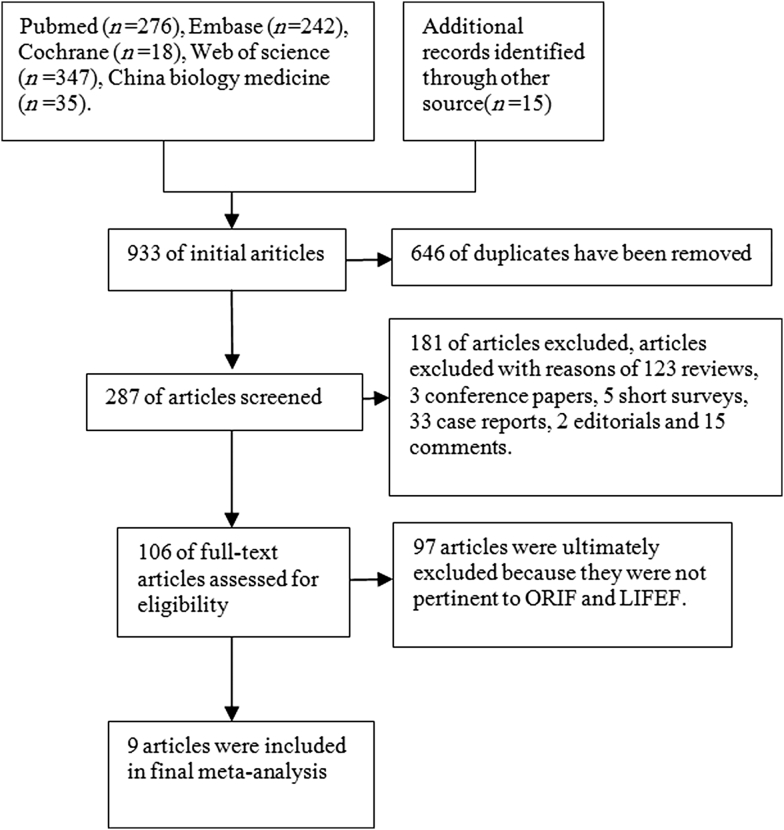
We searched databases including Pubmed, Embase, Web of science, Cochrane Library and China Biology Medicine disc for the studies comparing clinical efficacy and complications of LIFEF and ORIF in the treatment of Pilon fracture. The clinical efficacy was evaluated by the rate of nonunion, malunion/delayed union and the excellent/good rate assessed by Mazur ankle score. The complications including infections and arthritis symptoms after surgery were also investigated.
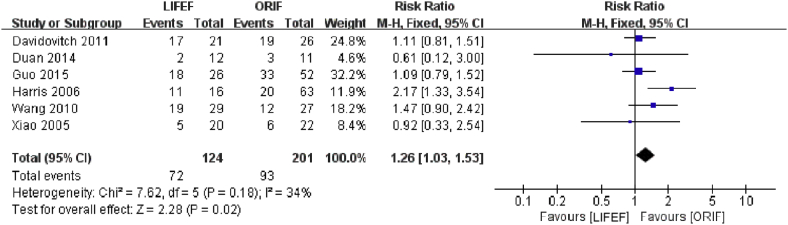
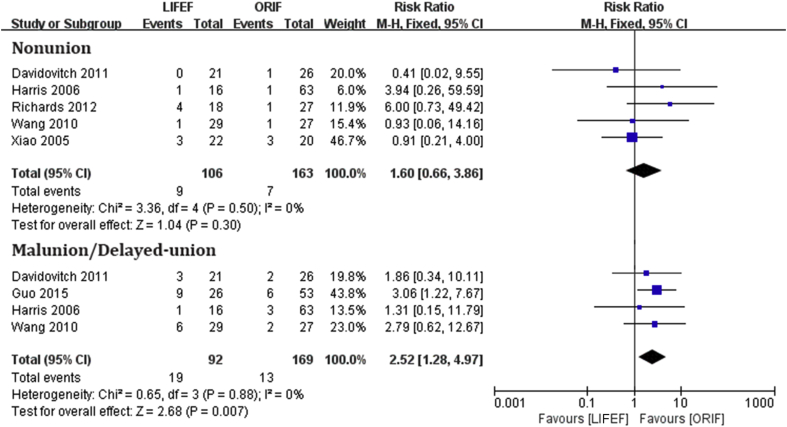
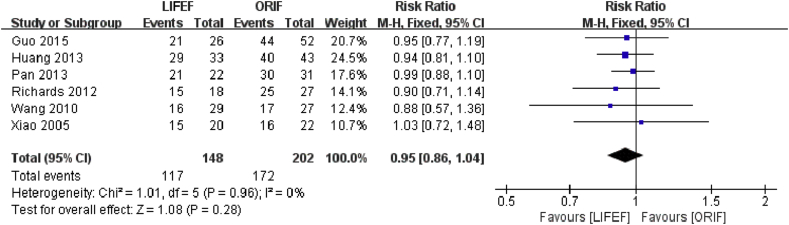
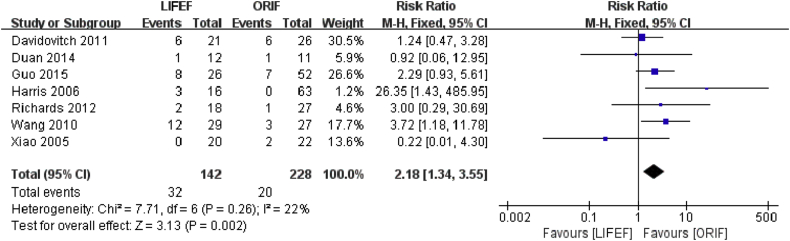
Nine trials including 498 pilon fractures of 494 patients were identified. The meta-analysis found no significant differences in nonunion rate (RR = 1.60, 95% CI: 0.66 to 3.86, p = 0.30), and the excellent/good rate (RR = 0.95, 95% CI: 0.86 to 1.04, p = 0.28) between LIFEF group and ORIF group. For assessment of infections, there were significant differences in the rate of deep infection (RR = 2.18, 95% CI: 1.34 to 3.55, p = 0.002), and the rate of arthritis (RR = 1.26, 95% CI: 1.03 to 1.53, p = 0.02) between LIFEF group and ORIF group.
LIFEF has similar effect as ORIF in the treatment of pilon fractures, however, LIFEF group has significantly higher risk of complications than ORIF group does. So LIFEF is not recommended in the treatment of pilon fracture.
比较有限内固定联合外固定(LIFEF)与切开复位内固定(ORIF)治疗Pilon骨折的临床疗效及并发症。
检索包括Pubmed、Embase、Web of science、Cochrane图书馆和中国生物医学光盘数据库在内的数据库,查找比较LIFEF与ORIF治疗Pilon骨折临床疗效及并发症的研究。临床疗效通过骨不连发生率、畸形愈合/延迟愈合率以及Mazur踝关节评分评估的优良率来评价。同时调查术后包括感染和关节炎症状在内的并发症。
共纳入9项试验,涉及494例患者的498例Pilon骨折。荟萃分析发现,LIFEF组与ORIF组在骨不连发生率(RR = 1.60,95%CI:0.66至3.86,p = 0.30)和优良率(RR = 0.95,95%CI:0.86至1.04,p = 0.28)方面无显著差异。在感染评估方面,LIFEF组与ORIF组在深部感染率(RR = 2.18,95%CI:1.34至3.55,p = 0.002)和关节炎发生率(RR = 1.26,95%CI:1.03至1.53,p = 0.02)方面存在显著差异。
LIFEF在治疗Pilon骨折方面与ORIF效果相似,然而,LIFEF组的并发症风险显著高于ORIF组。因此,不建议采用LIFEF治疗Pilon骨折。