Elrod JoAnn Broeckel, Merchant Raina, Daya Mohamud, Youngquist Scott, Salcido David, Valenzuela Terence, Nichol Graham
Department of Medicine, University of Washington-Harborview Center for Prehospital Emergency Care, University of Washington, Seattle, Washington, USA.
Salt Lake City Fire Department, University of Utah School of Medicine, Salt Lake City, Utah, USA.
BMJ Open. 2017 Mar 29;7(3):e014902. doi: 10.1136/bmjopen-2016-014902.
Lay use of automated external defibrillators (AEDs) before the arrival of emergency medical services (EMS) providers on scene increases survival after out-of-hospital cardiac arrest (OHCA). AEDs have been placed in public locations may be not ready for use when needed. We describe a protocol for AED surveillance that tracks these devices through time and space to improve public health, and survival as well as facilitate research.
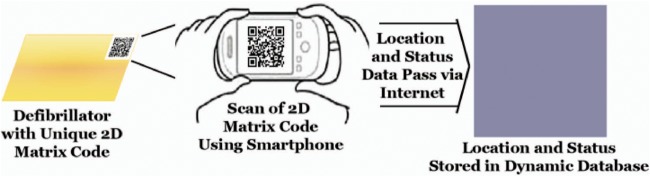
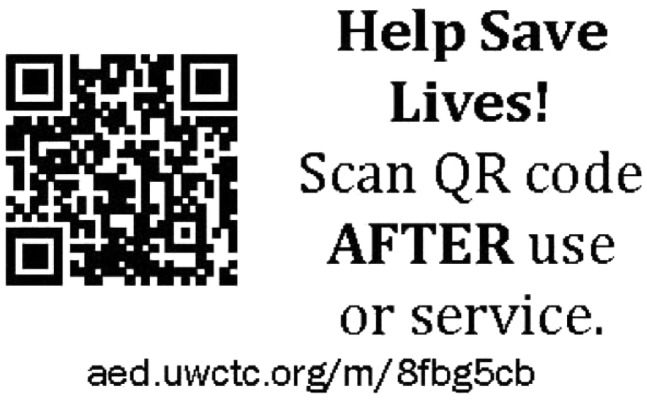
Included AEDs are installed in public locations for use by laypersons to treat patients with OHCA before the arrival of EMS providers on scene. Included cases of OHCA are patients evaluated by organised EMS personnel and treated for OHCA. Enrolment of 10 000 AEDs annually will yield precision of 0.4% in the estimate of readiness for use. Enrolment of 2500 patients annually will yield precision of 1.9% in the estimate of survival to hospital discharge. Recruitment began on 21 Mar 2014 and is ongoing. AEDs are found by using multiple methods. Each AED is then tagged with a label which is a unique two-dimensional (2D) matrix code; the 2D matrix code is recorded and the location and status of the AED tracked using a smartphone; these elements are automatically passed via the internet to a secure and confidential database in real time. Whenever the 2D matrix code is rescanned for any non-clinical or clinical use of an AED, the user is queried to answer a finite set of questions about the device status. The primary outcome of any clinical use of an AED is survival to hospital discharge. Results are summarised descriptively.
These activities are conducted under a grant of authority for public health surveillance from the Food and Drug Administration. Results are provided periodically to participating sites and sponsors to improve public health and quality of care.
在紧急医疗服务(EMS)人员到达现场之前,非专业人员使用自动体外除颤器(AED)可提高院外心脏骤停(OHCA)后的生存率。放置在公共场所的AED在需要时可能无法随时使用。我们描述了一种AED监测方案,该方案可通过时间和空间追踪这些设备,以改善公众健康、提高生存率并促进研究。
纳入的AED安装在公共场所,供非专业人员在EMS人员到达现场之前用于治疗OHCA患者。纳入的OHCA病例是由有组织的EMS人员评估并接受OHCA治疗的患者。每年登记10000台AED将使使用准备情况估计的精确度达到0.4%。每年登记2500名患者将使出院生存率估计的精确度达到1.9%。招募工作于2014年3月21日开始,目前仍在进行。通过多种方法查找AED。然后为每台AED贴上一个标签,该标签是一个独特的二维(2D)矩阵码;记录2D矩阵码,并使用智能手机追踪AED的位置和状态;这些信息通过互联网实时自动传输到一个安全且保密的数据库。每当为AED的任何非临床或临床用途重新扫描2D矩阵码时,会询问用户回答一组关于设备状态的有限问题。AED任何临床使用的主要结果是出院生存率。结果以描述性方式总结。
这些活动是在食品药品监督管理局授予的公共卫生监测授权下进行的。定期向参与站点和赞助商提供结果,以改善公众健康和护理质量。