Langdon-Daly Jasmin, Serpell Lucy
Department of Clinical, Educational, and Health Psychology, University College London, London, UK.
J Eat Disord. 2017 Mar 28;5:12. doi: 10.1186/s40337-017-0141-7. eCollection 2017.
This systematic review aims to identify and evaluate the literature investigating protective factors and eating disorders (EDs), to establish what is known about factors in family systems that could be considered protective against the development of ED/disordered eating.
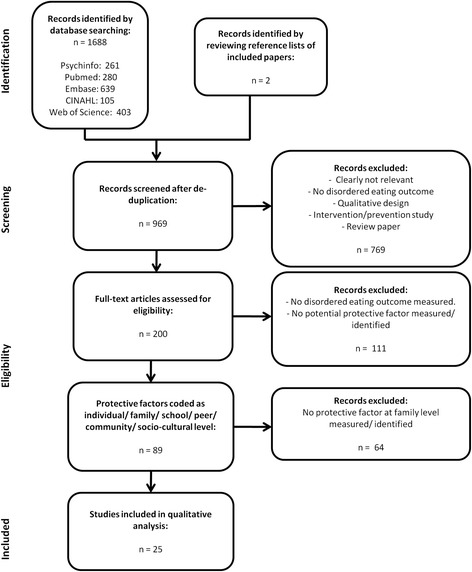
A systematic review of the literature was conducted on five databases, using search terms related to ED/disordered eating and protective factors. Studies were systematically screened and included if they made reference to a protective factor within the family system and explored associations with a quantitative measure of ED/disordered eating behaviours. All included studies were evaluated for study quality.
Twenty-five studies met criteria for inclusion. Ten papers made use of longitudinal or prospective designs appropriate to identify factors potentially protecting against the development of disordered eating difficulties, while a further 15 papers report cross-sectional associations between family factors and disordered eating outcomes. Studies looked at aspects of family relationships and family practices around food or eating. There was a particular research focus on the potential protective role of regular family meals.
Many of the potential protective factors identified, such as family support and connectedness, may be non-specific to eating difficulties, promoting general adaptive development and a range of positive development outcomes. Factors in the family environment around food, eating and weight, such as frequent family meals and avoiding comments about weight, may be more specific to ED and disordered eating. Issues with the methodologies used severely impact on the ability to draw conclusions about whether factors are 'protective'.
本系统评价旨在识别和评估有关保护因素与饮食失调(EDs)的文献,以明确家庭系统中哪些因素可被视为预防饮食失调/紊乱饮食发展的保护因素。
对五个数据库进行文献系统评价,使用与饮食失调/紊乱饮食及保护因素相关的检索词。对研究进行系统筛选,若研究提及家庭系统中的保护因素并探讨其与饮食失调/紊乱饮食行为定量测量之间的关联,则纳入研究。对所有纳入研究的质量进行评估。
25项研究符合纳入标准。10篇论文采用了纵向或前瞻性设计,适合识别可能预防紊乱饮食问题发展的因素,另有15篇论文报告了家庭因素与紊乱饮食结果之间的横断面关联。研究关注了家庭关系以及围绕食物或饮食的家庭习惯等方面。特别关注了规律家庭聚餐的潜在保护作用。
所确定的许多潜在保护因素,如家庭支持和亲密关系,可能并非饮食问题所特有,而是促进一般适应性发展和一系列积极发展结果。家庭环境中围绕食物、饮食和体重的因素,如频繁的家庭聚餐和避免对体重发表评论,可能对饮食失调和紊乱饮食更为特定。所用方法学问题严重影响了就因素是否具有“保护作用”得出结论的能力。