Schwartz Sheree R, Bassett Jean, Holmes Charles B, Yende Nompumelelo, Phofa Rebecca, Sanne Ian, Van Rie Annelies
Department of Epidemiology, Johns Hopkins School of Public Health, Baltimore, MD, USA.
Witkoppen Health and Welfare Centre, Johannesburg, South Africa.
J Int AIDS Soc. 2017 Mar 8;20(Suppl 1):21291. doi: 10.7448/IAS.20.2.21291.
Implementation of safer conception services for HIV-affected couples within primary healthcare clinics in resource-limited settings remains limited. We review service utilization and safer conception strategy uptake during the first three years of , which is a safer conception clinic in South Africa.
is located at Witkoppen Health and Welfare Centre, a high-volume primary healthcare clinic in northern Johannesburg. Men and women desiring to conceive in less than or equal to six months and in relationships in which one or both partners are living with HIV are eligible for safer conception services. Clients receive a baseline health assessment and counselling around periconception HIV risk reduction strategies and choose which strategies they plan to use. Clients are followed-up monthly. We describe client service utilization and uptake and continuation of safer conception methods. Factors associated with male partner attendance are assessed using robust Poisson regression.
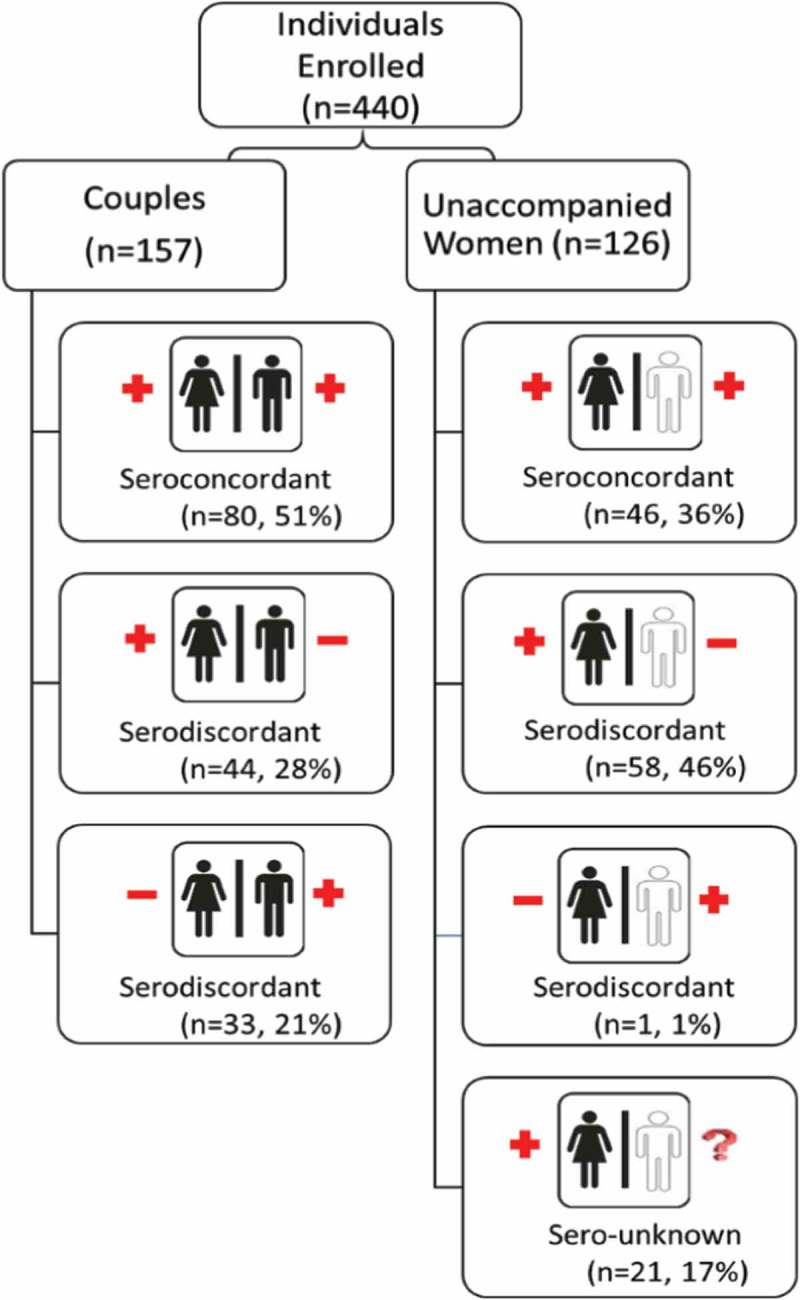
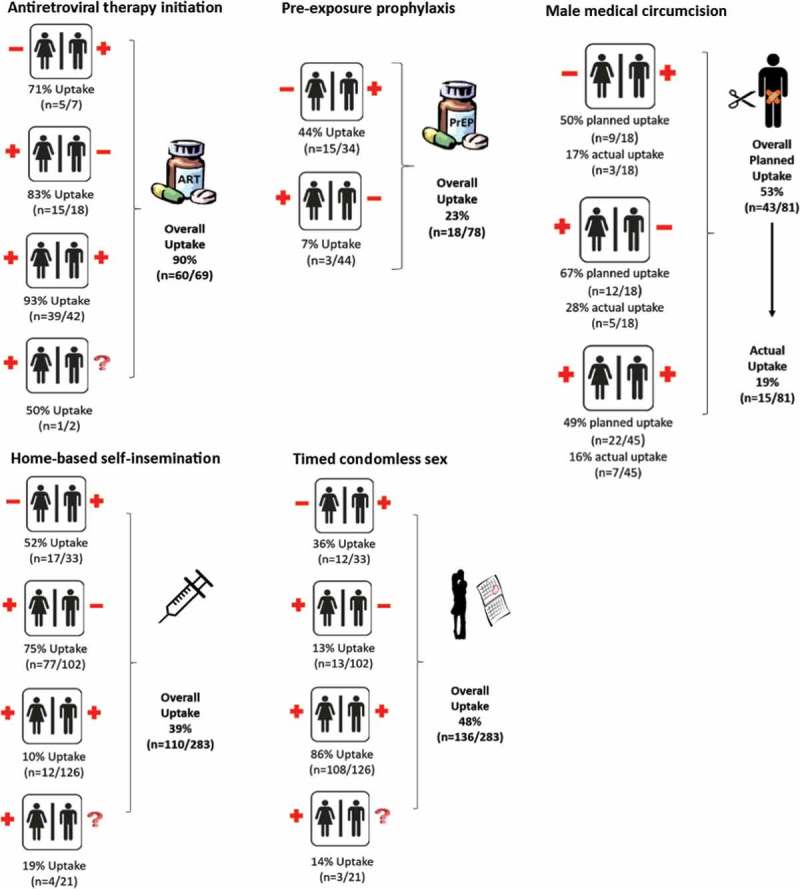
Overall 440 individuals utilized the service including 157 couples in which both partners attended (55%) and 126 unaccompanied female partners. Over half of the couples (55%) represented were in serodiscordant/unknown status relationships. Higher economic status and HIV-negative status of the women increased male partner involvement, while HIV-negative status of the men decreased male involvement. Regarding safer conception strategies, uptake of antiretroviral therapy initiation (90%), vaginal self-insemination among partnerships with HIV-negative men (75%) and timed condomless intercourse strategies (48%) were variable, but generally high. Overall uptake of pre-exposure prophylaxis (PrEP) was 23% and was lower among HIV-negative men than women (7% vs. 44%, < 0.001). Male medical circumcision (MMC) was used by 28% of HIV-negative men. Over 80% of clients took up at least one recommended safer conception strategy. Continuation of selected strategies over attempted conception attempts was >60%.
Safer conception strategies are generally used by clients per recommendations. High uptake of strategies suggests that the proposed combination prevention methods are acceptable to clients and appropriate for scale-up; however, low uptake of PrEP and MMC among HIV-negative men needs improvement. Targeted community-based efforts to reach men unlinked to safer conception services are needed, alongside streamlined approaches for service scale-up within existing HIV and non-HIV service delivery platforms.
在资源有限的环境中,为感染艾滋病毒的夫妇在初级保健诊所实施更安全的受孕服务仍然有限。我们回顾了南非一家更安全受孕诊所头三年的服务利用情况和更安全受孕策略的采用情况。
该诊所位于约翰内斯堡北部一家高流量的初级保健诊所威特科普恩健康与福利中心。希望在不到或等于六个月内受孕且一方或双方伴侣感染艾滋病毒的男女有资格获得更安全的受孕服务。客户接受基线健康评估,并就受孕前后降低艾滋病毒风险的策略接受咨询,然后选择他们计划使用的策略。客户每月接受随访。我们描述了客户服务的利用情况、更安全受孕方法的采用和持续情况。使用稳健的泊松回归评估与男性伴侣就诊相关的因素。
共有440人使用了该服务,其中包括157对双方都就诊的夫妇(55%)和126名单独前来的女性伴侣。超过一半(55%)的夫妇处于血清学不一致/未知状态关系。女性较高的经济地位和艾滋病毒阴性状态增加了男性伴侣的参与度,而男性的艾滋病毒阴性状态则降低了男性的参与度。关于更安全的受孕策略,开始抗逆转录病毒治疗的采用率(90%)、与艾滋病毒阴性男性伴侣进行阴道自我授精的采用率(75%)和定时无保护性交策略的采用率(48%)各不相同,但总体较高。暴露前预防(PrEP)的总体采用率为23%,艾滋病毒阴性男性的采用率低于女性(7%对44%,<0.001)。28%的艾滋病毒阴性男性进行了男性包皮环切术(MMC)。超过80%的客户采用了至少一种推荐的更安全受孕策略。在尝试受孕期间,选定策略的持续采用率>60%。
客户通常按照建议使用更安全的受孕策略。策略的高采用率表明,提议的综合预防方法为客户所接受,适合扩大规模;然而,艾滋病毒阴性男性中PrEP和MMC的低采用率需要改进。需要开展有针对性的社区工作,以接触与更安全受孕服务无关的男性,同时在现有的艾滋病毒和非艾滋病毒服务提供平台内采用简化方法扩大服务规模。