Jazi Atieh Aminian, Ploetz Evelyn, Arizki Muhamad, Dhandayuthapani Balasubramaniam, Waclawska Izabela, Krämer Reinhard, Ziegler Christine, Cordes Thorben
Molecular Microscopy Research Group, Zernike Institute for Advanced Materials, University of Groningen , Nijenborgh 4, 9747 AG Groningen, The Netherlands.
Institute of Biophysics and Biophysical Chemistry, Universität Regensburg , 95053 Regensburg, Germany.
Biochemistry. 2017 Apr 11;56(14):2031-2041. doi: 10.1021/acs.biochem.6b00916. Epub 2017 Mar 31.
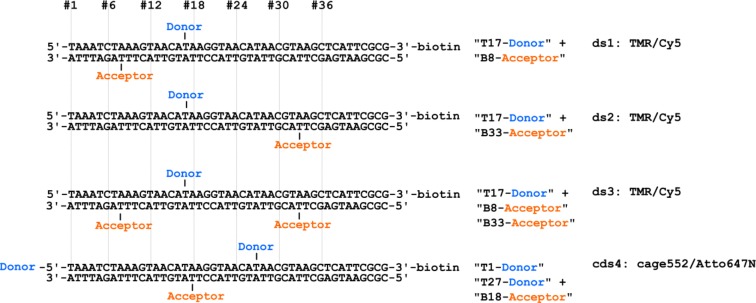
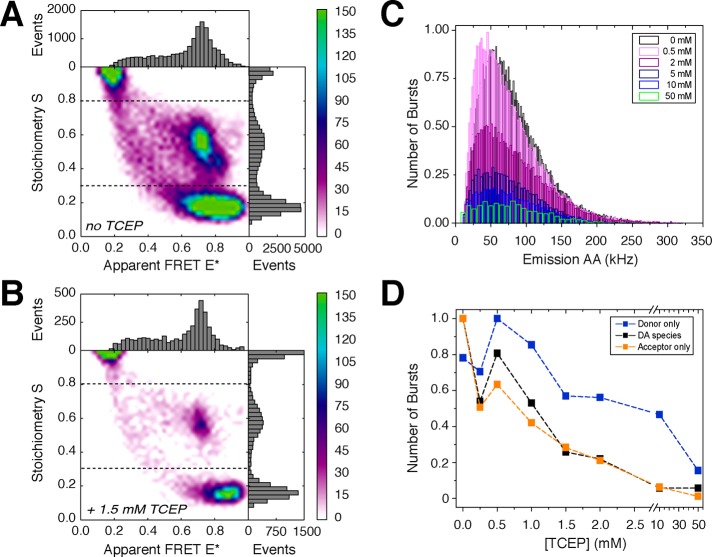
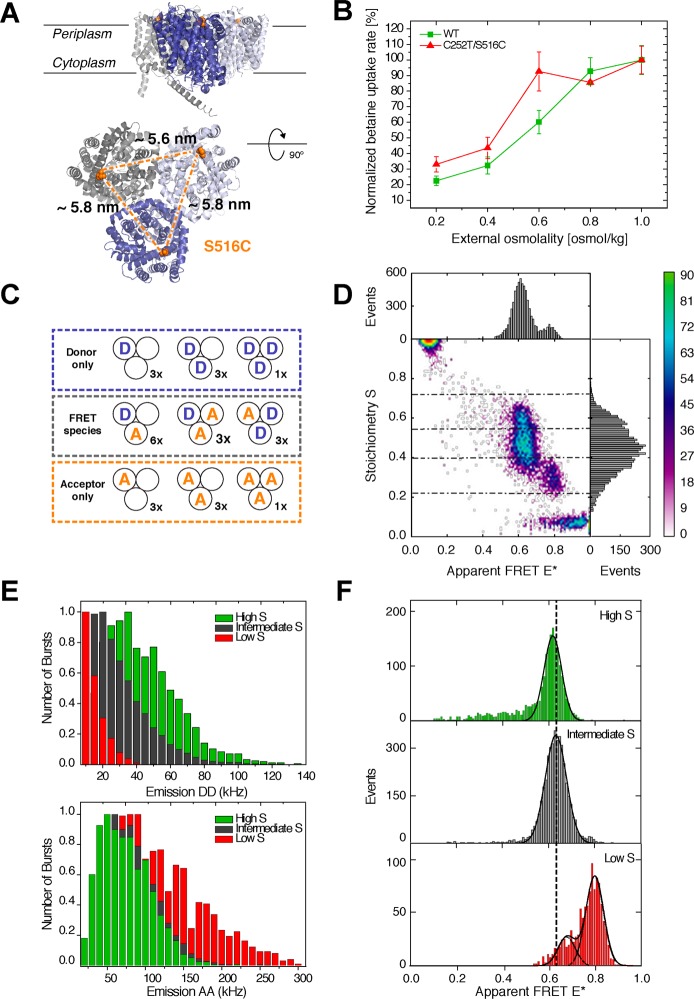
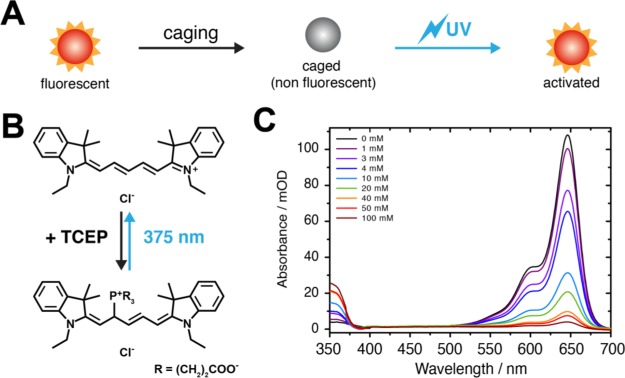
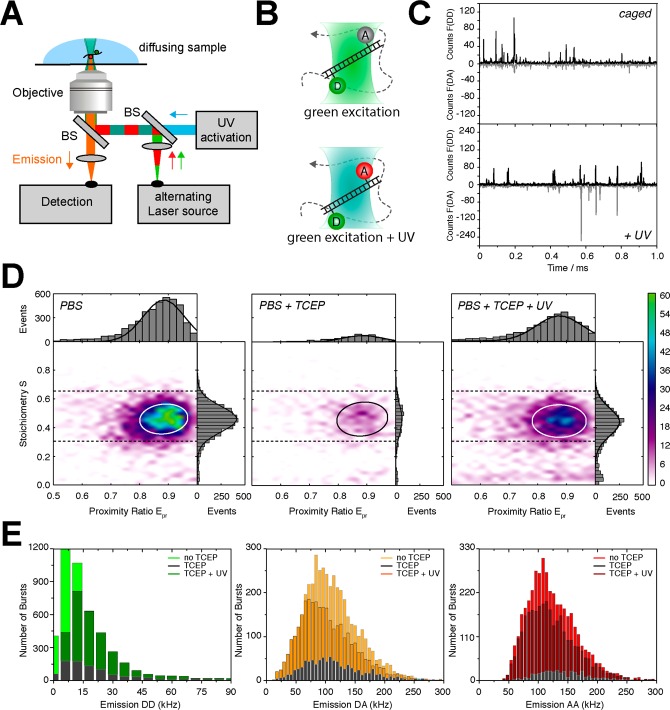
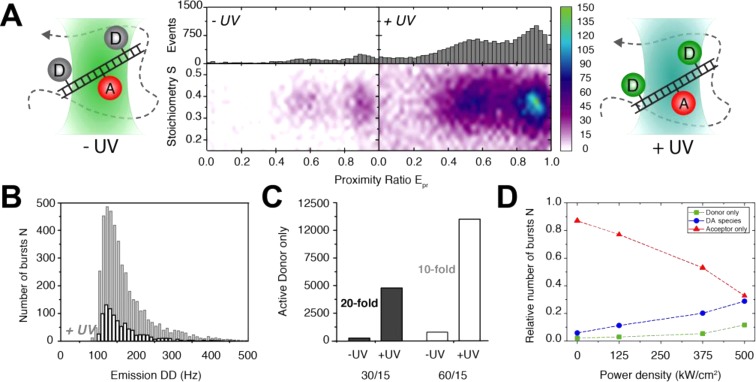
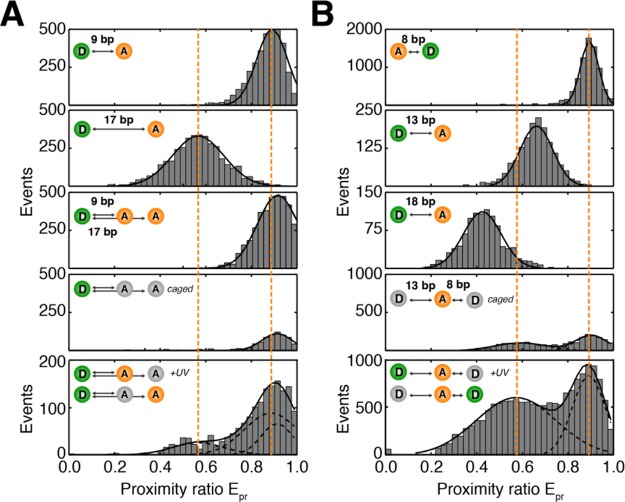
Caged organic fluorophores are established tools for localization-based super-resolution imaging. Their use relies on reversible deactivation of standard organic fluorophores by chemical reduction or commercially available caged dyes with ON switching of the fluorescent signal by ultraviolet (UV) light. Here, we establish caging of cyanine fluorophores and caged rhodamine dyes, i.e., chemical deactivation of fluorescence, for single-molecule Förster resonance energy transfer (smFRET) experiments with freely diffusing molecules. They allow temporal separation and sorting of multiple intramolecular donor-acceptor pairs during solution-based smFRET. We use this "caged FRET" methodology for the study of complex biochemical species such as multisubunit proteins or nucleic acids containing more than two fluorescent labels. Proof-of-principle experiments and a characterization of the uncaging process in the confocal volume are presented. These reveal that chemical caging and UV reactivation allow temporal uncoupling of convoluted fluorescence signals from, e.g., multiple spectrally similar donor or acceptor molecules on nucleic acids. We also use caging without UV reactivation to remove unwanted overlabeled species in experiments with the homotrimeric membrane transporter BetP. We finally outline further possible applications of the caged FRET methodology, such as the study of weak biochemical interactions, which are otherwise impossible with diffusion-based smFRET techniques because of the required low concentrations of fluorescently labeled biomolecules.
笼状有机荧光团是基于定位的超分辨率成像的成熟工具。它们的使用依赖于通过化学还原使标准有机荧光团可逆失活,或使用市售的笼状染料,通过紫外光实现荧光信号的开启。在此,我们建立了用于自由扩散分子的单分子荧光共振能量转移(smFRET)实验的花菁荧光团和笼状罗丹明染料的笼化,即荧光的化学失活。它们允许在基于溶液的smFRET过程中对多个分子内供体 - 受体对进行时间上的分离和分类。我们使用这种“笼化FRET”方法来研究复杂的生物化学物质,如含有多个荧光标记的多亚基蛋白质或核酸。本文展示了原理验证实验以及共聚焦体积内解笼过程的表征。这些结果表明,化学笼化和紫外光再激活能够使来自例如核酸上多个光谱相似的供体或受体分子的复杂荧光信号在时间上解耦。我们还在同源三聚体膜转运蛋白BetP的实验中使用不进行紫外光再激活的笼化来去除不需要的过度标记物种。我们最后概述了笼化FRET方法的进一步可能应用,例如研究弱生物化学相互作用,否则由于基于扩散的smFRET技术需要低浓度的荧光标记生物分子,这些弱相互作用是无法研究的。