Bikker Floris J, End Caroline, Ligtenberg Antoon J M, Blaich Stephanie, Lyer Stefan, Renner Marcus, Wittig Rainer, Nazmi Kamran, van Nieuw Amerongen Arie, Poustka Annemarie, Veerman Enno C I, Mollenhauer Jan
Department of Oral Biochemistry, Academic Centre for Dentistry Amsterdam, University of Amsterdam and VU University Amsterdam, Gustav Mahlerlaan 3004, 1081LA, Amsterdam, Netherlands.
Division of Molecular Genome Analysis, German Cancer Research Center, Heidelberg, Germany.
Immunogenetics. 2017 Jun;69(6):401-407. doi: 10.1007/s00251-017-0982-x. Epub 2017 Mar 31.
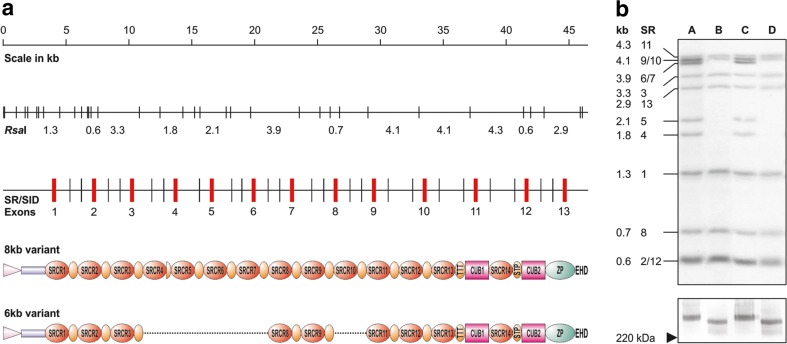
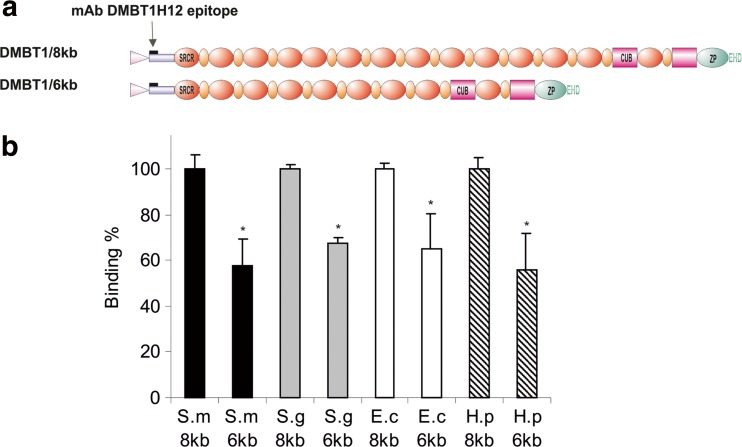
The Scavenger Receptor Cysteine-Rich (SRCR) proteins are an archaic group of proteins characterized by the presence of multiple SRCR domains. They are membrane-bound or secreted proteins, which are generally related to host defense systems in animals. Deleted in Malignant Brain Tumors 1 (DMBT1) is a SRCR protein which is secreted in mucosal fluids and involved in host defense by pathogen binding by its SRCR domains. Genetic polymorphism within DMBT1 leads to DMBT1-alleles giving rise to polypeptides with interindividually different numbers of SRCR domains, ranging from 8 SRCR domains (encoded by 6 kb DMBT1 variant) to 13 SRCR domains (encoded by the 8 kb DMBT1 variant). In the present study, we have investigated whether reduction from 13 to 8 amino-terminal SRCR domains leads to reduction of bacterial binding. The 6 kb variant bound ~20-45% less bacteria compared to the 8 kb variant. These results support the hypothesis that genetic variation in DMBT1 may influence microbial defense.
富含半胱氨酸的清道夫受体(SRCR)蛋白是一类古老的蛋白质,其特征是存在多个SRCR结构域。它们是膜结合蛋白或分泌蛋白,通常与动物的宿主防御系统有关。恶性脑肿瘤缺失基因1(DMBT1)是一种SRCR蛋白,它分泌于黏液中,通过其SRCR结构域与病原体结合参与宿主防御。DMBT1内的基因多态性导致DMBT1等位基因产生个体间SRCR结构域数量不同的多肽,范围从8个SRCR结构域(由6 kb DMBT1变体编码)到13个SRCR结构域(由8 kb DMBT1变体编码)。在本研究中,我们调查了从13个氨基末端SRCR结构域减少到8个是否会导致细菌结合减少。与8 kb变体相比,6 kb变体结合的细菌减少了约20 - 45%。这些结果支持了DMBT1基因变异可能影响微生物防御的假说。