Subhra Das Sankha, James Mithun, Paul Sandip, Chakravorty Nishant
School of Medical Science and Technology, Indian Institute of Technology, Kharagpur, West Bengal 721302, India.
National Brain Research Centre, Manesar, Haryana 122051, India.
Database (Oxford). 2017 Jan 1;2017(1). doi: 10.1093/database/bax015.
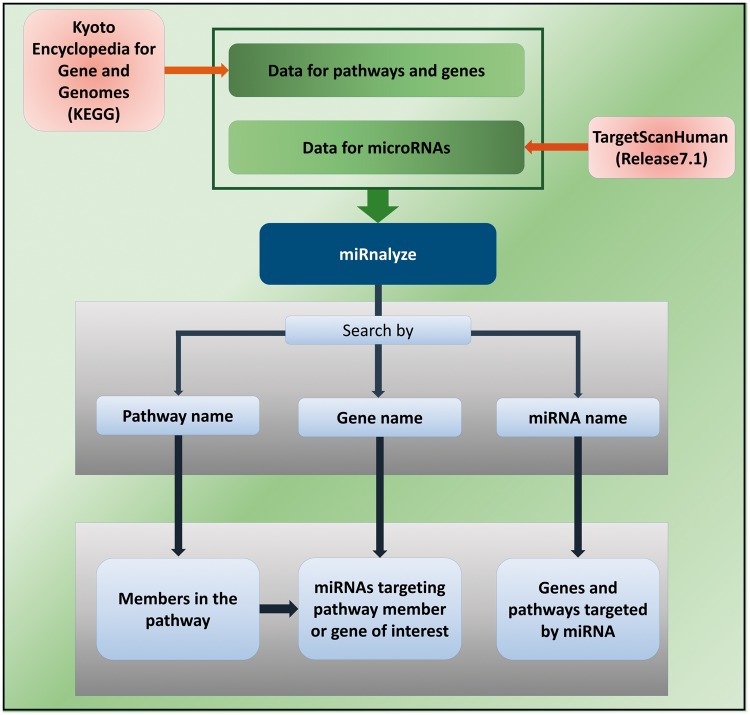
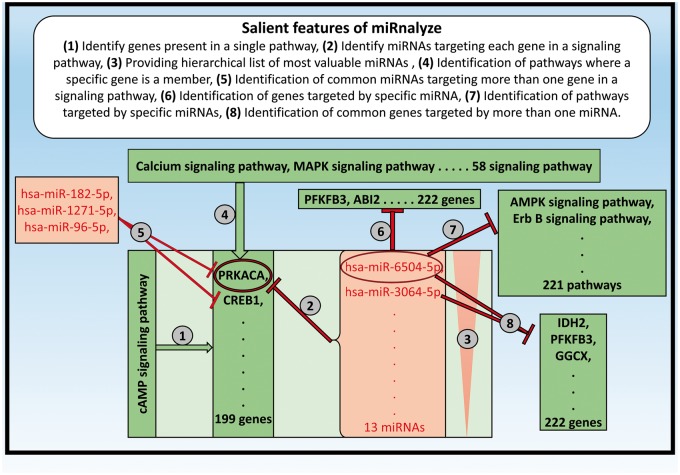
The various pathophysiological processes occurring in living systems are known to be orchestrated by delicate interplays and cross-talks between different genes and their regulators. Among the various regulators of genes, there is a class of small non-coding RNA molecules known as microRNAs. Although, the relative simplicity of miRNAs and their ability to modulate cellular processes make them attractive therapeutic candidates, their presence in large numbers make it challenging for experimental researchers to interpret the intricacies of the molecular processes they regulate. Most of the existing bioinformatic tools fail to address these challenges. Here, we present a new web resource 'miRnalyze' that has been specifically designed to directly identify the putative regulation of cell signaling pathways by miRNAs. The tool integrates miRNA-target predictions with signaling cascade members by utilizing TargetScanHuman 7.1 miRNA-target prediction tool and the KEGG pathway database, and thus provides researchers with in-depth insights into modulation of signal transduction pathways by miRNAs. miRnalyze is capable of identifying common miRNAs targeting more than one gene in the same signaling pathway-a feature that further increases the probability of modulating the pathway and downstream reactions when using miRNA modulators. Additionally, miRnalyze can sort miRNAs according to the seed-match types and TargetScan Context ++ score, thus providing a hierarchical list of most valuable miRNAs. Furthermore, in order to provide users with comprehensive information regarding miRNAs, genes and pathways, miRnalyze also links to expression data of miRNAs (miRmine) and genes (TiGER) and proteome abundance (PaxDb) data. To validate the capability of the tool, we have documented the correlation of miRnalyze's prediction with experimental confirmation studies.
已知生物系统中发生的各种病理生理过程是由不同基因及其调节因子之间微妙的相互作用和相互交流所协调的。在基因的各种调节因子中,有一类小的非编码RNA分子,称为微小RNA(miRNA)。尽管miRNA相对简单,且具有调节细胞过程的能力,使其成为有吸引力的治疗候选物,但它们数量众多,这使得实验研究人员难以解释它们所调节的分子过程的复杂性。现有的大多数生物信息学工具都无法应对这些挑战。在这里,我们展示了一个新的网络资源“miRnalyze”,它经过专门设计,可直接识别miRNA对细胞信号通路的假定调节作用。该工具通过利用TargetScanHuman 7.1 miRNA靶点预测工具和KEGG通路数据库,将miRNA靶点预测与信号级联成员整合在一起,从而为研究人员提供了关于miRNA对信号转导通路调节的深入见解。miRnalyze能够识别靶向同一信号通路中多个基因的常见miRNA——这一特性进一步增加了使用miRNA调节剂调节该通路及下游反应的可能性。此外,miRnalyze可以根据种子匹配类型和TargetScan Context ++ 评分对miRNA进行排序,从而提供最有价值miRNA的分层列表。此外,为了向用户提供有关miRNA、基因和通路的全面信息,miRnalyze还链接到miRNA(miRmine)和基因(TiGER)的表达数据以及蛋白质组丰度(PaxDb)数据。为了验证该工具的能力,我们记录了miRnalyze的预测与实验验证研究之间的相关性。