Truin Wilfred, Roumen Rudi M H, Siesling Sabine, van de Vijver Koen K, Tjan-Heijnen Vivianne C G, Voogd Adri C
Department of Surgery, Máxima Medical Center, Veldhoven, The Netherlands.
Department of Medical Oncology, GROW - School for Oncology and Developmental Biology, Maastricht University Medical Center, Maastricht, The Netherlands.
Breast Cancer Res Treat. 2017 Jul;164(1):133-138. doi: 10.1007/s10549-017-4220-x. Epub 2017 Apr 1.
Differences in estrogen (ER) and progesterone (PR) expression between invasive lobular carcinoma (ILC) and invasive ductal carcinoma (IDC) could be an underlying reason for the difference in chemo-sensitivity and response to hormonal therapy between ILC and IDC. The aim of this study was to investigate the differences in ER and PR expression levels between postmenopausal patients with hormonal receptor-positive ILC and IDC.
We included all ER and/or PR receptor-positive ILC and IDC, diagnosed between January 2011 and December 2013 from the population-based Netherlands Cancer Registry. A semi-quantitative classification was used to analyze differences in ER/PR expression, which consisted of three ER expression classes: 10-69, 70-89, and ≥90%. Differences in ER and PR expression levels between IDC and ILC were analyzed according to age group, tumor size, axillary nodal status, grade, and HER2 status.
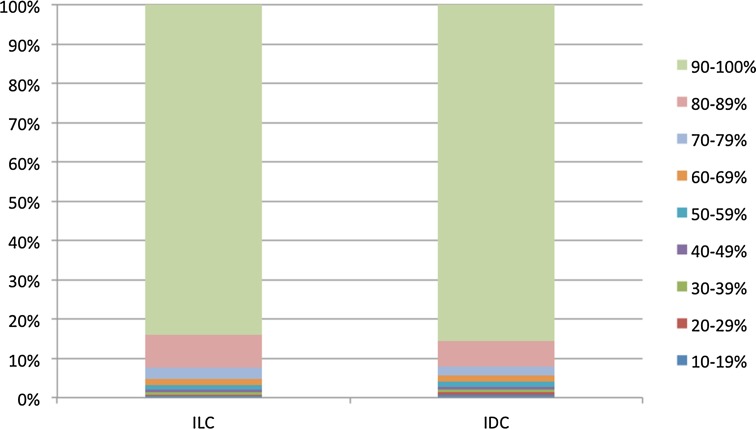
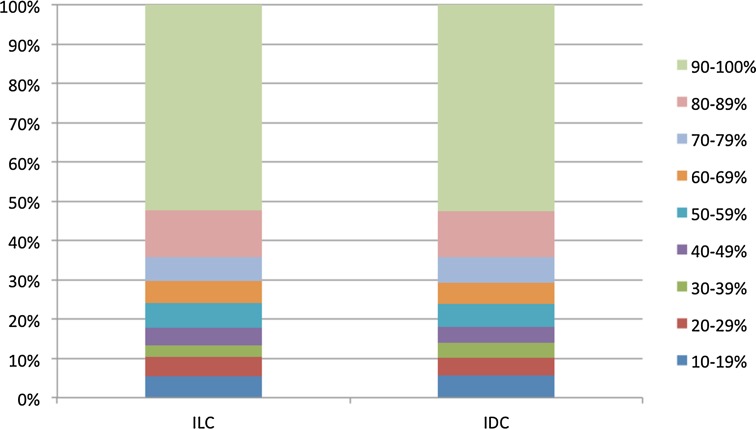
In total, 26,339 ER and/or PR-positive breast cancers were included in the study, of which 17% were ILC and 83% IDC. In patients with IDC, 86% of the tumors showed an ER expression level of 90% or more, compared to 84% in those with ILC. In both IDC and ILC a PR expression level of 90% or more was observed in 54% of the tumors. In postmenopausal patients aged 50-69 years no significant differences could be observed in ER and PR expression levels between ILC and IDC.
Patients with ER and PR-positive ILC and IDC have similar quantitative ER and PR expression profiles, implicating that ER/PR expression is unlikely to be a confounding factor in studies concerning chemo-sensitivity of ILC and IDC.
浸润性小叶癌(ILC)和浸润性导管癌(IDC)之间雌激素(ER)和孕激素(PR)表达的差异可能是ILC和IDC化疗敏感性及激素治疗反应存在差异的潜在原因。本研究的目的是调查绝经后激素受体阳性的ILC和IDC患者之间ER和PR表达水平的差异。
我们纳入了2011年1月至2013年12月期间基于人群的荷兰癌症登记处诊断的所有ER和/或PR受体阳性的ILC和IDC。采用半定量分类法分析ER/PR表达的差异,该分类法包括三个ER表达类别:10 - 69%、70 - 89%和≥90%。根据年龄组、肿瘤大小、腋窝淋巴结状态、分级和HER2状态分析IDC和ILC之间ER和PR表达水平的差异。
本研究共纳入26339例ER和/或PR阳性乳腺癌患者,其中17%为ILC,83%为IDC。在IDC患者中,86%的肿瘤ER表达水平为90%或更高,而ILC患者中这一比例为84%。在IDC和ILC中,均有54%的肿瘤PR表达水平为90%或更高。在50 - 69岁的绝经后患者中,未观察到ILC和IDC之间ER和PR表达水平的显著差异。
ER和PR阳性的ILC和IDC患者具有相似的ER和PR定量表达谱,这意味着在关于ILC和IDC化疗敏感性的研究中,ER/PR表达不太可能是一个混杂因素。