Alamian Golnoush, Hincapié Ana-Sofía, Combrisson Etienne, Thiery Thomas, Martel Véronique, Althukov Dmitrii, Jerbi Karim
Department of Psychology, University of Montreal , Montreal, QC , Canada.
Department of Psychology, University of Montreal, Montreal, QC, Canada; Department of Computer Science, Pontificia Universidad Católica de Chile, Santiago de Chile, Chile; Interdisciplinary Center for Neurosciences, School of Psychology, Pontificia Universidad Católica de Chile, Santiago de Chile, Chile.
Front Psychiatry. 2017 Mar 17;8:41. doi: 10.3389/fpsyt.2017.00041. eCollection 2017.
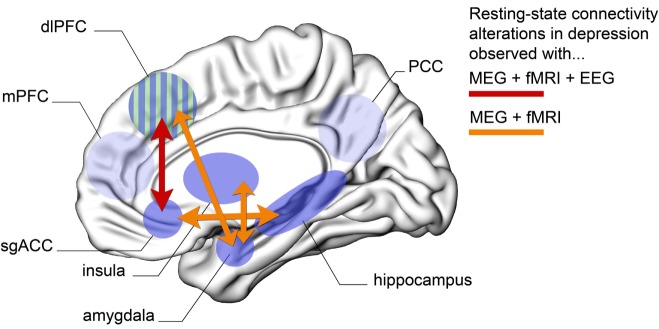
Despite being the object of a thriving field of clinical research, the investigation of intrinsic brain network alterations in psychiatric illnesses is still in its early days. Because the pathological alterations are predominantly probed using functional magnetic resonance imaging (fMRI), many questions about the electrophysiological bases of resting-state alterations in psychiatric disorders, particularly among mood disorder patients, remain unanswered. Alongside important research using electroencephalography (EEG), the specific recent contributions and future promise of magnetoencephalography (MEG) in this field are not fully recognized and valued. Here, we provide a critical review of recent findings from MEG resting-state connectivity within major depressive disorder (MDD) and bipolar disorder (BD). The clinical MEG resting-state results are compared with those previously reported with fMRI and EEG. Taken together, MEG appears to be a promising but still critically underexploited technique to unravel the neurophysiological mechanisms that mediate abnormal (both hyper- and hypo-) connectivity patterns involved in MDD and BD. In particular, a major strength of MEG is its ability to provide source-space estimations of neuromagnetic long-range rhythmic synchronization at various frequencies (i.e., oscillatory coupling). The reviewed literature highlights the relevance of probing local and interregional rhythmic synchronization to explore the pathophysiological underpinnings of each disorder. However, before we can fully take advantage of MEG connectivity analyses in psychiatry, several limitations inherent to MEG connectivity analyses need to be understood and taken into account. Thus, we also discuss current methodological challenges and outline paths for future research. MEG resting-state studies provide an important window onto perturbed spontaneous oscillatory brain networks and hence supply an important complement to fMRI-based resting-state measurements in psychiatric populations.
尽管精神疾病中大脑内在网络改变的研究是一个蓬勃发展的临床研究领域,但目前仍处于早期阶段。由于病理改变主要通过功能磁共振成像(fMRI)进行探究,许多关于精神疾病静息状态改变的电生理基础的问题,尤其是在情绪障碍患者中,仍未得到解答。除了使用脑电图(EEG)的重要研究外,脑磁图(MEG)在该领域的近期具体贡献和未来前景尚未得到充分认识和重视。在此,我们对重度抑郁症(MDD)和双相情感障碍(BD)中MEG静息态连接性的近期研究结果进行了批判性综述。将临床MEG静息态结果与先前fMRI和EEG报告的结果进行了比较。总体而言,MEG似乎是一种有前景但仍未得到充分利用的技术,可用于揭示介导MDD和BD中异常(包括高连接和低连接)连接模式的神经生理机制。特别是,MEG的一个主要优势在于其能够在各种频率下提供神经磁长程节律同步的源空间估计(即振荡耦合)。综述文献强调了探究局部和区域间节律同步对于探索每种疾病病理生理基础的相关性。然而,在我们能够充分利用MEG连接性分析用于精神病学研究之前,需要理解并考虑MEG连接性分析固有的几个局限性。因此,我们还讨论了当前的方法学挑战并概述了未来研究的路径。MEG静息态研究为扰动的自发振荡脑网络提供了一个重要窗口,因此为精神病患者基于fMRI的静息态测量提供了重要补充。