Kozlowska Anna Karolina, Topchyan Paytsar, Kaur Kawaljit, Tseng Han-Ching, Teruel Antonia, Hiraga Toru, Jewett Anahid
The Jane and Jerry Weintraub Center for Reconstructive Biotechnology, The Jonsson Comprehensive Cancer Center, Dental Research Institute, Division of Oral Biology and Oral Medicine. UCLA School of Dentistry, Los Angeles, CA 90095, USA.; Department of Tumor Immunology, Chair of Medical Biotechnology, Poznan University of Medical Sciences, Poznan, Poland.
The Jane and Jerry Weintraub Center for Reconstructive Biotechnology, The Jonsson Comprehensive Cancer Center, Dental Research Institute, Division of Oral Biology and Oral Medicine. UCLA School of Dentistry, Los Angeles, CA 90095, USA.
J Cancer. 2017 Feb 11;8(4):537-554. doi: 10.7150/jca.15989. eCollection 2017.
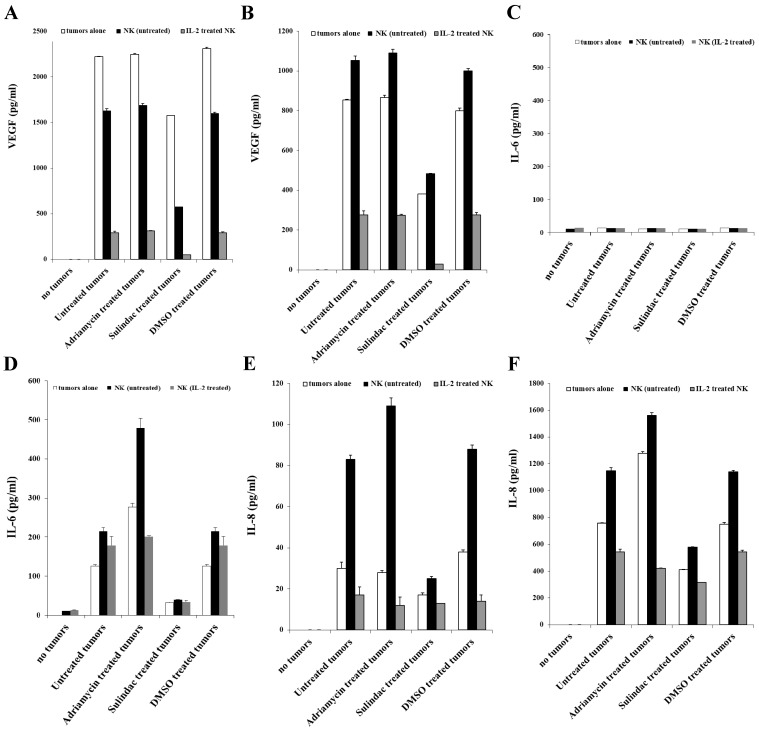
Natural Killer (NK) cells target oral, pancreatic, lung, breast, glioblastoma and melanoma stem-like/poorly differentiated tumors. Differentiation of the abovementioned tumors with supernatants from split-anergized NK cells decreases their susceptibility to NK cells, but increases their sensitivity to cisplatin (CDDP)-mediated cell death. Breast and melanoma tumor cells with CD44 knockdown display enhanced susceptibility to NK cell-mediated lysis, potentially due to decreased differentiation. We also demonstrate that sulindac, a non-steroidal anti-inflammatory drug and a chemopreventive agent, not only limits the growth of oral tumor cells, but also aids in cancer cell elimination by NK cells. Treatment of oral tumors with sulindac, but not adriamycin inversely modulates the expression and function of NFκB and JNK, resulting in a significant down-regulation of IL-6, and VEGF secretion by oral tumor cells. In addition, increased secretion of IL-6 and VEGF is blocked by sulindac during interaction of oral tumors with NK cells. Sulindac treatment prevents synergistic induction of VEGF secretion by the tumor cells after their co-culture with untreated NK cells since non-activated NK cells lack the ability to efficiently kill tumor cells. Moreover, sulindac is able to profoundly reduce VEGF secretion by tumor cells cultured with IL-2 activated NK cells, which are able to significantly lyse the tumor cells. Based on the data presented in this study, we propose the following combinatorial approach for the treatment of stem-like/ poorly differentiated tumors in cancer patients with metastatic disease. Stem-like/ poorly differentiated tumor cells may in part undergo lysis or differentiation after NK cell immunotherapy, followed by treatment of differentiated tumors with chemotherapy and chemopreventive agents to eliminate the bulk of the tumor. This dual approach should limit tumor growth and prevent metastasis.
自然杀伤(NK)细胞可靶向口腔、胰腺、肺、乳腺、胶质母细胞瘤和黑色素瘤等具有干细胞样特征/低分化的肿瘤。用分裂失能的NK细胞培养上清处理上述肿瘤细胞,可降低其对NK细胞的敏感性,但会增加它们对顺铂(CDDP)介导的细胞死亡的敏感性。敲低CD44的乳腺和黑色素瘤肿瘤细胞对NK细胞介导的裂解表现出更高的敏感性,这可能是由于分化程度降低所致。我们还证明,舒林酸作为一种非甾体抗炎药和化学预防剂,不仅能抑制口腔肿瘤细胞的生长,还能协助NK细胞清除癌细胞。用舒林酸而非阿霉素处理口腔肿瘤,可反向调节NFκB和JNK的表达及功能,导致口腔肿瘤细胞分泌的IL-6和VEGF显著下调。此外,在口腔肿瘤与NK细胞相互作用过程中,舒林酸可阻断IL-6和VEGF分泌的增加。由于未激活的NK细胞缺乏有效杀伤肿瘤细胞的能力,舒林酸处理可防止肿瘤细胞与未处理的NK细胞共培养后协同诱导VEGF分泌。此外,舒林酸能够显著降低与IL-2激活的NK细胞共培养的肿瘤细胞分泌的VEGF,而IL-2激活的NK细胞能够显著裂解肿瘤细胞。基于本研究提供的数据,我们提出以下联合治疗方法,用于治疗转移性疾病癌症患者的干细胞样/低分化肿瘤。干细胞样/低分化肿瘤细胞在NK细胞免疫治疗后可能部分发生裂解或分化,随后用化疗药物和化学预防剂治疗分化后的肿瘤,以消除大部分肿瘤。这种双重方法应能限制肿瘤生长并预防转移。