Departamento de Geodinámica, Facultad de Ciencias Geológicas, Universidad Complutense de Madrid, 28040 Madrid, Spain.
Sci Rep. 2017 Apr 3;7:45629. doi: 10.1038/srep45629.
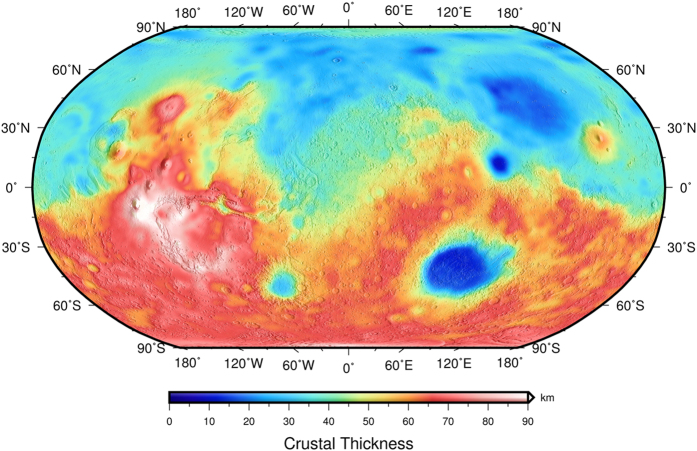
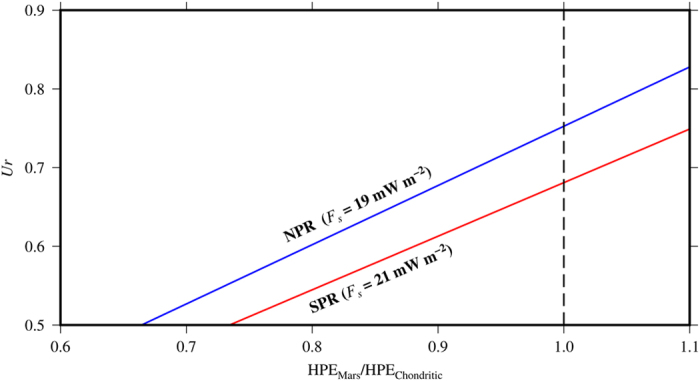
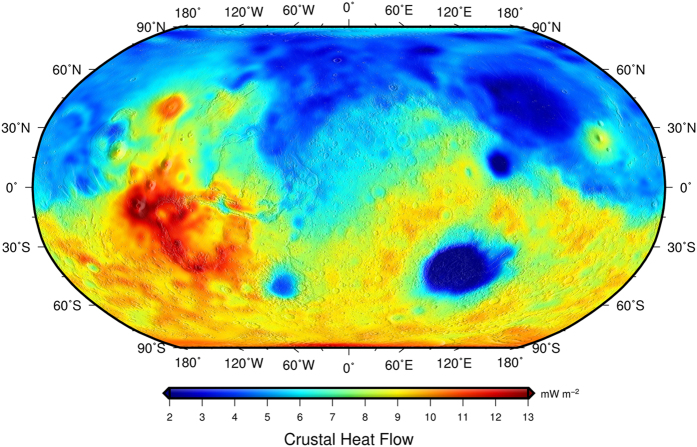
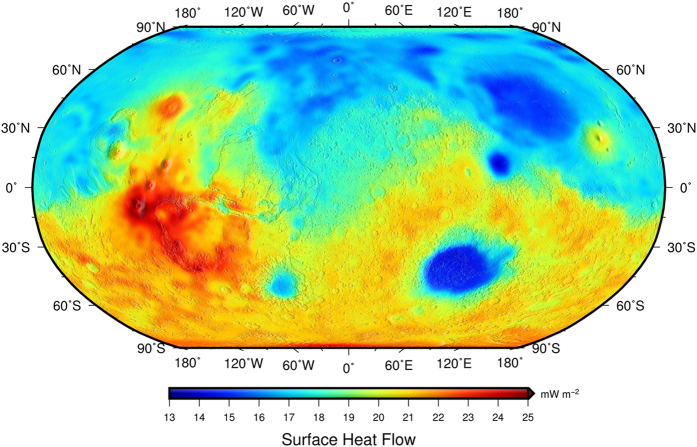
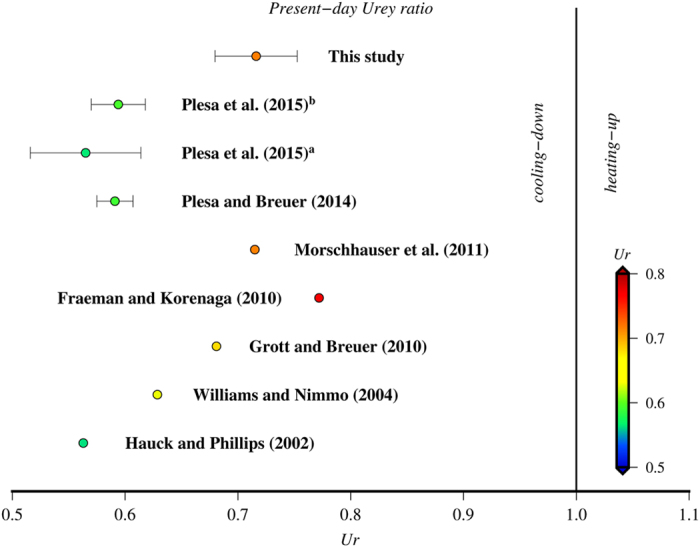
Until the acquisition of in-situ measurements, the study of the present-day heat flow of Mars must rely on indirect methods, mainly based on the relation between the thermal state of the lithosphere and its mechanical strength, or on theoretical models of internal evolution. Here, we present a first-order global model for the present-day surface heat flow for Mars, based on the radiogenic heat production of the crust and mantle, on scaling of heat flow variations arising from crustal thickness and topography variations, and on the heat flow derived from the effective elastic thickness of the lithosphere beneath the North Polar Region. Our preferred model finds heat flows varying between 14 and 25 mW m, with an average value of 19 mW m. Similar results (although about ten percent higher) are obtained if we use heat flow based on the lithospheric strength of the South Polar Region. Moreover, expressing our results in terms of the Urey ratio (the ratio between total internal heat production and total heat loss through the surface), we estimate values close to 0.7-0.75, which indicates a moderate contribution of secular cooling to the heat flow of Mars (consistent with the low heat flow values deduced from lithosphere strength), unless heat-producing elements abundances for Mars are subchondritic.
在获得原位测量结果之前,对火星现今热流的研究必须依赖间接方法,这些方法主要基于岩石圈的热状态与其机械强度之间的关系,或者基于内部演化的理论模型。在这里,我们提出了一种基于地壳和地幔放射性生热、地壳厚度和地形变化引起的热流变化的标度以及从北极地区岩石圈有效弹性厚度得出的热流的火星现今表面热流的一阶全球模型。我们的首选模型发现热流在 14 到 25 mW/m 之间变化,平均值为 19 mW/m。如果我们使用基于南极地区岩石圈强度的热流,我们会得到相似的结果(尽管略高 10%)。此外,我们用 Urey 比(内部总热产生与通过表面的总热损失之比)表示我们的结果,估计值接近 0.7-0.75,这表明火星的 secular cooling 对其热流有适度的贡献(与从岩石圈强度推断出的低热流值一致),除非火星的产热元素丰度低于chondritic。