Ojha Lujendra, Buffo Jacob, Karunatillake Suniti, Siegler Matthew
Department of Earth and Planetary Sciences, Rutgers, The State University of New Jersey, Piscataway, NJ 08854, USA.
Thayer School of Engineering, Dartmouth College, Hanover, NH 03755, USA.
Sci Adv. 2020 Dec 2;6(49). doi: 10.1126/sciadv.abb1669. Print 2020 Dec.
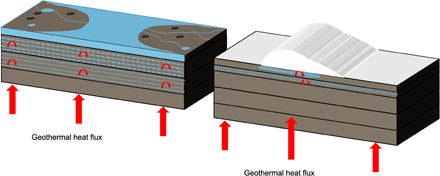
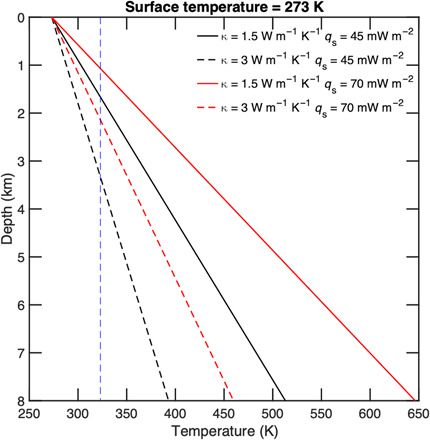
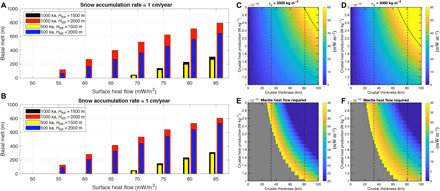
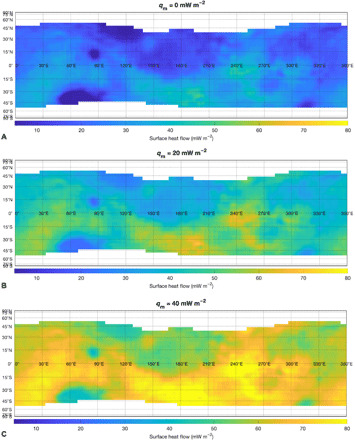
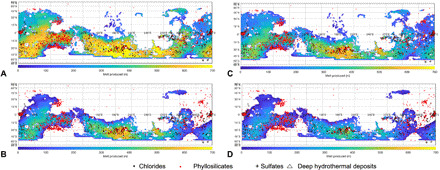
In explaining extensive evidence for past liquid water, the debate on whether Mars was primarily warm and wet or cold and arid 4 billion years (Ga) ago has continued for decades. The Sun's luminosity was ~30% lower 4 Ga ago; thus, most martian climate models struggle to elevate the mean surface temperature past the melting point of water. Basal melting of ice sheets may help resolve that paradox. We modeled the thermophysical evolution of ice and estimate the geothermal heat flux required to produce meltwater on a cold, arid Mars. We then analyzed geophysical and geochemical data, showing that basal melting would have been feasible on Mars 4 Ga ago. If Mars were warm and wet 4 Ga ago, then the geothermal flux would have even sustained hydrothermal activity. Regardless of the actual nature of the ancient martian climate, the subsurface would have been the most habitable region on Mars.
在解释过去存在液态水的大量证据时,关于40亿年前火星主要是温暖潮湿还是寒冷干旱的争论已经持续了数十年。40亿年前太阳的光度比现在低约30%;因此,大多数火星气候模型都难以将平均地表温度提升至水的熔点以上。冰盖的底部融化可能有助于解决这一矛盾。我们对冰的热物理演化进行了建模,并估算了在寒冷干旱的火星上产生融水所需的地热通量。然后我们分析了地球物理和地球化学数据,结果表明40亿年前在火星上进行底部融化是可行的。如果40亿年前火星是温暖潮湿的,那么地热通量甚至会维持热液活动。无论古代火星气候的实际情况如何,地下都曾是火星上最适宜居住的区域。