Grasselli J, Elez E, Caratù G, Matito J, Santos C, Macarulla T, Vidal J, Garcia M, Viéitez J M, Paéz D, Falcó E, Lopez Lopez C, Aranda E, Jones F, Sikri V, Nuciforo P, Fasani R, Tabernero J, Montagut C, Azuara D, Dienstmann R, Salazar R, Vivancos A
Department of Medical Oncology, Vall d'Hebron Institute of Oncology, Barcelona.
Department of Medical Oncology, Catalan Institute of Oncology, Universitat de Barcelona, L'Hospitalet, Barcelona.
Ann Oncol. 2017 Jun 1;28(6):1294-1301. doi: 10.1093/annonc/mdx112.
Circulating tumor DNA (ctDNA) is a potential source for tumor genome analysis. We explored the concordance between the mutational status of RAS in tumor tissue and ctDNA in metastatic colorectal cancer (mCRC) patients to establish eligibility for anti-epidermal growth factor receptor (EGFR) therapy.
A prospective-retrospective cohort study was carried out. Tumor tissue from 146 mCRC patients was tested for RAS status with standard of care (SoC) PCR techniques, and Digital PCR (BEAMing) was used both in plasma and tumor tissue.
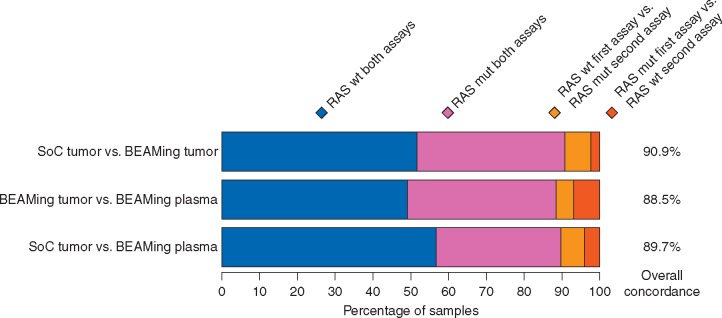
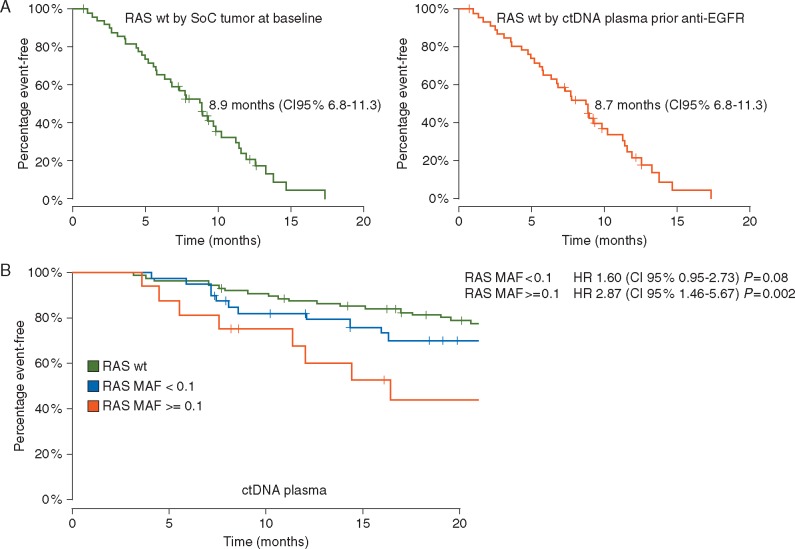
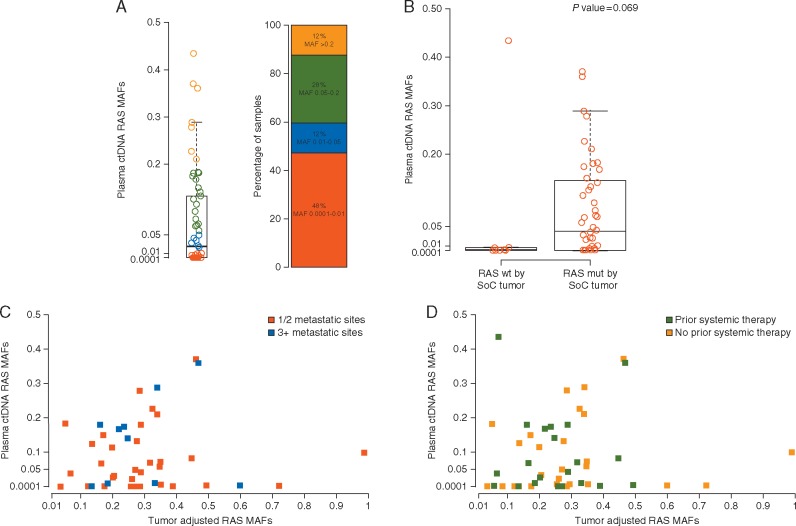
ctDNA BEAMing RAS testing showed 89.7% agreement with SoC (Kappa index 0.80; 95% CI 0.71 - 0.90) and BEAMing in tissue showed 90.9% agreement with SoC (Kappa index 0.83; 95% CI 0.74 - 0.92). Fifteen cases (10.3%) showed discordant tissue-plasma results. ctDNA analysis identified nine cases of low frequency RAS mutations that were not detected in tissue, possibly due to technical sensitivity or heterogeneity. In six cases, RAS mutations were not detected in plasma, potentially explained by low tumor burden or ctDNA shedding. Prediction of treatment benefit in patients receiving anti-EGFR plus irinotecan in second- or third-line was equivalent if tested with SoC PCR and ctDNA. Forty-eight percent of the patients showed mutant allele fractions in plasma below 1%.
Plasma RAS determination showed high overall agreement and captured a mCRC population responsive to anti-EGFR therapy with the same predictive level as SoC tissue testing. The feasibility and practicality of ctDNA analysis may translate into an alternative tool for anti-EGFR treatment selection.
循环肿瘤DNA(ctDNA)是肿瘤基因组分析的潜在来源。我们探究了转移性结直肠癌(mCRC)患者肿瘤组织和ctDNA中RAS突变状态的一致性,以确定抗表皮生长因子受体(EGFR)治疗的适用性。
开展了一项前瞻性-回顾性队列研究。采用标准护理(SoC)PCR技术检测146例mCRC患者的肿瘤组织RAS状态,并在血浆和肿瘤组织中使用数字PCR(BEAMing)。
ctDNA BEAMing RAS检测与SoC的一致性为89.7%(卡帕指数0.80;95%CI 0.71 - 0.90),组织中的BEAMing与SoC的一致性为90.9%(卡帕指数0.83;95%CI 0.74 - 0.92)。15例(10.3%)患者的组织-血浆结果不一致。ctDNA分析鉴定出9例组织中未检测到的低频RAS突变病例,可能是由于技术敏感性或异质性。6例患者血浆中未检测到RAS突变,可能是由于肿瘤负荷低或ctDNA释放。对于接受二线或三线抗EGFR加伊立替康治疗的患者,如果用SoC PCR和ctDNA检测,治疗获益预测相当。48%的患者血浆中突变等位基因分数低于1%。
血浆RAS检测显示总体一致性高,且捕获了与SoC组织检测具有相同预测水平的对抗EGFR治疗有反应的mCRC人群。ctDNA分析的可行性和实用性可能转化为抗EGFR治疗选择的替代工具。