Campbell Aimee N C, Montgomery L, Sanchez Katherine, Pavlicova M, Hu M, Newville H, Weaver L, Nunes E V
a Columbia University Medical Center , New York , New York.
b New York State Psychiatric Institute , New York , New York.
J Ethn Subst Abuse. 2017 Oct-Dec;16(4):460-478. doi: 10.1080/15332640.2017.1300550. Epub 2017 Apr 3.
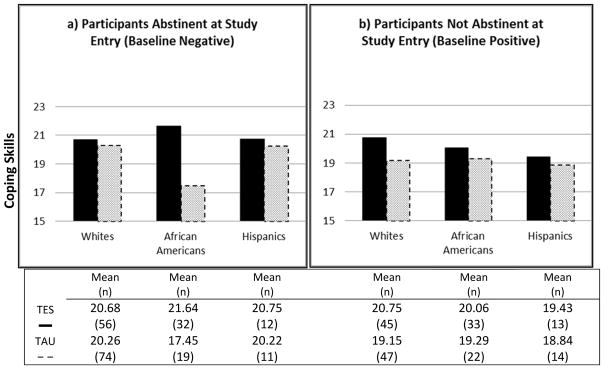
The Therapeutic Education System (TES), an Internet version of the Community Reinforcement Approach plus prize-based motivational incentives, is one of few empirically supported technology-based interventions. To date, however, there has not been a study exploring differences in substance use outcomes or acceptability of TES among racial/ethnic subgroups. This study uses data from a multisite (N = 10) effectiveness study of TES to explore whether race/ethnicity subgroups (White [n = 267], Black/African American [n = 112], and Hispanic/Latino [n = 55])moderate the effect of TES. Generalized linear mixed models were used to test whether abstinence, retention, social functioning, coping, craving, or acceptability differed by racial/ethnic subgroup. Findings demonstrated that race/ethnicity did not moderate the effect of TES versus TAU on abstinence, retention, social functioning, or craving. A three-way interaction (treatment, race/ethnicity, and abstinence status at study entry) showed that TES was associated with greater coping scores among nonabstinent White participants (p = .008) and among abstinent Black participants (p < .001). Acceptability of the TES intervention, although high overall, was significantly different by race/ethnicity subgroup with White participants reporting lower acceptability of TES compared to Black (p = .006) and Hispanic/Latino (p = .008) participants. TES appears to be a good candidate treatment among a diverse population of treatment-seeking individuals with substance use disorders.
治疗教育系统(TES)是社区强化法的网络版,加上基于奖励的激励措施,是少数经实证支持的基于技术的干预措施之一。然而,迄今为止,尚未有研究探讨种族/族裔亚组在物质使用结果或对TES的接受度方面的差异。本研究使用来自TES多地点(N = 10)有效性研究的数据,以探讨种族/族裔亚组(白人[n = 267]、黑人/非裔美国人[n = 112]和西班牙裔/拉丁裔[n = 55])是否会调节TES的效果。使用广义线性混合模型来测试戒酒、留存率、社会功能、应对方式、渴望程度或接受度在种族/族裔亚组之间是否存在差异。研究结果表明,种族/族裔并未调节TES与常规治疗(TAU)在戒酒、留存率、社会功能或渴望程度方面的效果。一个三向交互作用(治疗、种族/族裔和研究开始时的戒酒状态)表明,TES与未戒酒的白人参与者(p = 0.008)和已戒酒的黑人参与者(p < 0.001)中更高的应对得分相关。TES干预的接受度虽然总体较高,但在种族/族裔亚组之间存在显著差异,白人参与者报告的TES接受度低于黑人(p = 0.006)和西班牙裔/拉丁裔(p = 0.008)参与者。对于寻求治疗的患有物质使用障碍的不同人群而言,TES似乎是一种不错的候选治疗方法。