Hamill Matthew M, Pettifor John M, Ward Kate A, Norris Shane A, Prentice Ann
Medical Research Council Human Nutrition Research, Elsie Widdowson Laboratory, Cambridge, UK.
South African Medical Research Council (SAMRC)/University of Witswatersrand Developmental Pathways for Health Research Unit, Faculty of Health Sciences, University of Witswatersrand, Johannesburg, South Africa.
J Bone Miner Res. 2017 Aug;32(8):1615-1624. doi: 10.1002/jbmr.3147. Epub 2017 May 8.
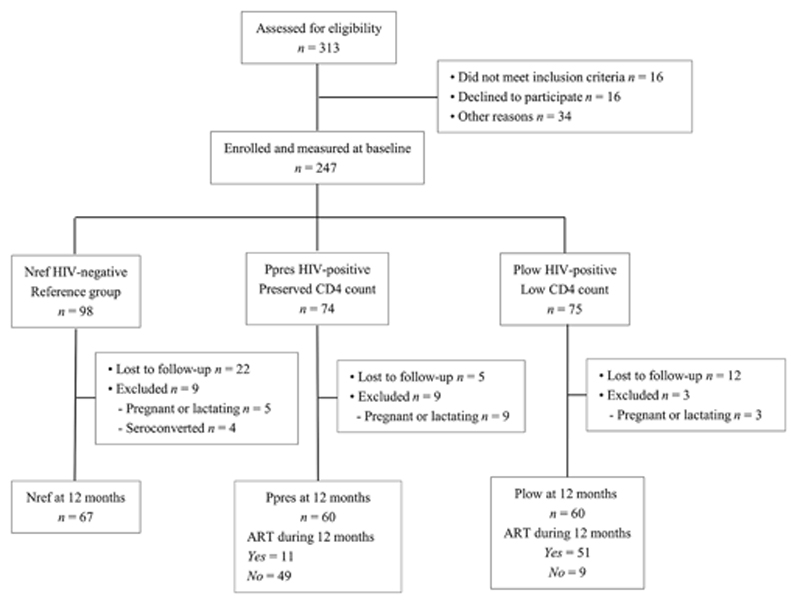
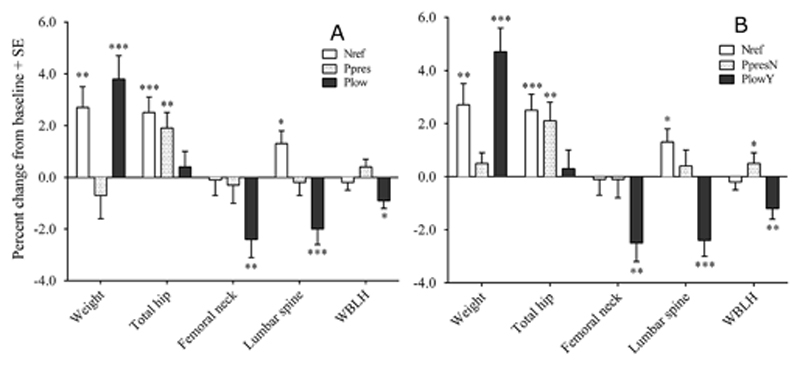
Human immunodeficiency virus (HIV) infection and antiretroviral therapy (ART) are associated with bone loss and poor vitamin D status in white populations, though their relative roles are not known. No previous studies have examined longitudinal changes in areal bone mineral density (aBMD), measured by dual-energy X-ray absorptiometry (DXA), or in vitamin D status in HIV-positive African women. Of 247 premenopausal, urban, black African women from Soweto, South Africa, initially recruited, 187 underwent anthropometry, DXA scanning and blood and urine collections at both baseline and 12 months. Of these, 67 were HIV-negative throughout (Nref), 60 were HIV-positive with preserved CD4 counts at baseline (Ppres), and 60 were HIV-positive with low CD4 counts at baseline, eligible for ART by South African standards of care at the time (Plow). No participant had been exposed to ART at baseline. By 12 months, 51 Plow women had initiated ART, >85% of whom took combined tenofovir disoproxil fumarate (TDF), lamivudine, and efavirenz. By 12 months, Plow and Nref, but not Ppres, increased in body weight and fat mass (group-by-timepoint p ≤ 0.001, p = 0.002, respectively). Plow had significant decreases in aBMD of 2% to 3%, before and after size adjustment, at the femoral neck (p ≤ 0.002) and lumbar spine (p ≤ 0.001), despite significant weight gain. These decreases were associated with increased bone turnover but there were no significant differences or changes over time in vitamin D status, serum phosphate concentrations, or renal phosphate handling. Excluding data from nine Plow women unexposed to ART and 11 Ppres women who had initiated ART accentuated these findings, suggesting the bone loss in Plow was related to ART exposure. This is the first study describing DXA-defined bone loss in HIV-positive Sub-Saharan African women in association with ART. Further work is required to establish if bone loss continues with ongoing ART and, if so, whether this results in increased fracture rates. © 2017 American Society for Bone and Mineral Research.
人类免疫缺陷病毒(HIV)感染和抗逆转录病毒疗法(ART)与白人人群的骨质流失和维生素D水平低下有关,但其相对作用尚不清楚。此前尚无研究调查过通过双能X线吸收法(DXA)测量的面积骨密度(aBMD)的纵向变化,或HIV阳性非洲女性的维生素D水平变化。在最初招募的来自南非索韦托的247名绝经前城市黑人非洲女性中,187人在基线和12个月时接受了人体测量、DXA扫描以及血液和尿液采集。其中,67人在整个研究期间均为HIV阴性(Nref),60人在基线时HIV阳性且CD4细胞计数保持正常(Ppres),60人在基线时HIV阳性且CD4细胞计数较低,根据当时南非的护理标准符合ART治疗条件(Plow)。在基线时,没有参与者接受过ART治疗。到12个月时,51名Plow组女性开始接受ART治疗,其中超过85%的人服用了替诺福韦酯(TDF)、拉米夫定和依非韦伦的组合药物。到12个月时,Plow组和Nref组体重和脂肪量增加,但Ppres组未增加(组间时间点p分别≤0.001、p = 0.002)。尽管体重显著增加,但Plow组在股骨颈(p≤0.002)和腰椎(p≤0.001)的aBMD在大小调整前后均显著下降2%至3%。这些下降与骨转换增加有关,但维生素D水平、血清磷酸盐浓度或肾脏磷酸盐处理方面没有显著差异或随时间的变化。排除9名未接受ART治疗的Plow组女性和11名已开始接受ART治疗的Ppres组女性的数据后,这些结果更加明显,表明Plow组的骨质流失与ART治疗有关。这是第一项描述HIV阳性撒哈拉以南非洲女性中与ART相关的DXA定义的骨质流失的研究。需要进一步的研究来确定随着ART治疗的持续进行骨质流失是否会继续,如果是,这是否会导致骨折率增加。©2017美国骨与矿物质研究学会。