Cecilio-Fernandes Dario, Aalders Wytze S, Bremers André J A, Tio René A, de Vries Jakob
Center for Education Development and Research in Health Professions (CEDAR), University of Groningen and University Medical Center Groningen, Antonius Deusinglaan 1, FC40, 9713 AV, Groningen, The Netherlands.
University Medical Center Groningen, University of Groningen, Groningen, The Netherlands.
J Cancer Educ. 2018 Oct;33(5):1110-1114. doi: 10.1007/s13187-017-1219-2.
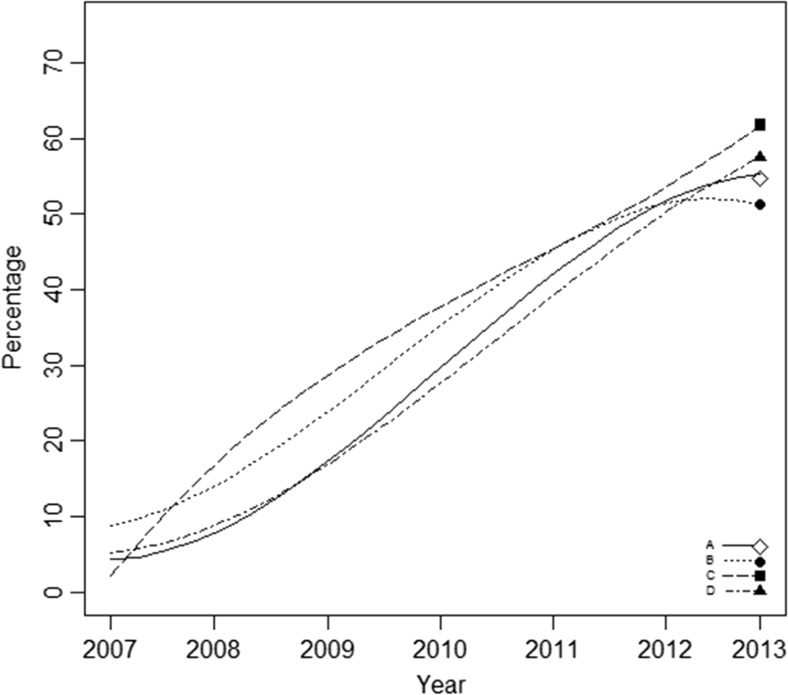
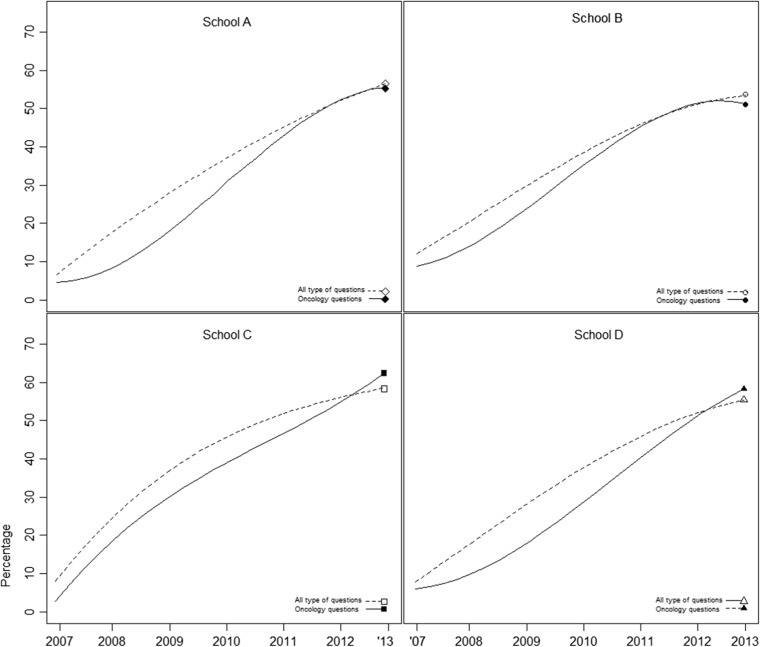
Over the past 5 years, cancer has replaced coronary heart disease as the leading cause of death in the Netherlands. It is thus paramount that medical doctors acquire a knowledge of cancer, since most of them will face many patients with cancer. Studies, however, have indicated that there is a deficit in knowledge of oncology among medical students, which may be due not only to the content but also to the structure of the curriculum. In this study, we compared students' knowledge acquisition in four different undergraduate medical programs. Further, we investigated possible factors that might influence students' knowledge growth as related to oncology. The participants comprised 1440 medical students distributed over four universities in the Netherlands. To measure students' knowledge of oncology, we used their progress test results from 2007 to 2013. The progress test consists of 200 multiple-choice questions; this test is taken simultaneously four times a year by all students. All questions regarding oncology were selected. We first compared the growth of knowledge of oncology using mixed models. Then, we interviewed the oncology coordinator of each university to arrive at a better insight of each curriculum. Two schools showed similar patterns of knowledge growth, with a slight decrease in the growth rate for one of them in year 6. The third school had a faster initial growth with a faster decrease over time compared to other medical schools. The fourth school showed a steep decrease in knowledge growth during years 5 and 6. The interviews showed that the two higher-scoring schools had a more focused semester on oncology, whereas in the others, oncology was scattered throughout the curriculum. Furthermore, the absence of a pre-internship training program seemed to hinder knowledge growth in one school. Our findings suggest that curricula have an influence on students' knowledge acquisition. A focused semester on oncology and a pre-internship preparatory training program are likely to have a positive impact on students' progress in terms of knowledge of oncology.
在过去5年里,癌症已取代冠心病成为荷兰的首要死因。因此,医生掌握癌症知识至关重要,因为他们中的大多数人会面对许多癌症患者。然而,研究表明医学生在肿瘤学知识方面存在欠缺,这可能不仅归因于课程内容,还与课程结构有关。在本研究中,我们比较了四个不同本科医学项目的学生的知识获取情况。此外,我们调查了可能影响学生肿瘤学知识增长的相关因素。参与者包括分布在荷兰四所大学的1440名医学生。为了衡量学生的肿瘤学知识,我们使用了他们2007年至2013年的进展测试结果。进展测试由200道多项选择题组成;所有学生每年同时进行四次该测试。我们挑选了所有与肿瘤学相关的问题。我们首先使用混合模型比较肿瘤学知识的增长情况。然后,我们采访了每所大学的肿瘤学协调员,以便更好地了解每个课程。两所学校的知识增长模式相似,其中一所学校在第6年的增长率略有下降。与其他医学院相比,第三所学校最初增长较快,但随着时间推移下降也较快。第四所学校在第5年和第6年期间知识增长急剧下降。访谈表明,得分较高的两所学校有一个更集中的肿瘤学学期,而在其他学校,肿瘤学分散在整个课程中。此外,缺乏实习前培训计划似乎阻碍了一所学校的知识增长。我们的研究结果表明课程对学生的知识获取有影响。一个集中的肿瘤学学期和一个实习前预备培训计划可能会对学生在肿瘤学知识方面的进步产生积极影响。