Subramaniam Mythily, Satghare Pratika, Vaingankar Janhavi A, Picco Louisa, Browning Colette J, Chong Siow Ann, Thomas Shane A
, Research Division, Institute of Mental Health, Buangkok Green Medical Park, 10 Buangkok View, Singapore, 539747, Singapore.
International Primary Health Care Research Institute, Shenzhen, China.
BMC Psychiatry. 2017 Apr 4;17(1):124. doi: 10.1186/s12888-017-1282-6.
Responsible gambling (RG) is defined as gambling for pleasure and entertainment but with an awareness of the likelihood of losing, an understanding of the associated risks and the ability to exercise control over one's gambling activity. The current study describes a qualitative approach to explore RG among older adults (aged 60 years and above) in Singapore and reports on the cognitive and behavioural strategies employed by them to regulate their gambling.
Inclusion criteria included Singapore residents aged 60 years and above, who could speak in English, Chinese, Malay or Tamil and were current or past regular gamblers. Participants were recruited using a combination of network and purposive sampling. Socio-demographic information on age, age of onset of gambling, gender, ethnicity, marital status, education and employment was collected. The South Oaks Gambling Screen (SOGS) was used to collect information on gambling activities and problems associated with gambling behaviour. Qualitative interviews were conducted with 25 older adults (60 years and above) who currently gambled. The data was analyzed using thematic network analysis.
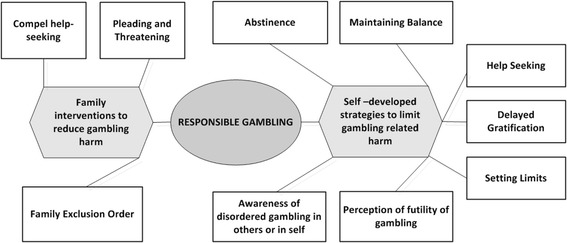
This global theme of RG comprised two organising themes: self -developed strategies to limit gambling related harm and family interventions to reduce gambling harm. The basic themes included delayed gratification, perception of futility of gambling, setting limits, maintaining balance, help-seeking and awareness of disordered gambling in self or in others. Family interventions included pleading and threatening, compelling help-seeking as well as family exclusion order.
The study highlights the significant role that families play in Asian societies in imposing RG. Education of family members both in terms of the importance of RG, and communication of the ways in which older adults can incorporate RG behaviours including the use of exclusion in specific scenarios is important.
负责任赌博(RG)被定义为出于娱乐目的而进行赌博,但要意识到输钱的可能性,理解相关风险,并能够对自己的赌博活动进行控制。本研究描述了一种定性方法,以探索新加坡老年人(60岁及以上)中的负责任赌博情况,并报告他们用于调节赌博行为的认知和行为策略。
纳入标准包括60岁及以上的新加坡居民,他们能说英语、中文、马来语或泰米尔语,并且是当前或过去的经常赌博者。通过网络抽样和目的抽样相结合的方式招募参与者。收集了关于年龄、赌博起始年龄、性别、种族、婚姻状况、教育程度和就业情况的社会人口统计学信息。使用南橡树赌博筛查量表(SOGS)收集关于赌博活动以及与赌博行为相关问题的信息。对25名当前仍在赌博的60岁及以上老年人进行了定性访谈。采用主题网络分析法对数据进行分析。
负责任赌博的这一总体主题包括两个组织主题:自我制定的限制赌博相关危害的策略和家庭干预以减少赌博危害。基本主题包括延迟满足、认识到赌博的徒劳、设定限制、保持平衡、寻求帮助以及意识到自己或他人存在赌博问题。家庭干预包括恳求与威胁、强制寻求帮助以及家庭禁赌令。
该研究强调了家庭在亚洲社会实施负责任赌博方面所起的重要作用。对家庭成员进行关于负责任赌博重要性的教育,以及传达老年人可以纳入负责任赌博行为的方式,包括在特定情况下使用禁赌措施,是很重要的。