Dept. of Immunology, Genetics & Pathology, Science for Life Laboratory, Uppsala University, Uppsala, Sweden.
Dept. of Medical Science and Division of Hematology, University Hospital, Uppsala, Sweden.
Sci Rep. 2017 Apr 4;7(1):623. doi: 10.1038/s41598-017-00755-y.
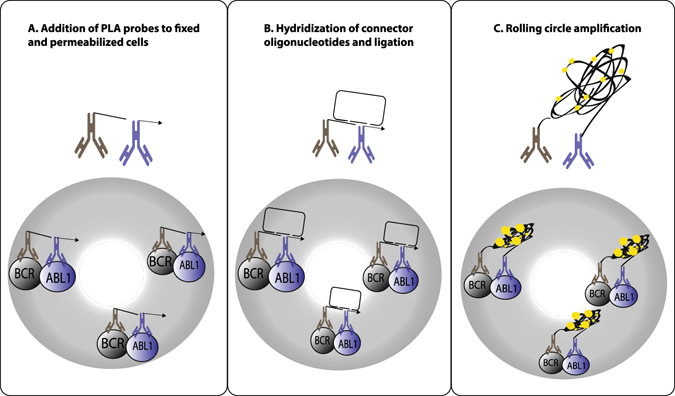
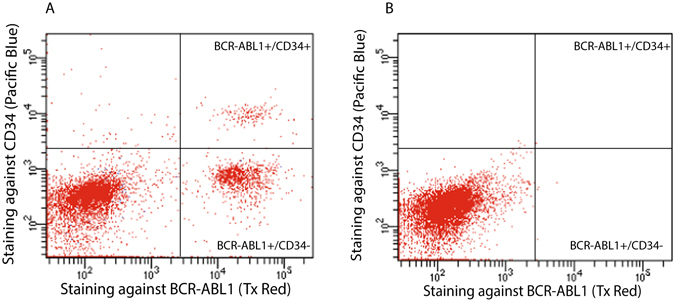
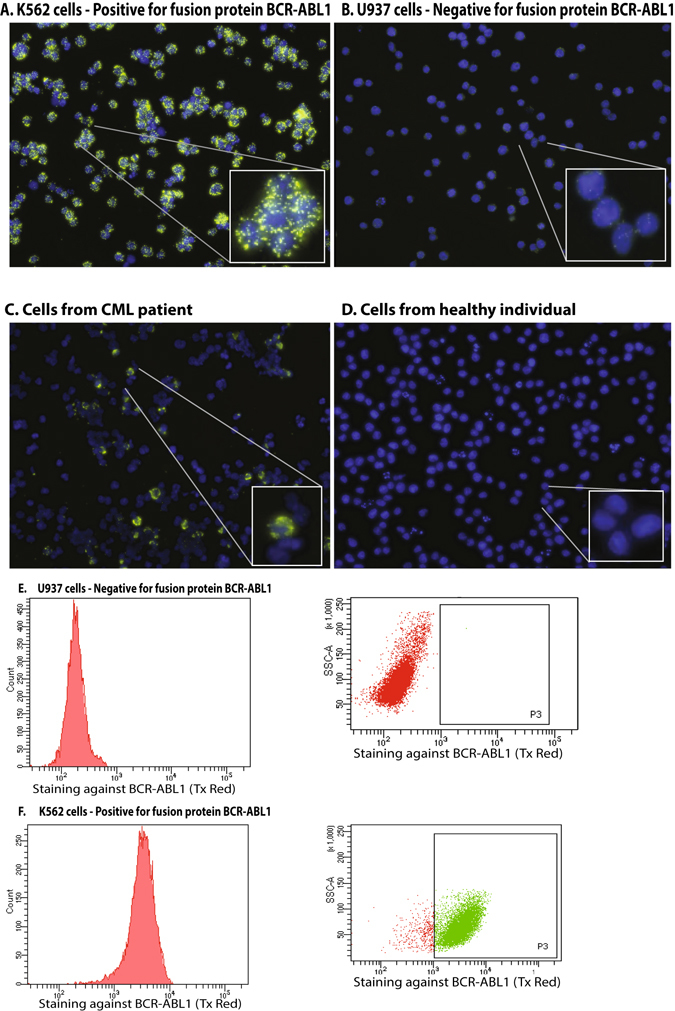
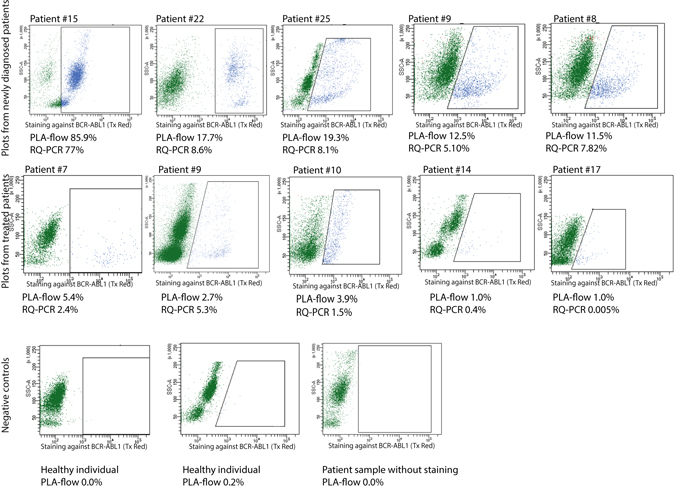
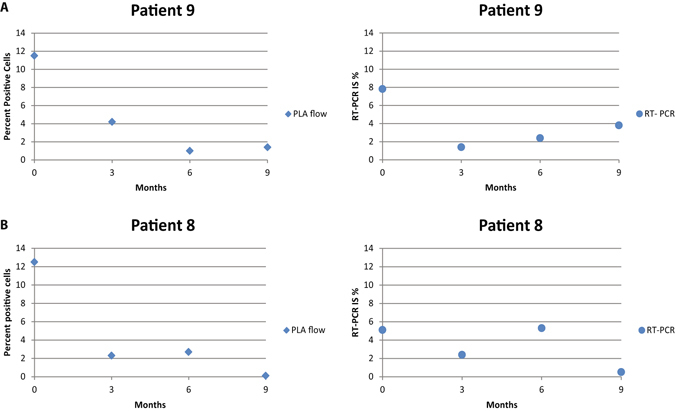
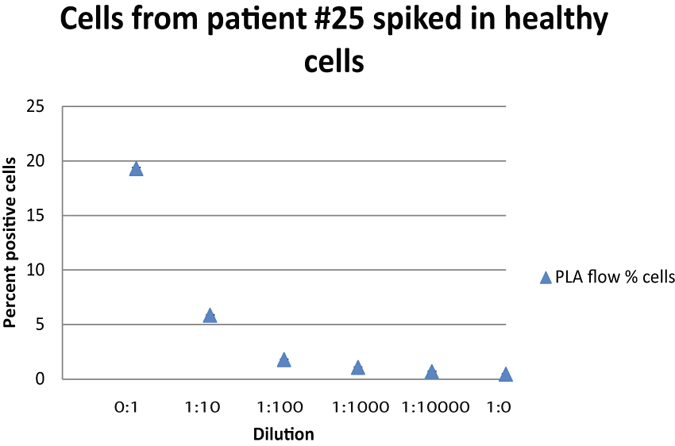
Chronic myeloid leukemia (CML) is characterized in the majority of cases by a t(9;22)(q34;q11) translocation, also called the Philadelphia chromosome, giving rise to the BCR-ABL1 fusion protein. Current treatment with tyrosine kinase inhibitors is directed against the constitutively active ABL1 domain of the fusion protein, and minimal residual disease (MRD) after therapy is monitored by real-time quantitative PCR (RQ-PCR) of the fusion transcript. Here, we describe a novel approach to detect and enumerate cells positive for the BCR-ABL1 fusion protein by combining the in situ proximity ligation assay with flow cytometry as readout (PLA-flow). By targeting of the BCR and ABL1 parts of the fusion protein with one antibody each, and creating strong fluorescent signals through rolling circle amplification, PLA-flow allowed sensitive detection of cells positive for the BCR-ABL1 fusion at frequencies as low as one in 10,000. Importantly, the flow cytometric results correlated strongly to those of RQ-PCR, both in diagnostic testing and for MRD measurements over time. In summary, we believe this flow cytometry-based method can serve as an attractive approach for routine measurement of cells harboring BCR-ABL1 fusions, also allowing simultaneously assessment of other cell surface markers as well as sensitive longitudinal follow-up.
慢性髓细胞白血病(CML)在大多数情况下的特征是 t(9;22)(q34;q11)易位,也称为费城染色体,导致 BCR-ABL1 融合蛋白的产生。目前的治疗方法是针对融合蛋白的固有活性 ABL1 结构域,通过实时定量聚合酶链反应(RQ-PCR)检测融合转录本来监测治疗后的微小残留病(MRD)。在这里,我们描述了一种通过将原位邻近连接测定与流式细胞术相结合来检测和计数 BCR-ABL1 融合蛋白阳性细胞的新方法(PLA-flow)。通过用每个抗体靶向融合蛋白的 BCR 和 ABL1 部分,并通过滚环扩增产生强荧光信号,PLA-flow 允许以低至 1/10000 的频率敏感地检测到 BCR-ABL1 融合阳性的细胞。重要的是,流式细胞术结果与 RQ-PCR 的结果高度相关,无论是在诊断测试中还是在随时间进行的 MRD 测量中。总之,我们认为这种基于流式细胞术的方法可以作为常规测量携带 BCR-ABL1 融合细胞的有吸引力的方法,同时也允许同时评估其他细胞表面标志物以及敏感的纵向随访。