Kim Han Wool, Lee Ji Hyen, Cho Hye Kyung, Lee Hyunju, Seo Ho Seong, Lee Soyoung, Kim Kyung Hyo
Center for Vaccine Evaluation and Study, Medical Research Institute, Ewha Womans University School of Medicine, Seoul, Korea.
Department of Pediatrics, Ewha Womans University School of Medicine, Seoul, Korea.
J Korean Med Sci. 2017 May;32(5):737-743. doi: 10.3346/jkms.2017.32.5.737.
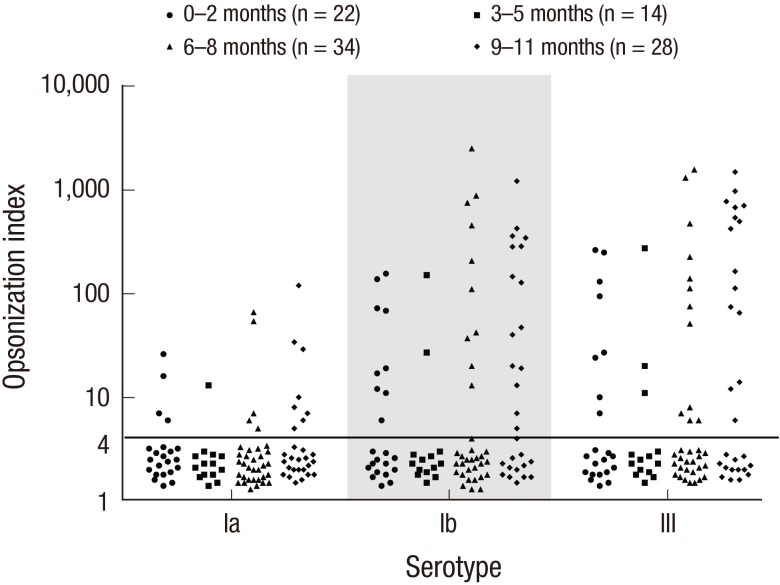
Group B streptococcus (GBS) infection is a leading cause of sepsis and meningitis among infants, and is associated with high rates of morbidity and mortality in many countries. Protection against GBS typically involves antibody-mediated opsonization by phagocytes and complement components. The present study evaluated serotype-specific functional antibodies to GBS among Korean infants and in intravenous immunoglobulin (IVIG) products. An opsonophagocytic killing assay (OPA) was used to calculate the opsonization indices (OIs) of functional antibodies to serotypes Ia, Ib, and III in 19 IVIG products from 5 international manufacturers and among 98 Korean infants (age: 0-11 months). The GBS Ia, Ib, and III serotypes were selected because they are included in a trivalent GBS vaccine formulation that is being developed. The OI values for the IVIG products were 635-5,706 (serotype Ia), 488-1,421 (serotype Ib), and 962-3,315 (serotype III), and none of the IVIG lots exhibited undetectable OI values (< 4). The geometric mean OI values were similar for all 3 serotypes when we compared the Korean manufacturers. The seropositive rate among infants was significantly lower for serotype Ia (18.4%), compared to serotype Ib and serotype III (both, 38.8%). Infant age of ≥ 3 months was positively correlated with the seropositive rates for each serotype. Therefore, only a limited proportion of infants exhibited protective immunity against serotype Ia, Ib, and III GBS infections. IVIG products that exhibit high antibody titers may be a useful therapeutic or preventive measure for infants. Further studies are needed to evaluate additional serotypes and age groups.
B族链球菌(GBS)感染是婴儿败血症和脑膜炎的主要病因,在许多国家与高发病率和死亡率相关。针对GBS的保护通常涉及吞噬细胞和补体成分介导的抗体调理作用。本研究评估了韩国婴儿以及静脉注射免疫球蛋白(IVIG)产品中针对GBS的血清型特异性功能性抗体。采用吞噬细胞杀菌试验(OPA)计算了来自5家国际制造商的19种IVIG产品以及98名韩国婴儿(年龄:0 - 11个月)中针对血清型Ia、Ib和III功能性抗体的调理指数(OIs)。选择GBS血清型Ia、Ib和III是因为它们包含在正在研发的三价GBS疫苗配方中。IVIG产品的OI值分别为635 - 5706(血清型Ia)、488 - 1421(血清型Ib)和962 - 3315(血清型III),且没有一批IVIG的OI值检测不到(<4)。当我们比较韩国制造商的产品时,所有3种血清型的几何平均OI值相似。与血清型Ib和血清型III(均为38.8%)相比,婴儿中血清型Ia的血清阳性率显著较低(18.4%)。≥3个月的婴儿年龄与每种血清型的血清阳性率呈正相关。因此,只有有限比例的婴儿对血清型Ia、Ib和III的GBS感染表现出保护性免疫。具有高抗体滴度的IVIG产品可能是对婴儿有用的治疗或预防措施。需要进一步研究以评估其他血清型和年龄组。