Kang Chang Kyung, Song Kyoung Ho, Choe Pyoeng Gyun, Park Wan Beom, Bang Ji Hwan, Kim Eu Suk, Park Sang Won, Kim Hong Bin, Kim Nam Joong, Cho Sung Il, Lee Jong Koo, Oh Myoung Don
Department of Internal Medicine, Seoul National University College of Medicine, Seoul, Korea.
JW Lee Center for Global Medicine, Seoul National University College of Medicine, Seoul, Korea.
J Korean Med Sci. 2017 May;32(5):744-749. doi: 10.3346/jkms.2017.32.5.744.
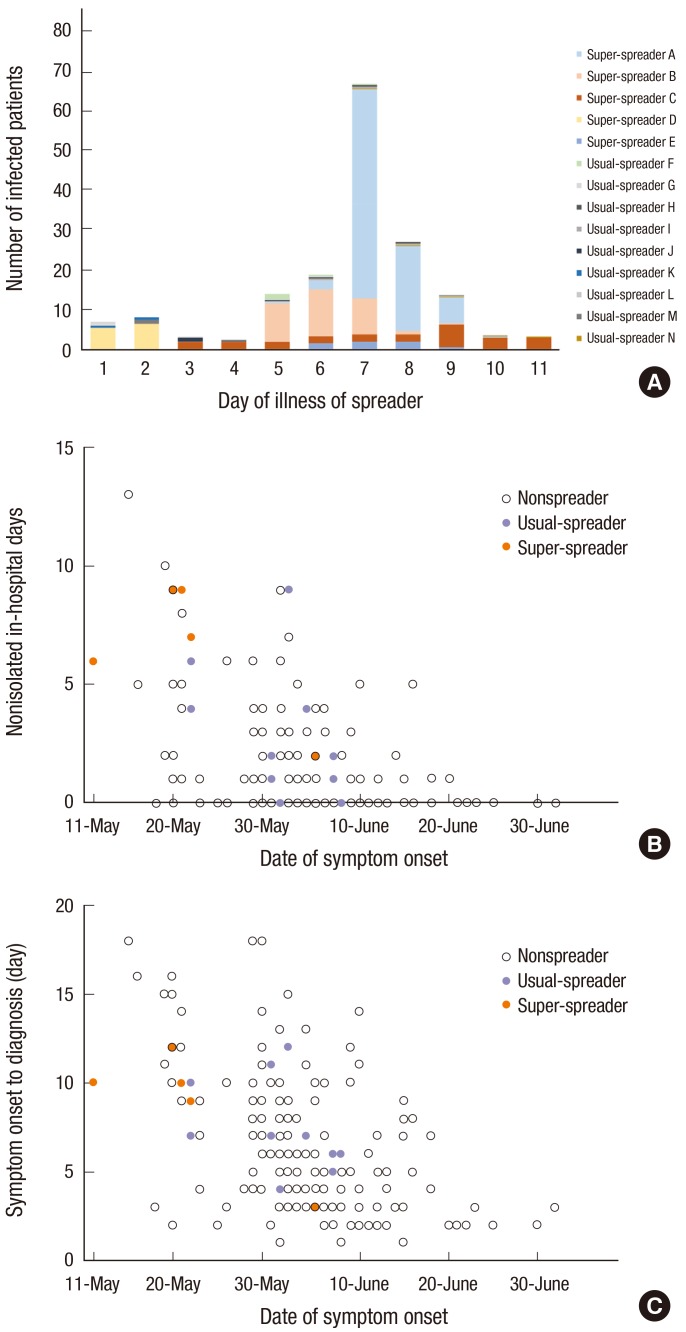
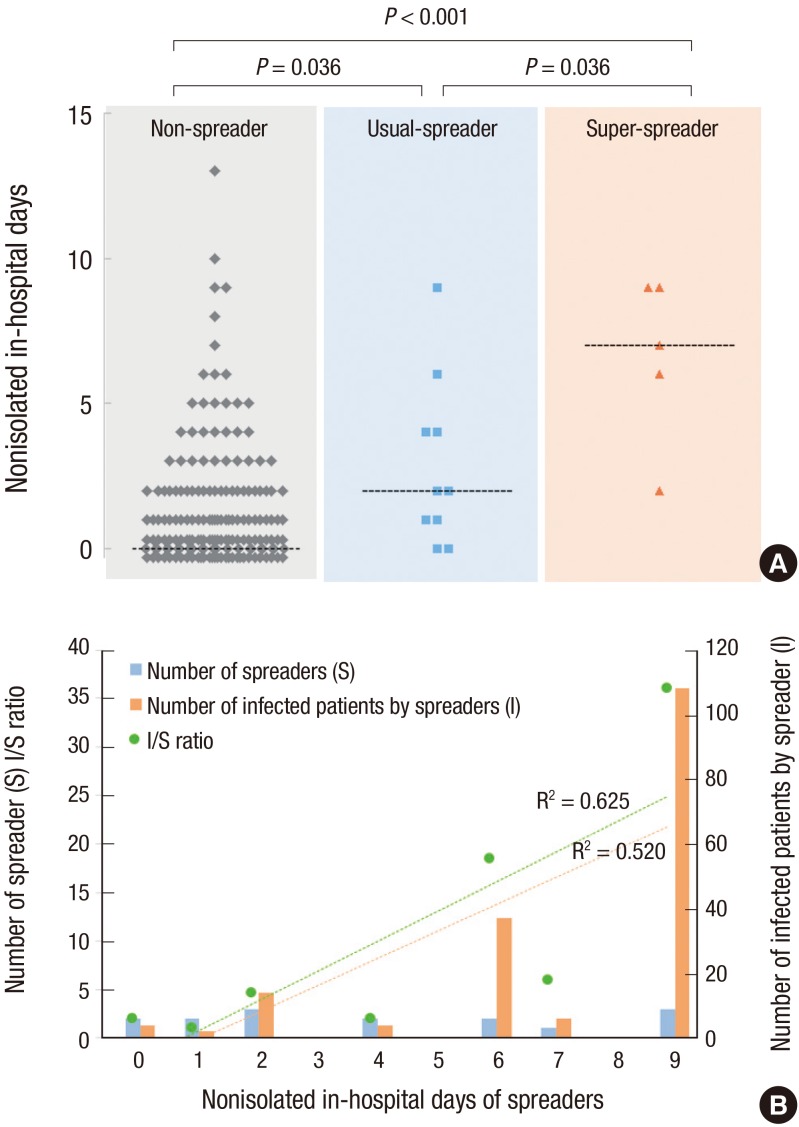
Nosocomial transmission is an important characteristic of Middle East Respiratory Syndrome Coronavirus (MERS-CoV) infection. Risk factors for transmission of MERS-CoV in healthcare settings are not well defined. During the Korean outbreak in 2015, 186 patients had laboratory-confirmed MERS-CoV infection. Those suspected as a source of viral transmission were categorized into the spreader groups (super-spreader [n = 5] and usual-spreader [n = 10]) and compared to the non-spreader group (n = 171). Body temperature of ≥ 38.5°C (adjusted odds ratio [aOR], 5.54; 95% confidence interval [CI], 1.38-22.30; P = 0.016), pulmonary infiltration of ≥ 3 lung zones (aOR, 7.33; 95% CI, 1.93-27.79; P = 0.003), and a more nonisolated in-hospital days (aOR, 1.32 per 1 day; 95% CI, 1.09-1.60; P = 0.004) were significant risk factors in the spreader group. There was no different clinical factor between super-spreaders and usual-spreaders. Nonisolated in-hospital days was the only factor which tended to be higher in super-spreaders than usual-spreaders (Mean, 6.6 vs. 2.9 days; P = 0.061). Early active quarantine might help reducing the size of an outbreak.
医院内传播是中东呼吸综合征冠状病毒(MERS-CoV)感染的一个重要特征。医疗机构中MERS-CoV传播的危险因素尚未明确界定。在2015年韩国疫情爆发期间,有186例患者经实验室确诊感染MERS-CoV。那些被怀疑为病毒传播源的患者被归类为传播者组(超级传播者[n = 5]和普通传播者[n = 10]),并与非传播者组(n = 171)进行比较。体温≥38.5°C(调整比值比[aOR],5.54;95%置信区间[CI],1.38 - 22.30;P = 0.016)、≥3个肺区出现肺部浸润(aOR,7.33;95%CI,1.93 - 27.79;P = 0.003)以及住院期间更多的非隔离天数(aOR,每1天为1.32;95%CI,1.09 - 1.60;P = 0.004)是传播者组的显著危险因素。超级传播者和普通传播者之间没有不同的临床因素。非隔离住院天数是唯一一个超级传播者往往比普通传播者更高的因素(平均值,6.6天对2.9天;P = 0.061)。早期主动隔离可能有助于减小疫情规模。