Takatani Massanobu, Crispim Myuki Esashika, Fraiji Nelson, Stefani Mariane Martins Araujo, Kiesslich Dagmar
Universidade Federal do Amazonas, Faculdade de Medicina, Departamento de Clínica Cirúrgica, Manaus, Amazonas, Brazil.
Fundação Hospitalar de Hemoterapia e Hematologia do Amazonas (FHEMOAM), Manaus, Amazonas, Brazil.
Rev Inst Med Trop Sao Paulo. 2017 Apr 3;59:e5. doi: 10.1590/S1678-9946201759005.
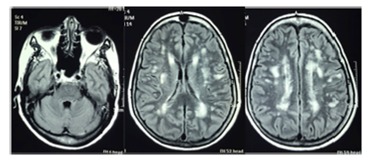
Clinical and laboratory parameters including blood and cerebrospinal fluid (CSF) neopterin were investigated in human-T-lymphotropic-virus-type-I associated-myelopathy/tropical-spastic-paraparesis-HAM/TSP and in HTLV-I carriers. HAM/TSP (n = 11, 2 males/9 females, median age = 48 years), recently diagnosed HTLV-I carriers (n = 21, 15 females/6 males, median age = 44 years), healthy individuals (n = 20, 10 males/10 females, median age = 34.6 years) from the Brazilian Amazon (Manaus, Amazonas State) were investigated. Neopterin was measured (IBL ELISA Neopterin, Germany) in serum samples of all the participants, in CSF of 9 HAM/TSP patients as well as in 6 carriers. In HAM/TSP patients, CSF cell counts, protein and glucose were measured, the Osame's motor-disability-score/OMDS was determined, and brain/spinal cord magnetic-resonance-imaging (MRI) was performed. HAM/TSP patients had normal CSF glucose, leukocyte counts; and normal protein levels predominated. Brain-MRI showed white-matter lesions in 7 out of 11 HAM/TSP patients. OMDS varied from 2-8: 9 were able to walk, 2 were wheel-chair-users. The median serum neopterin concentration in HAM/TSP patients was 6.6 nmol/ L; min. 2.8- max. 12.5 nmol/ L); was lower in carriers (4.3 nmol/L; min. 2.7- max. 7.2 nmol/ L) as well as in healthy participants (4.7 nmol/ L; min. 2.7- max. 8.0 nmol/ L) (p < 0.05). CSF neopterin concentrations in HAM/TSP patients were higher than in serum samples, and higher compared to carriers (p < 0.05). Carriers had similar serum-CSF neopterin concentrations compared to healthy participants. Variable clinical and laboratory profiles were seen in HAM/TSP patients, however our results support the neopterin measurement as a potential biomarker of disease activity.
对人类嗜T淋巴细胞病毒I型相关脊髓病/热带痉挛性截瘫(HAM/TSP)患者和HTLV-I携带者的临床和实验室参数进行了研究,包括血液和脑脊液(CSF)中的新蝶呤。研究对象包括来自巴西亚马逊地区(马瑙斯,亚马孙州)的HAM/TSP患者(n = 11,男2例/女9例,中位年龄 = 48岁)、近期诊断的HTLV-I携带者(n = 21,女15例/男6例,中位年龄 = 44岁)、健康个体(n = 20,男10例/女10例,中位年龄 = 34.6岁)。对所有参与者的血清样本、9例HAM/TSP患者以及6例携带者的脑脊液进行新蝶呤检测(德国IBL ELISA新蝶呤检测法)。对HAM/TSP患者检测脑脊液细胞计数、蛋白质和葡萄糖水平,确定小见运动障碍评分(OMDS),并进行脑/脊髓磁共振成像(MRI)检查。HAM/TSP患者脑脊液葡萄糖、白细胞计数正常;蛋白质水平以正常为主。脑部MRI显示,11例HAM/TSP患者中有7例存在白质病变。OMDS评分在2至8分之间:9例患者能够行走,2例患者需使用轮椅。HAM/TSP患者血清新蝶呤浓度中位数为6.6 nmol/L(最小值2.8 - 最大值12.5 nmol/L);携带者(4.3 nmol/L;最小值2.7 - 最大值7.2 nmol/L)和健康参与者(4.7 nmol/L;最小值2.7 - 最大值8.0 nmol/L)的血清新蝶呤浓度较低(p < 0.05)。HAM/TSP患者脑脊液新蝶呤浓度高于血清样本,且高于携带者(p < 0.05)。与健康参与者相比,携带者血清 - 脑脊液新蝶呤浓度相似。HAM/TSP患者呈现出不同的临床和实验室特征,然而我们的结果支持将新蝶呤检测作为疾病活动的潜在生物标志物。