Sharip Ainur, Abdukhakimova Diyora, Wang Xiao, Kim Alexey, Kim Yevgeniy, Sharip Aigul, Orakov Askarbek, Miao Lixia, Sun Qinglei, Chen Yue, Chen Zhenbang, Xie Yingqiu
Department of Biology, School of Science and Technology, Nazarbayev University, Astana, 010000, Republic of Kazakhstan.
Shandong Analysis and Test Center, Shandong Academy of Sciences, 19 Keyuan Street, Jinan, 250014, P.R. China.
J Cancer. 2017 Mar 12;8(5):903-912. doi: 10.7150/jca.17961. eCollection 2017.
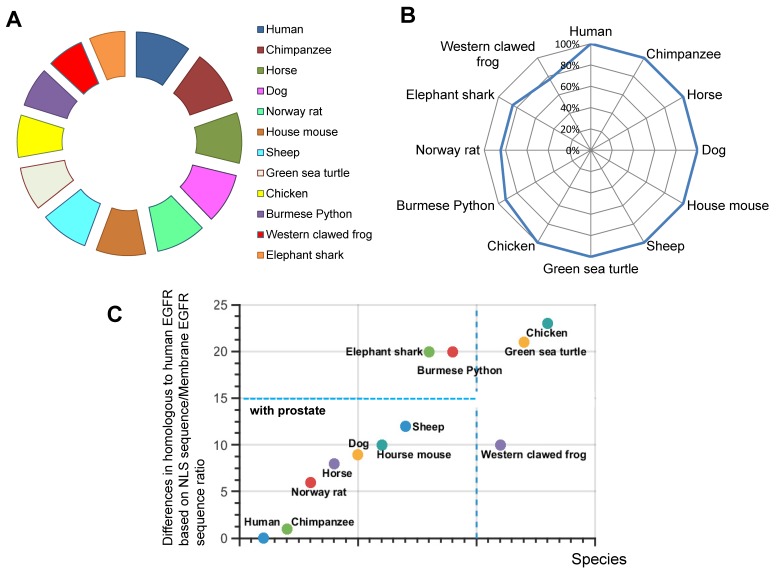
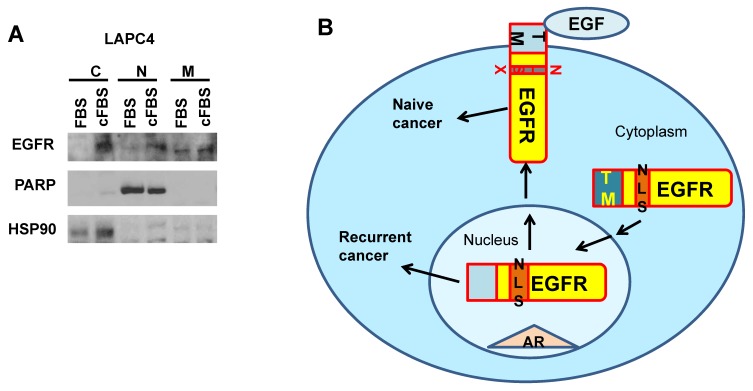
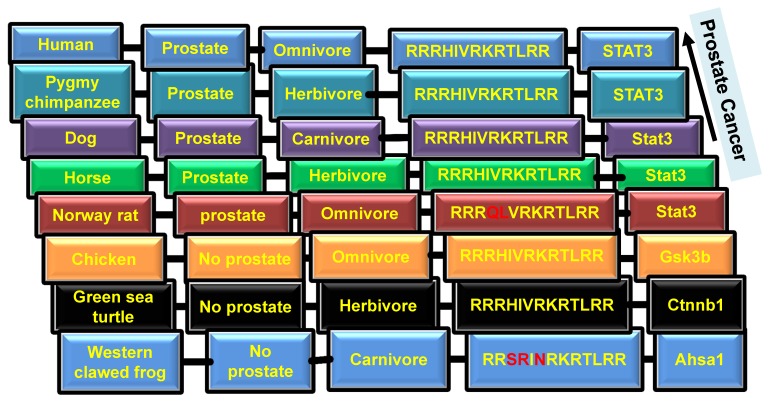
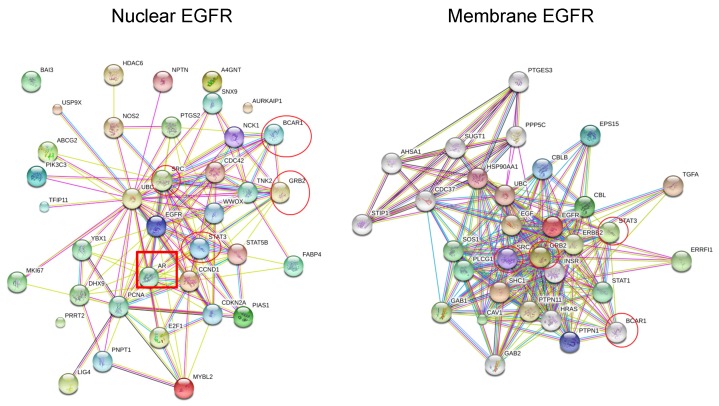
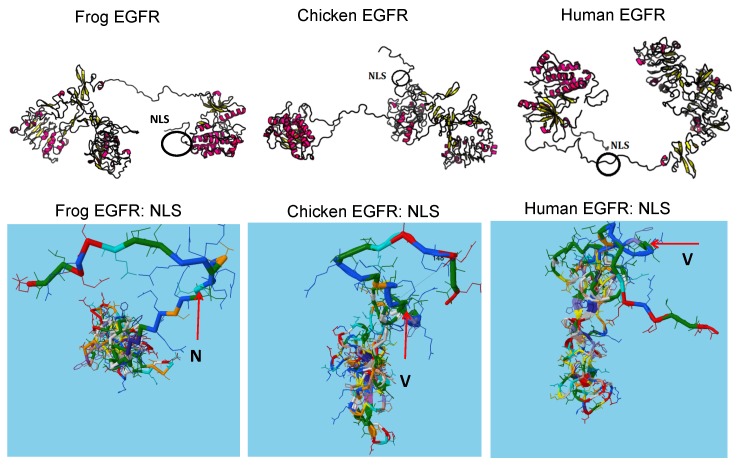
Receptor tyrosine kinase EGFR usually is localized on plasma membrane to induce progression of many cancers including cancers in children (Bodey . 2005, 19:931-41), but it contains a nuclear localization signal (NLS) that mediates EGFR nuclear translocation (Lin et al. Nat Cell Biol. 2001, 3:802-8). Here we report that NLS of EGFR has its old evolutionary origin. Protein-protein interaction maps suggests that nEGFR pathways are different from membrane EGFR and EGF is not found in nEGFR network while androgen receptor (AR) is found, which suggests the evolution of prostate cancer, a well-known AR driven cancer, through changes in androgen- or EGF-dependence. Database analysis suggests that nEGFR correlates with the tumor grades especially in prostate cancer patients. Structural predication analysis suggests that NLS can compromise the differential protein binding to EGFR through stretch linkers with evolutionary mutation from N to V. In experiment, elevation of nEGFR but not membrane EGFR was found in castration resistant prostate cancer cells. Finally, systems analysis of NLS and transmembrane domain (TM) suggests that NLS has old origin while NLS neighboring domain of TM has been undergone accelerated evolution. Thus nEGFR has an old origin resembling the cancer evolution but TM may interfere with NLS driven signaling for natural selection of survival to evade NLS induced aggressive cancers. Our data suggest NLS is a dynamic inducer of EGFR oncogenesis during evolution for advanced cancers. Our model provides novel insights into the evolutionary role of NLS of oncogenic kinases in cancers.
受体酪氨酸激酶表皮生长因子受体(EGFR)通常定位于质膜,可诱导包括儿童癌症在内的多种癌症进展(博德伊,2005年,第19卷:931 - 41页),但它含有一个核定位信号(NLS),可介导EGFR的核转位(林等人,《自然细胞生物学》,2001年,第3卷:802 - 8页)。在此我们报告,EGFR的NLS具有古老的进化起源。蛋白质 - 蛋白质相互作用图谱表明,核内EGFR途径与膜上EGFR不同,在核内EGFR网络中未发现表皮生长因子(EGF),而发现了雄激素受体(AR),这表明前列腺癌(一种众所周知的由AR驱动的癌症)通过雄激素或EGF依赖性的改变而发生进化。数据库分析表明,核内EGFR与肿瘤分级相关,尤其是在前列腺癌患者中。结构预测分析表明,NLS可通过从N到V发生进化突变的伸展连接子破坏与EGFR的差异蛋白结合。在实验中,去势抵抗性前列腺癌细胞中发现核内EGFR升高,而膜上EGFR未升高。最后,对NLS和跨膜结构域(TM)的系统分析表明,NLS起源古老,而TM的NLS相邻结构域经历了加速进化。因此,核内EGFR起源古老,类似于癌症进化,但TM可能会干扰NLS驱动的信号传导,以实现生存的自然选择,从而逃避NLS诱导的侵袭性癌症。我们的数据表明,NLS是进化过程中晚期癌症EGFR致癌作用的动态诱导剂。我们的模型为致癌激酶的NLS在癌症中的进化作用提供了新的见解。