Valles S M, Chen Y, Firth A E, Guérin D M A, Hashimoto Y, Herrero S, de Miranda J R, Ryabov E
United States Department of Agriculture, Agricultural Research Service, Gainesville FL 32608, USA.
United States Department of Agriculture, Agricultural Research Service, Beltsville MD 20705, USA.
J Gen Virol. 2017 Apr;98(4):527-528. doi: 10.1099/jgv.0.000757. Epub 2017 Apr 6.
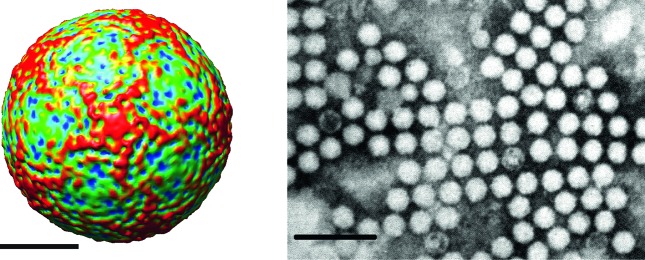
Iflaviridae is a family of small non-enveloped viruses with monopartite, positive-stranded RNA genomes of approximately 9-11 kilobases. Viruses of all classified species infect arthropod hosts, with the majority infecting insects. Both beneficial and pest insects serve as hosts, and infections can be symptomless (Nilaparvatalugens honeydew virus 1) or cause developmental abnormalities (deformed wing virus), behavioural changes (sacbrood virus) and premature mortality (infectious flacherie virus). The host range has not been examined for most members. The most common route of infection for iflaviruses is the ingestion of virus-contaminated food sources. This is a summary of the International Committee on Taxonomy of Viruses (ICTV) Report on the taxonomy of the Iflaviridae, which is available at www.ictv.global/report/iflaviridae.
蟋蟀病毒科是一类小型无包膜病毒,其基因组为单分体、正链RNA,大小约为9 - 11千碱基。所有已分类物种的病毒都感染节肢动物宿主,大多数感染昆虫。益虫和害虫都可作为宿主,感染可能无症状(褐飞虱蜜露病毒1),也可能导致发育异常(变形翼病毒)、行为改变(囊雏病病毒)和过早死亡(传染性软化病病毒)。大多数成员的宿主范围尚未研究。蟋蟀病毒最常见的感染途径是摄入受病毒污染的食物来源。这是国际病毒分类委员会(ICTV)关于蟋蟀病毒科分类的报告摘要,可在www.ictv.global/report/iflaviridae查阅。