McMahon Dino P, Fürst Matthias A, Caspar Jesicca, Theodorou Panagiotis, Brown Mark J F, Paxton Robert J
School of Biological Sciences, MBC, Queen's University Belfast, Belfast, BT9 7BL, UK.
Institute of Biology, Free University Berlin, Schwendenerstr. 1, 14195, Berlin, Germany.
J Anim Ecol. 2015 May;84(3):615-624. doi: 10.1111/1365-2656.12345. Epub 2015 Mar 3.
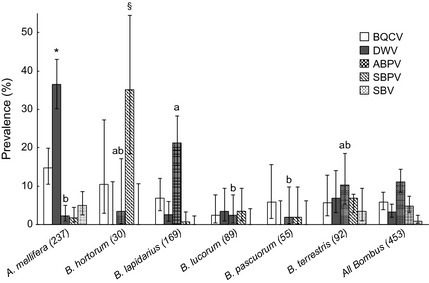
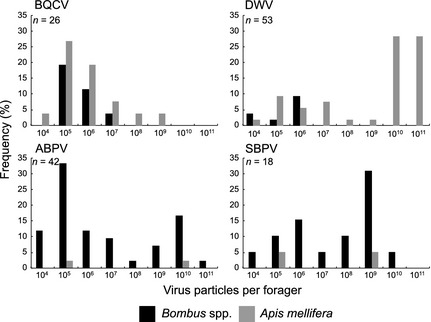
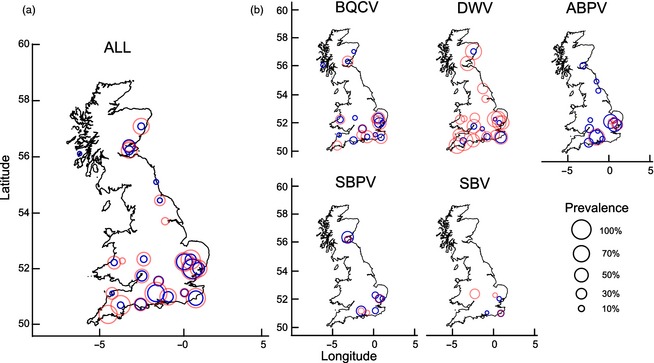
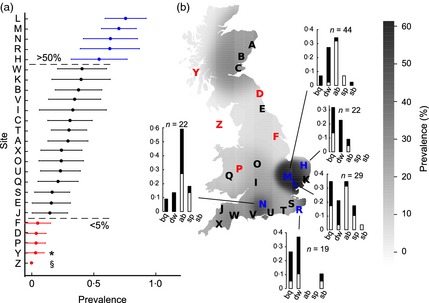
Declining populations of bee pollinators are a cause of concern, with major repercussions for biodiversity loss and food security. RNA viruses associated with honeybees represent a potential threat to other insect pollinators, but the extent of this threat is poorly understood. This study aims to attain a detailed understanding of the current and ongoing risk of emerging infectious disease (EID) transmission between managed and wild pollinator species across a wide range of RNA viruses. Within a structured large-scale national survey across 26 independent sites, we quantify the prevalence and pathogen loads of multiple RNA viruses in co-occurring managed honeybee (Apis mellifera) and wild bumblebee (Bombus spp.) populations. We then construct models that compare virus prevalence between wild and managed pollinators. Multiple RNA viruses associated with honeybees are widespread in sympatric wild bumblebee populations. Virus prevalence in honeybees is a significant predictor of virus prevalence in bumblebees, but we remain cautious in speculating over the principle direction of pathogen transmission. We demonstrate species-specific differences in prevalence, indicating significant variation in disease susceptibility or tolerance. Pathogen loads within individual bumblebees may be high and in the case of at least one RNA virus, prevalence is higher in wild bumblebees than in managed honeybee populations. Our findings indicate widespread transmission of RNA viruses between managed and wild bee pollinators, pointing to an interconnected network of potential disease pressures within and among pollinator species. In the context of the biodiversity crisis, our study emphasizes the importance of targeting a wide range of pathogens and defining host associations when considering potential drivers of population decline.
蜜蜂传粉者数量的减少令人担忧,对生物多样性丧失和粮食安全产生重大影响。与蜜蜂相关的RNA病毒对其他昆虫传粉者构成潜在威胁,但这种威胁的程度尚不清楚。本研究旨在详细了解在广泛的RNA病毒中,受管理的传粉者物种与野生传粉者物种之间新兴传染病(EID)传播的当前及持续风险。在一项涵盖26个独立地点的结构化大规模全国性调查中,我们对同时出现的受管理蜜蜂(西方蜜蜂)和野生熊蜂(熊蜂属)种群中多种RNA病毒的流行率和病原体载量进行了量化。然后,我们构建模型,比较野生传粉者和受管理传粉者之间的病毒流行率。与蜜蜂相关的多种RNA病毒在同域野生熊蜂种群中广泛存在。蜜蜂中的病毒流行率是熊蜂中病毒流行率的一个重要预测指标,但我们在推测病原体传播的主要方向时仍持谨慎态度。我们证明了流行率存在物种特异性差异,表明疾病易感性或耐受性存在显著差异。单个熊蜂体内的病原体载量可能很高,而且至少有一种RNA病毒的情况是,野生熊蜂中的流行率高于受管理的蜜蜂种群。我们的研究结果表明RNA病毒在受管理的蜜蜂传粉者和野生蜜蜂传粉者之间广泛传播,这表明传粉者物种内部和之间存在一个潜在疾病压力的相互关联网络。在生物多样性危机的背景下,我们的研究强调了在考虑种群下降的潜在驱动因素时,针对多种病原体并确定宿主关联的重要性。