Department of Ophthalmology, King's College London, 3rd Floor Block D South Wing, St Thomas' Hospital, Westminster Bridge Road, London, SE1 7EH, UK.
Department of Twin Research &Genetic Epidemiology, King's College London, 3rd Floor Block D South Wing, St Thomas' Hospital, Westminster Bridge Road, London, SE1 7EH, UK.
Sci Rep. 2017 Apr 6;7:45977. doi: 10.1038/srep45977.
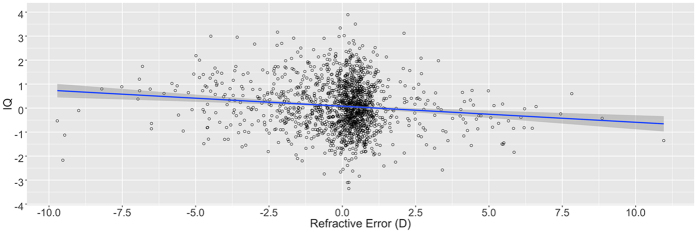
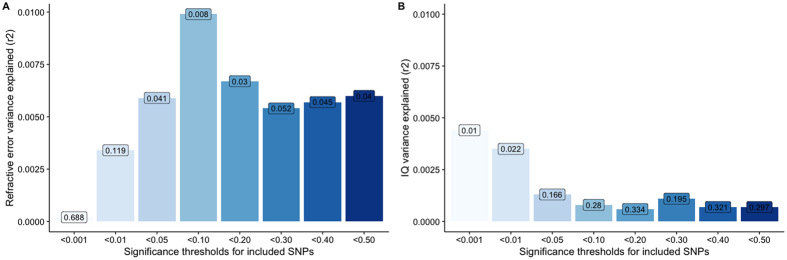
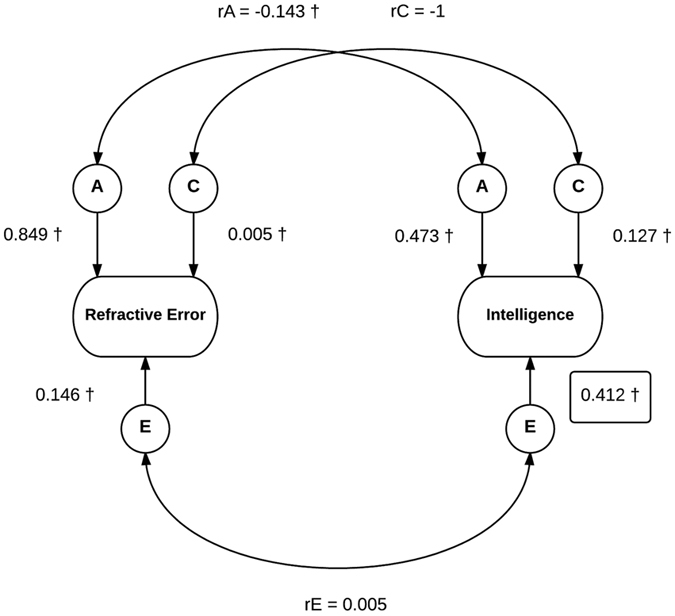
Myopia, or near-sightedness, is our most common eye condition and the prevalence is increasing globally. Visual impairment will occur if uncorrected, whilst high myopia causes sight-threatening complications. Myopia is associated with higher intelligence. As both are heritable, we set out to examine whether there is a genetic correlation between myopia and intelligence in over 1,500 subjects (aged 14-18 years) from a twin birth cohort. The phenotypic correlation between refractive error and intelligence was -0.116 (p < 0.01) - the inverse correlation due to the fact that myopia is a negative refractive error. Bivariate twin modeling confirmed both traits were heritable (refractive error 85%, intelligence 47%) and the genetic correlation was -0.143 (95% CI -0.013 to -0.273). Of the small phenotypic correlation the majority (78%) was explained by genetic factors. Polygenic risk scores were constructed based on common genetic variants identified in previous genome-wide association studies of refractive error and intelligence. Genetic variants for intelligence and refractive error explain some of the reciprocal variance, suggesting genetic pleiotropy; in the best-fit model the polygenic score for intelligence explained 0.99% (p = 0.008) of refractive error variance. These novel findings indicate shared genetic factors contribute significantly to the covariance between myopia and intelligence.
近视,又称远视,是我们最常见的眼部疾病,其患病率在全球范围内呈上升趋势。如果不加以矫正,视力将会受损,而高度近视会导致威胁视力的并发症。近视与较高的智力有关。由于两者都是遗传性的,我们着手研究在一个双胞胎出生队列中,对超过 1500 名(年龄在 14-18 岁)受试者进行的近视和智力之间是否存在遗传相关性。屈光度与智力之间的表型相关性为-0.116(p<0.01),这种负相关是由于近视是一种负屈光不正。双变量双胞胎模型证实这两种特征都是可遗传的(屈光度 85%,智力 47%),遗传相关性为-0.143(95%CI-0.013 至-0.273)。在很小的表型相关性中,大部分(78%)是由遗传因素解释的。基于先前全基因组关联研究中确定的常见遗传变异,构建了多基因风险评分。智力和屈光不正的遗传变异解释了一些相互的方差,表明存在遗传多效性;在最佳拟合模型中,智力的多基因评分解释了 0.99%(p=0.008)的屈光不正方差。这些新发现表明,共同的遗传因素对近视和智力之间的协方差有很大的影响。