Reid Victoria Louise, McDonald Rachael, Nwosu Amara Callistus, Mason Stephen R, Probert Chris, Ellershaw John E, Coyle Séamus
The Marie Curie Palliative Care Institute Liverpool, University of Liverpool, Liverpool, United Kingdom.
Renal Medicine, Aintree University Hospital NHS Foundation Trust, Liverpool, United Kingdom.
PLoS One. 2017 Apr 6;12(4):e0175123. doi: 10.1371/journal.pone.0175123. eCollection 2017.
The Neuberger review made a number of recommendations to improve end of life care, including research into the biology of dying. An important aspect of the biology of dying is the identification of biomarkers as indices of disease processes. Biomarkers have the potential to inform the current, limited understanding of the dying process and assist clinicians in recognising dying, in particular how to distinguish dying from reversible acute deterioration.
To critically appraise the literature on biological factors that may be used as prognostic indicators in advanced cancer patients and to identify candidate biomarkers of the dying process that can be measured serially in cancer patients' bodily fluids.
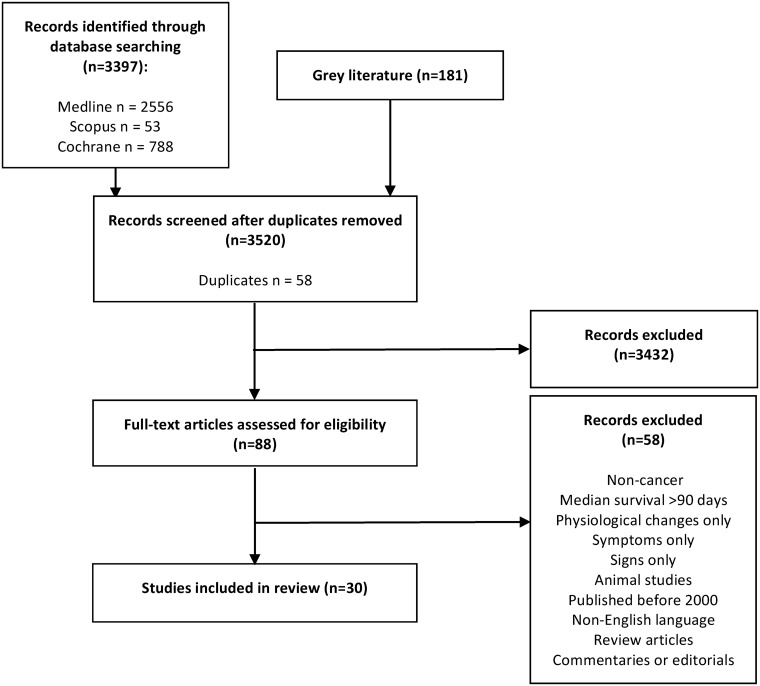
A systematically structured review was conducted using three electronic databases. A hand search of six peer-reviewed journals and conference abstracts was also conducted. Studies reporting prognostic biomarkers in cancer patients with a median survival of ≤90 days and post-mortem studies were included. Final levels of evidence and recommendations were made using the Evidence Based Medicine modified GRADE system.
30 articles were included. Seven prognostic biological factors demonstrated Grade A evidence (lymphocyte count, white blood cell count, serum C-reactive protein, albumin, sodium, urea and alkaline phosphatase). An additional eleven prognostic factors were identified with Grade B evidence (platelet count, international normalised ratio, serum vitamin B12, prealbumin, bilirubin, cholesterol, aspartate aminotransferase, alanine transaminase, lactate dehydrogenase, pseudocholinesterase and urate). A number of biomarkers were specifically identified in the last two weeks of life but limitations exist. No post-mortem studies met the inclusion criteria.
The biology of dying is an important area for future research, with the evidence focused on signs, symptoms and prognostic factors. This review identifies a number of common themes shared amongst advanced cancer patients and highlights candidate biomarkers which may be indicative of a common biological process to dying.
纽伯格报告提出了多项改善临终护理的建议,包括对死亡生物学的研究。死亡生物学的一个重要方面是将生物标志物识别为疾病进程的指标。生物标志物有可能增进目前对死亡过程有限的理解,并帮助临床医生识别死亡,特别是如何将死亡与可逆性急性恶化区分开来。
批判性地评估关于可作为晚期癌症患者预后指标的生物学因素的文献,并识别可在癌症患者体液中进行连续测量的死亡过程候选生物标志物。
使用三个电子数据库进行了系统结构化综述。还对手工检索的六种同行评审期刊和会议摘要进行了研究。纳入了报告中位生存期≤90天的癌症患者预后生物标志物的研究以及尸检研究。使用循证医学改良的GRADE系统得出最终的证据水平和建议。
纳入30篇文章。七个预后生物学因素显示为A级证据(淋巴细胞计数、白细胞计数、血清C反应蛋白、白蛋白、钠、尿素和碱性磷酸酶)。另外确定了11个具有B级证据的预后因素(血小板计数、国际标准化比值(即国际标准化比率)、血清维生素B12、前白蛋白、胆红素、胆固醇、天冬氨酸转氨酶、丙氨酸转氨酶、乳酸脱氢酶、假性胆碱酯酶和尿酸)。在生命的最后两周特别识别出了一些生物标志物,但存在局限性。没有尸检研究符合纳入标准。
死亡生物学是未来研究的一个重要领域,证据集中在体征、症状和预后因素上。本综述确定了晚期癌症患者之间的一些共同主题,并突出了可能指示共同死亡生物学过程的候选生物标志物。