Division of Clinical Medicine, University of Sheffield, Sheffield, UK.
Sheffield Teaching Hospitals NHS Foundation Trust, Sheffield, UK.
Palliat Med. 2024 Oct;38(9):923-934. doi: 10.1177/02692163241263231. Epub 2024 Jul 28.
Timely identification of dying in motor neurone disease enables optimal care, yet we know that healthcare professionals can fail to recognise when death is approaching. Clinical factors help predict the end of life in other terminal conditions. Examining these principles in motor neurone disease would help guide more accurate recognition of this critical phase.
To examine and map out what is known about dying in patients with motor neurone disease, and the recognition of dying by healthcare professionals.
A scoping review was conducted following the Arksey and O'Malley methodological framework.
Four electronic databases (MEDLINE, Scopus, PsycINFO and CINAHL) and grey literature were searched on the 10th May 2023. Reference lists and citations were also reviewed.
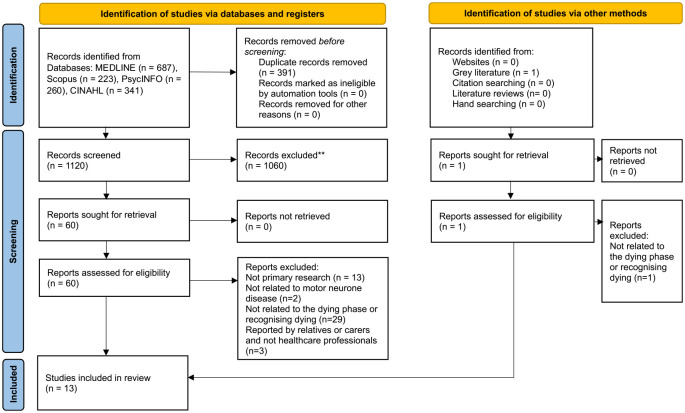
From 1512 articles, 13 studies were included. Dyspnoea, anxiety and pain were the most common symptoms associated with the dying phase. Worsening respiratory function, the development of specific new symptoms and deteriorating symptom control suggested approaching death. No studies reported changes in vital signs or biomarkers associated with dying. Barriers to the recognition of dying by healthcare professionals included a rapid and unpredictable terminal decline.
Dying in motor neurone disease is associated with patterns of symptoms and signs, however evidence is limited compared with other terminal conditions and requires further exploration. The characteristic sudden and unpredictable terminal decline is a key barrier to recognition of dying by healthcare professionals. Optimising advance care planning is one approach to navigate these complex, unpredictable clinical situations.
及时识别运动神经元病患者的死亡情况可以提供最佳的护理,但我们知道医疗保健专业人员可能无法识别死亡临近的迹象。临床因素有助于预测其他终末期疾病的生命末期。在运动神经元病中研究这些原则将有助于更准确地识别这一关键阶段。
检查和绘制运动神经元病患者死亡的相关情况,以及医疗保健专业人员对死亡的识别。
根据 Arksey 和 O'Malley 的方法学框架进行了范围审查。
2023 年 5 月 10 日在 MEDLINE、Scopus、PsycINFO 和 CINAHL 这四个电子数据库以及灰色文献中进行了搜索。还审查了参考文献列表和引文。
从 1512 篇文章中,纳入了 13 项研究。呼吸困难、焦虑和疼痛是与临终阶段最相关的常见症状。呼吸功能恶化、出现特定的新症状和恶化的症状控制提示即将死亡。没有研究报告与死亡相关的生命体征或生物标志物的变化。医疗保健专业人员识别死亡的障碍包括快速且不可预测的终末期下降。
运动神经元病患者的临终阶段与症状和体征模式相关,但与其他终末期疾病相比,证据有限,需要进一步探索。特征性的突然且不可预测的终末期下降是医疗保健专业人员识别死亡的一个关键障碍。优化预先护理计划是应对这些复杂、不可预测临床情况的一种方法。