Paal Piret, Bükki Johannes
Department of Research and Development, Hospice Care DaSein, Munich, Germany.
Institute of Nursing Sciences and Palliative Care, Paracelsus Medical University, Salzburg, Austria.
PLoS One. 2017 Apr 6;12(4):e0175314. doi: 10.1371/journal.pone.0175314. eCollection 2017.
In patients with life-limiting conditions and a history of migration, a higher risk of not dying at home and limited access to palliative care services has been reported.
To explore the views and end-of-life preferences of patients with a migration history in Germany and to identify migration specific themes.
Two-armed study using Kaufmann's 'understanding interview' ('focused interview') method and grounded theory approach. Thematic content analysis was applied using MaxQDA 12 software.
SETTING/PARTICIPANTS: Migrant and non-migrant adult patients with far advanced, life-limiting disease receiving palliative care in different specialist level settings (specialist home palliative care, palliative care inpatient unit, inpatient hospice).
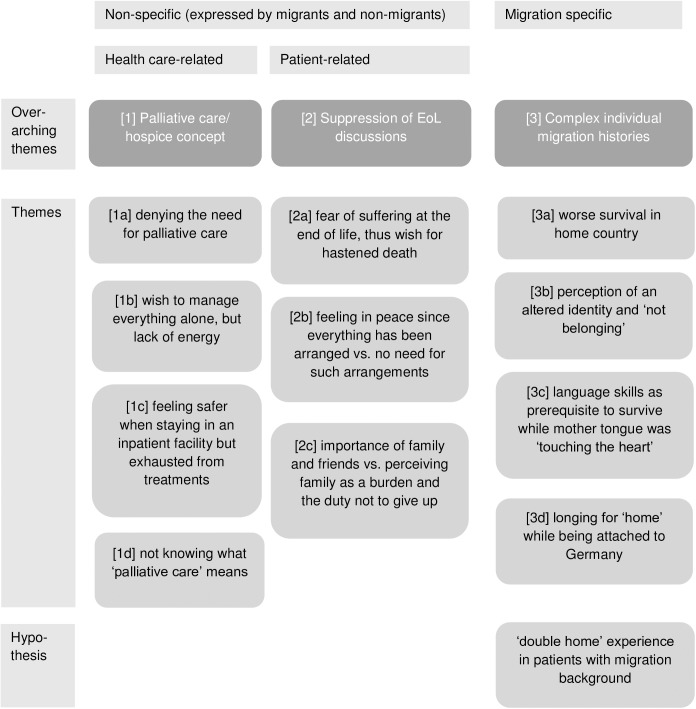
The 37 interviewees (19 native Germans and 18 patients from Europe and the U.S., Israel, Turkey, and Indonesia) expressed eleven themes covering health care- and patient-related issues, of which four emerged to be specific for migrants: worse survival in home country; the perception of an altered identity and 'not belonging'; language skills as prerequisite to survive; and longing for 'home' while being attached to Germany. From these categories, three overarching themes were derived: (1) a limited understanding of the concept of 'palliative care'; (2) the suppression of end of life discussions for its association with suffering and loss of autonomy; and (3) the significance of complex individual migration histories.
Based on these findings, the concept of a 'double home' experience is proposed. Barriers to access to palliative care should be minimized for all patients while cultural stereotyping has to be avoided.
在患有危及生命疾病且有移民史的患者中,有报道称其在家中去世的风险较高,且获得姑息治疗服务的机会有限。
探讨德国有移民史患者的观点和临终偏好,并确定与移民相关的特定主题。
采用考夫曼的“理解性访谈”(“聚焦访谈”)方法和扎根理论方法的双臂研究。使用MaxQDA 12软件进行主题内容分析。
设置/参与者:在不同专科水平环境(专科家庭姑息治疗、姑息治疗住院单元、住院临终关怀)中接受姑息治疗的患有晚期、危及生命疾病的移民和非移民成年患者。
37名受访者(19名德国本土人以及18名来自欧洲、美国、以色列、土耳其和印度尼西亚的患者)表达了涵盖医疗保健和患者相关问题的11个主题,其中4个主题是移民特有的:在原籍国的生存状况较差;身份改变和“归属感缺失”的认知;语言技能是生存的前提条件;以及在依恋德国的同时对“家乡”的渴望。从这些类别中得出了三个总体主题:(1)对“姑息治疗”概念的理解有限;(2)由于临终讨论与痛苦和自主权丧失相关而对其进行压制;(3)复杂个人移民历史的重要性。
基于这些发现,提出了“双重家乡”体验的概念。应尽量减少所有患者获得姑息治疗时的障碍,同时必须避免文化刻板印象。