Luque-Almagro Victor M, Manso Isabel, Sullivan Matthew J, Rowley Gary, Ferguson Stuart J, Moreno-Vivián Conrado, Richardson David J, Gates Andrew J, Roldán M Dolores
Departamento de Bioquímica y Biología Molecular, Universidad de Córdoba, Edificio Severo Ochoa, 1ª planta, Campus de Rabanales, Córdoba 14071, Spain.
School of Biological Sciences, University of East Anglia, Norwich Research Park, Norwich NR4 7TJ, U.K.
Biochem J. 2017 May 10;474(11):1769-1787. doi: 10.1042/BCJ20170115.
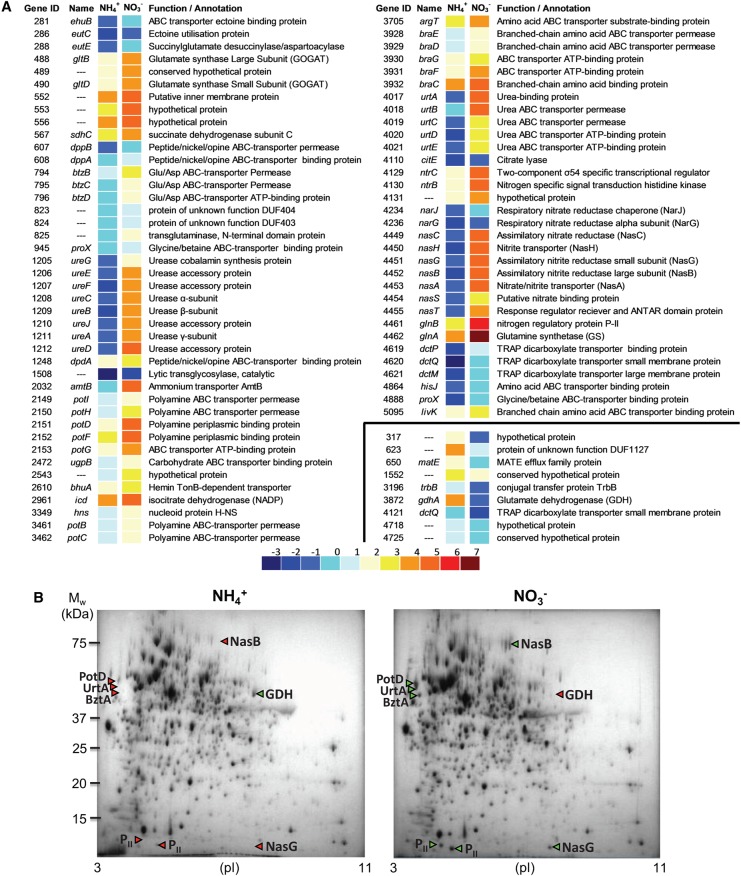
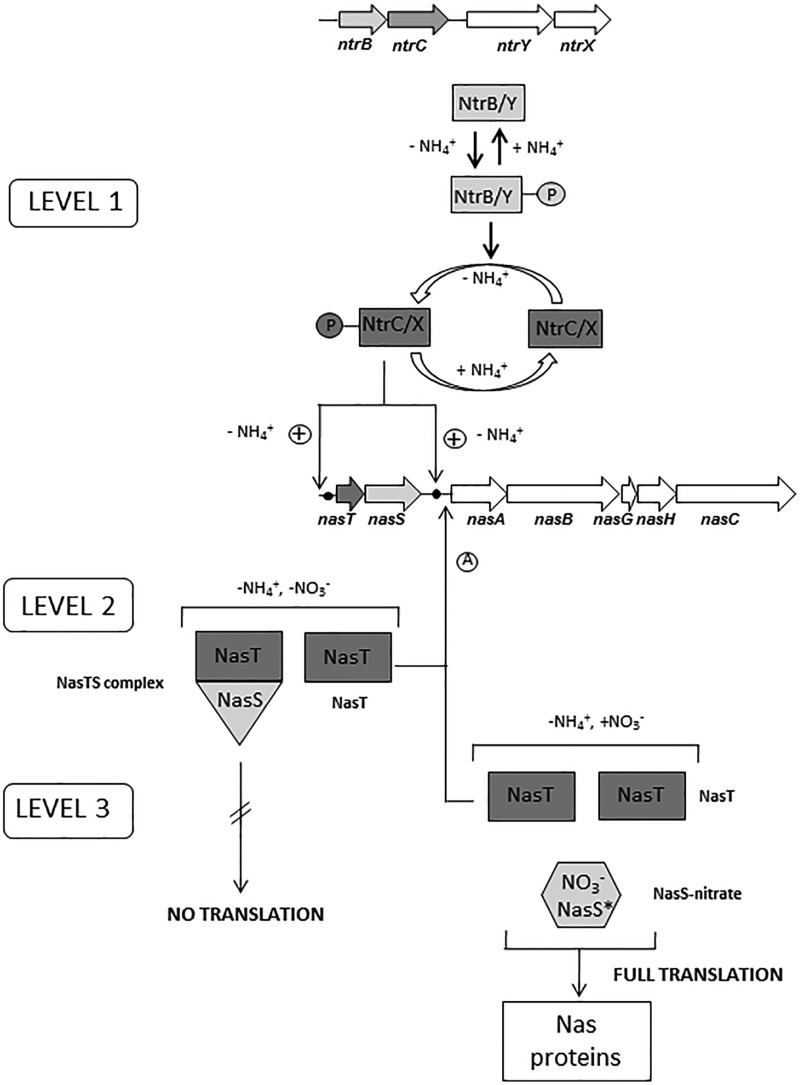
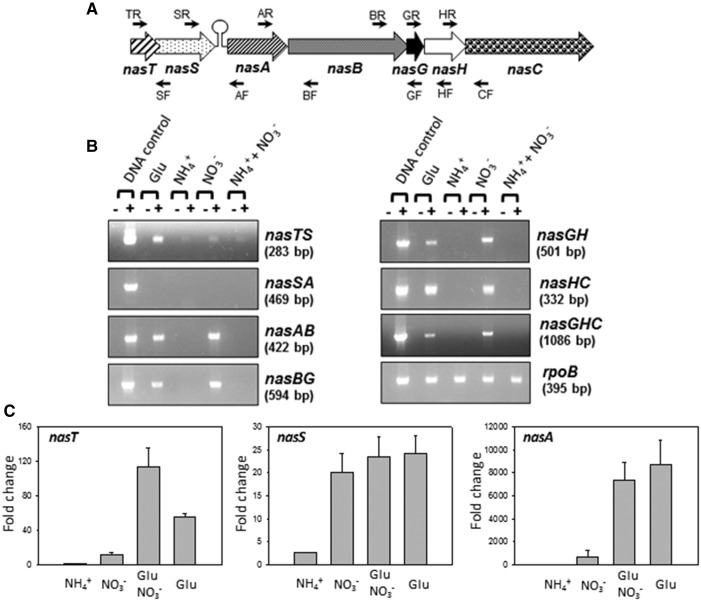
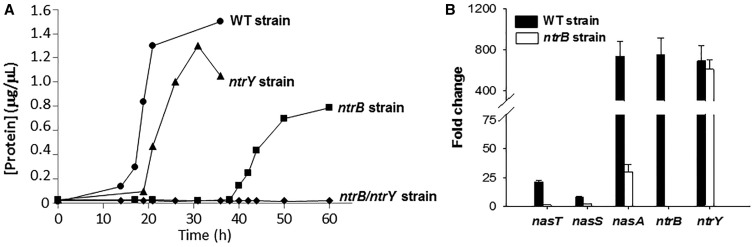
Transcriptional adaptation to nitrate-dependent anabolism by PD1222 was studied. A total of 74 genes were induced in cells grown with nitrate as N-source compared with ammonium, including and genes. The and genes were cotranscribed, although was more strongly induced by nitrate than The genes constituted a transcriptional unit, which is preceded by a non-coding region containing hairpin structures involved in transcription termination. The and transcripts were detected at similar levels with nitrate or glutamate as N-source, but transcript was undetectable in ammonium-grown cells. The nitrite reductase NasG subunit was detected by two-dimensional polyacrylamide gel electrophoresis in cytoplasmic fractions from nitrate-grown cells, but it was not observed when either ammonium or glutamate was used as the N-source. The mutant lacked both transcript and nicotinamide adenine dinucleotide (NADH)-dependent nitrate reductase activity. On the contrary, the mutant showed similar levels of the transcript to the wild-type strain and displayed NasG protein and NADH-nitrate reductase activity with all N-sources tested, except with ammonium. Ammonium repression of was dependent on the Ntr system. The and genes were expressed at low levels regardless of the nitrogen source supporting growth. Mutational analysis of the genes indicated that while genes are required for nitrate assimilation, genes can only partially restore growth on nitrate in the absence of genes. The existence of a regulation mechanism for nitrate assimilation in , by which nitrate induction operates at both transcriptional and translational levels, is proposed.
研究了PD1222对硝酸盐依赖性合成代谢的转录适应性。与以铵盐为氮源的细胞相比,以硝酸盐为氮源生长的细胞中共有74个基因被诱导,包括[具体基因]和[具体基因]。[具体基因]和[具体基因]是共转录的,尽管[具体基因]比[具体基因]更强烈地被硝酸盐诱导。[具体基因]构成一个转录单元,其前面是一个包含参与转录终止的发夹结构的非编码区。以硝酸盐或谷氨酸为氮源时,检测到[具体转录本]和[具体转录本]的水平相似,但在以铵盐生长的细胞中未检测到[具体转录本]。通过二维聚丙烯酰胺凝胶电泳在以硝酸盐生长的细胞的细胞质组分中检测到亚硝酸还原酶NasG亚基,但当以铵盐或谷氨酸作为氮源时未观察到。[具体突变体]缺乏[具体转录本]和烟酰胺腺嘌呤二核苷酸(NADH)依赖性硝酸盐还原酶活性。相反,[具体突变体]显示出与野生型菌株相似水平的[具体转录本],并且在除铵盐以外的所有测试氮源中都显示出NasG蛋白和NADH - 硝酸盐还原酶活性。铵盐对[具体基因]的抑制依赖于Ntr系统。无论支持生长的氮源如何,[具体基因]和[具体基因]都低水平表达。对[具体基因]的突变分析表明,虽然[具体基因]对于硝酸盐同化是必需的,但在没有[具体基因]的情况下,[具体基因]只能部分恢复在硝酸盐上的生长。提出了[具体细菌]中硝酸盐同化的调节机制,其中硝酸盐诱导在转录和翻译水平上起作用。