Kollár Márton, Ćirić Luka, Dil J Hugo, Weber Andrew, Muff Stefan, Ronnow Henrik M, Náfrádi Bálint, Monnier Benjamin Pierre, Luterbacher Jeremy Scott, Forró László, Horváth Endre
Institute of Physics, Ecole Polytechnique Fédérale de Lausanne, CH-1015, Lausanne, Switzerland.
Swiss Light Source, Paul Scherrer Institute, CH-5232, Villigen, Switzerland.
Sci Rep. 2017 Apr 6;7(1):695. doi: 10.1038/s41598-017-00799-0.
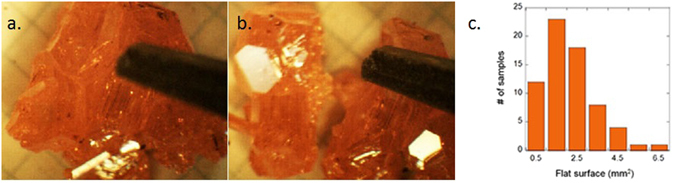
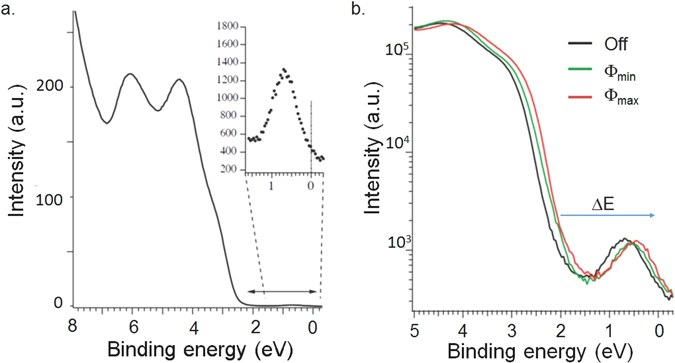
The surface of a material is not only a window into its bulk physical properties, but also hosts unique phenomena important for understanding the properties of a solid as a whole. Surface sensitive techniques, like ARPES (Angle-resolved photoemission spectroscopy), STM (Scanning tunneling microscopy), AFM (Atomic force microscopy), pump-probe optical measurements etc. require flat, clean surfaces. These can be obtained by cleaving, which is usually possible for layered materials. Such measurements have proven their worth by providing valuable information about cuprate superconductors, graphene, transition metal dichalcogenides, topological insulators and many other novel materials. Unfortunately, this was so far not the case for the cubic, organo-metallic photovoltaic perovskite which morsels during the cleavage. Here we show a method which results in flat, clean surfaces of CHNHPbBr which allows surface sensitive measurements, badly needed for the understanding and further engineering of this material family.
材料的表面不仅是了解其整体物理性质的窗口,还存在着一些独特现象,这些现象对于理解整个固体的性质至关重要。表面敏感技术,如角分辨光电子能谱(ARPES)、扫描隧道显微镜(STM)、原子力显微镜(AFM)、泵浦 - 探测光学测量等,都需要平整、清洁的表面。这些表面可以通过解理获得,对于层状材料来说通常是可行的。通过提供有关铜酸盐超导体、石墨烯、过渡金属二硫属化物、拓扑绝缘体和许多其他新型材料的有价值信息,此类测量已证明了其价值。不幸的是,到目前为止,立方有机金属光伏钙钛矿在解理过程中会破碎,情况并非如此。在这里,我们展示了一种方法,该方法可以得到平整、清洁的CHNHPbBr表面,这使得表面敏感测量成为可能,而这对于理解和进一步设计这个材料家族来说是非常必要的。