Niu Jing, Scheuerell Christie, Mehrotra Shailly, Karan Sharon, Puhalla Shannon, Kiesel Brian F, Ji Jiuping, Chu Edward, Gopalakrishnan Mathangi, Ivaturi Vijay, Gobburu Jogarao, Beumer Jan H
Center for Translational Medicine, School of Pharmacy, University of Maryland, Baltimore, MD, USA.
Division of Hematology-Oncology, Department of Medicine, University of Pittsburgh School of Medicine, Pittsburgh, PA, USA.
J Clin Pharmacol. 2017 Aug;57(8):977-987. doi: 10.1002/jcph.892. Epub 2017 Apr 7.
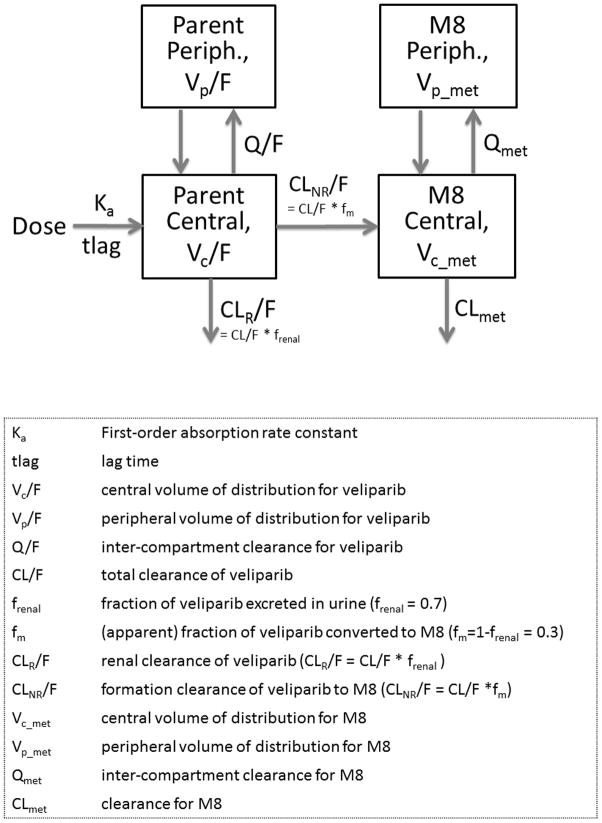
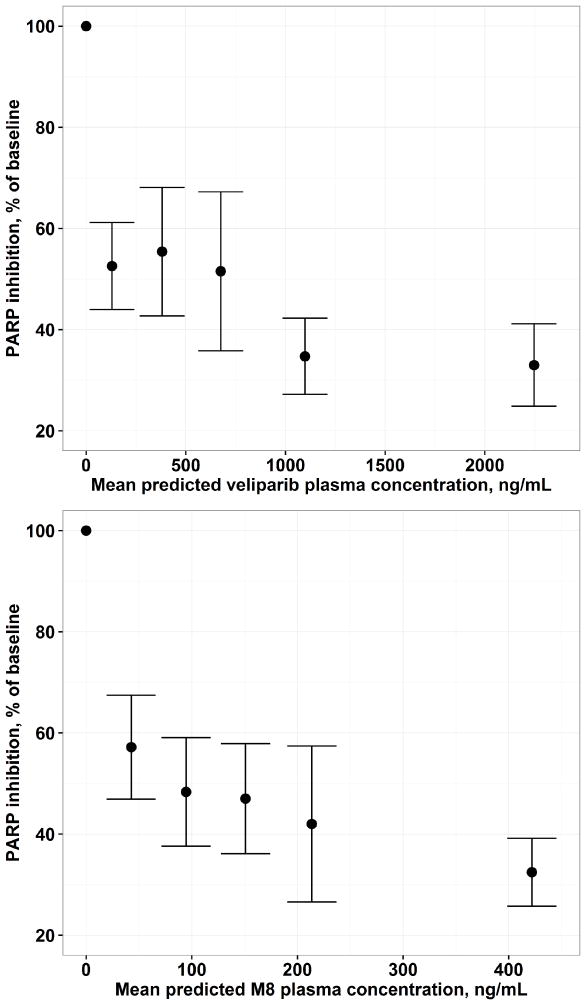
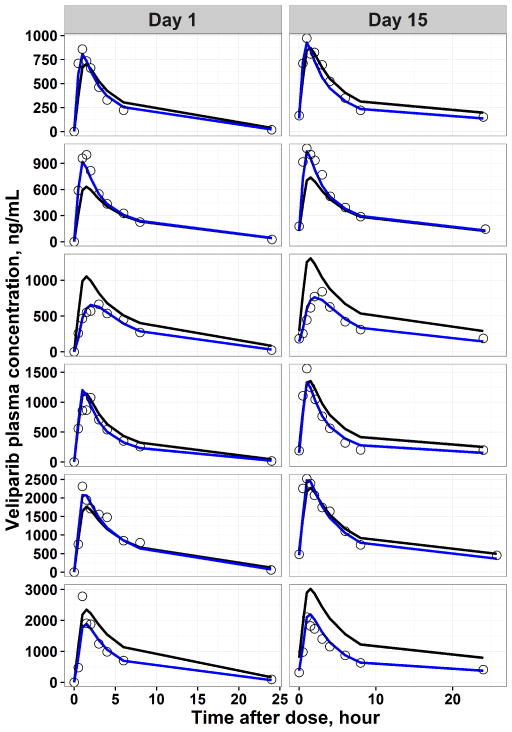
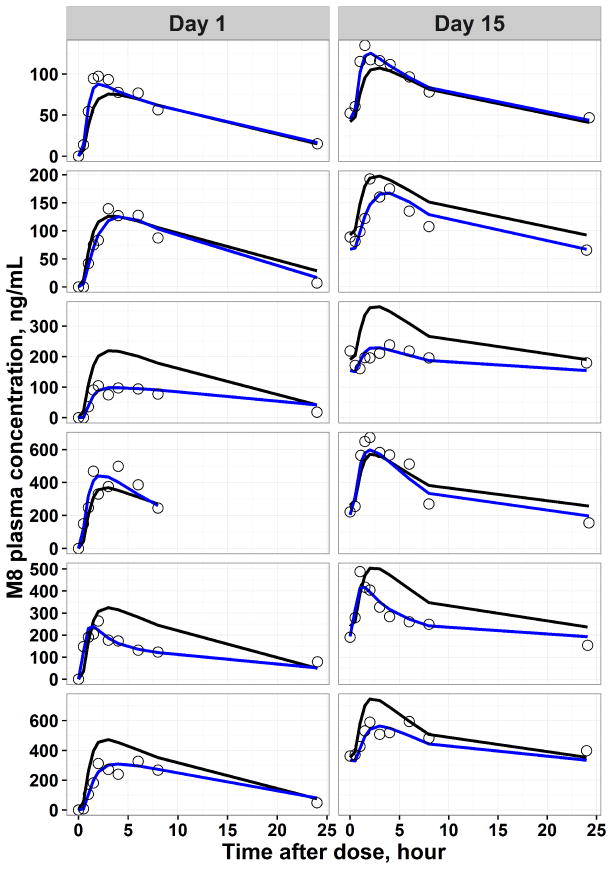
Veliparib (ABT-888) is a novel oral poly-ADP-ribose polymerase (PARP) inhibitor that is being developed for the treatment of hematologic malignancies and solid tumors. Although the pharmacokinetics of veliparib have been studied in combination with cytotoxic agents, limited information exists regarding the pharmacokinetics (PK) of chronically dosed single-agent veliparib in patients with either BRCA 1/2-mutated cancer or PARP-sensitive tumors. The objectives of the current analysis were to characterize the population pharmacokinetics of veliparib and its primary, active metabolite, M8, and to evaluate the relationship between veliparib and M8 concentrations and poly-ADP-ribose (PAR) level observed in peripheral blood mononuclear cells (PBMCs). Seventy-one subjects contributed with veliparib plasma concentrations, M8 plasma concentrations, and PAR levels in PBMCs. Veliparib and M8 concentrations were modeled simultaneously using a population PK approach. A 2-compartment model with delayed first-order absorption and the elimination parameterized as renal (CL /F) and nonrenal clearance (CL /F) adequately described veliparib pharmacokinetics. The pharmacokinetics of the M8 metabolite was described with a 2-compartment model. Creatinine clearance(CL ) and lean body mass (LBM) were identified as significant predictors of veliparib CL /F and central volume of distribution, respectively. For a typical subject (LBM, 48 kg; CL , 95 mL/min), total clearance (CL /F + CL /F), and central and peripheral volume of distribution for veliparib were estimated as 17.3 L/h, 98.7 L, and 48.3 L, respectively. At least 50% inhibition of PAR levels in PBMCs was observed at dose levels ranging from 50 to 500 mg.
维利帕尼(ABT - 888)是一种新型口服聚二磷酸腺苷核糖聚合酶(PARP)抑制剂,正被开发用于治疗血液系统恶性肿瘤和实体瘤。尽管已对维利帕尼与细胞毒性药物联合使用时的药代动力学进行了研究,但关于长期单药使用维利帕尼在携带BRCA 1/2突变癌症或PARP敏感肿瘤患者中的药代动力学(PK)信息有限。本次分析的目的是描述维利帕尼及其主要活性代谢产物M8的群体药代动力学,并评估维利帕尼和M8浓度与外周血单核细胞(PBMC)中观察到的聚二磷酸腺苷核糖(PAR)水平之间的关系。71名受试者提供了维利帕尼血浆浓度、M8血浆浓度以及PBMC中的PAR水平数据。使用群体PK方法对维利帕尼和M8浓度进行了同时建模。采用具有延迟一级吸收的二室模型,并将消除参数设定为肾清除率(CL /F)和非肾清除率(CL /F),该模型能充分描述维利帕尼的药代动力学。M8代谢产物的药代动力学用二室模型进行描述。肌酐清除率(CL )和瘦体重(LBM)分别被确定为维利帕尼CL /F和中央分布容积的显著预测因子。对于一名典型受试者(LBM,48 kg;CL ,95 mL/min),维利帕尼的总清除率(CL /F + CL /F)以及中央和外周分布容积分别估计为17.3 L/h、98.7 L和48.3 L。在50至500 mg的剂量范围内,观察到PBMC中PAR水平至少有50%的抑制。