McLaughlin John M, Munn James E, Anderson Terry L, Lambing Angela, Tortella Bartholomew, Witkop Michelle L
Pfizer Inc, Global Innovative Pharma, 500 Arcola Rd, Collegeville, PA, 19426, USA.
University of Michigan Hemophilia Treatment Center, 1500 E. Medical Center Drive, Ann Arbor, MI, USA.
Health Qual Life Outcomes. 2017 Apr 7;15(1):67. doi: 10.1186/s12955-017-0643-7.
Health-related quality of life (HRQoL) in adolescents and young adults with bleeding disorders is under-researched. We aimed to describe factors related to HRQoL in adolescents and young adults with hemophilia A or B or von Willebrand disease.
A convenience sample of volunteers aged 13 to 25 years with hemophilia or von Willebrand disease completed a cross-sectional survey that assessed Physical (PCS) and Mental (MCS) Component Summary scores on the SF-36 questionnaire. Quantile regression models were used to assess factors associated with HRQoL.
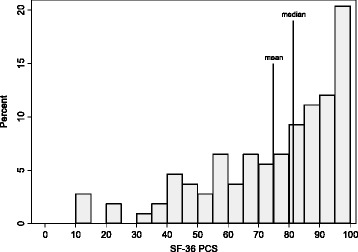
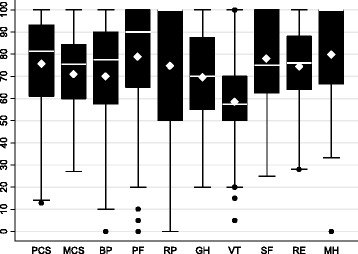
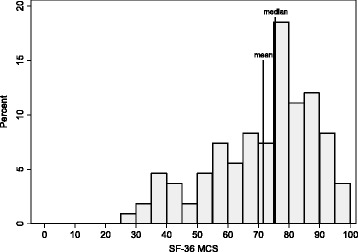
Of 108 respondents, 79, 7, and 14% had hemophilia A, hemophilia B, and von Willebrand disease, respectively. Most had severe disease (71%), had never developed an inhibitor (65%), and were treated prophylactically (68%). Half of patients were aged 13 to 17 years and most were white (80%) and non-Hispanic (89%). Chronic pain was reported as moderate to severe by 31% of respondents. Median PCS and MCS were 81.3 and 75.5, respectively. Quantile regression showed that the median PCS for women (61% with von Willebrand disease) was 13.1 (95% CI: 2.4, 23.8; p = 0.02) points lower than men. Ever developing an inhibitor (vs never) was associated with a 13.1-point (95% CI: 4.7, 21.5; p < 0.01) PCS reduction. MCS was 10.0 points (95% CI: 0.7, 19.3; p = 0.04) higher for prophylactic infusers versus those using on-demand treatment. Compared with patients with no to mild chronic pain, those with moderate to severe chronic pain had 25.5-point (95% CI: 17.2, 33.8; p < 0.001) and 10.0-point (95% CI: 0.8, 19.2; p = 0.03) reductions in median PCS and MCS, respectively.
Efforts should be made to prevent and manage chronic pain, which was strongly related to physical and mental HRQoL, in adolescents and young adults with hemophilia and von Willebrand disease. Previous research suggests that better clotting factor adherence may be associated with less chronic pain.
青少年和青年出血性疾病患者的健康相关生活质量(HRQoL)研究不足。我们旨在描述与甲型或乙型血友病或血管性血友病的青少年和青年HRQoL相关的因素。
对13至25岁患有血友病或血管性血友病的志愿者进行便利抽样,完成一项横断面调查,该调查使用SF-36问卷评估身体(PCS)和心理(MCS)成分总结得分。采用分位数回归模型评估与HRQoL相关的因素。
在108名受访者中,分别有79%、7%和14%患有甲型血友病、乙型血友病和血管性血友病。大多数患者病情严重(71%),从未产生抑制物(65%),且接受预防性治疗(68%)。一半患者年龄在13至17岁之间,大多数为白人(80%)且非西班牙裔(89%)。31%的受访者报告慢性疼痛为中度至重度。PCS和MCS的中位数分别为81.3和75.5。分位数回归显示,女性(61%患有血管性血友病)的PCS中位数比男性低13.1(95%CI:2.4,23.8;p = 0.02)分。曾产生抑制物(与未产生相比)与PCS降低13.1分(95%CI:4.7,21.5;p < 0.01)相关。与按需治疗的患者相比,预防性输注者的MCS高10.0分(95%CI:0.7,19.3;p = 0.04)。与无至轻度慢性疼痛的患者相比,中度至重度慢性疼痛的患者PCS和MCS中位数分别降低25.5分(95%CI:17.2,33.8;p < 0.001)和10.0分(95%CI:0.8,19.2;p = 0.03)。
应努力预防和管理慢性疼痛,慢性疼痛与血友病和血管性血友病青少年及青年的身体和心理HRQoL密切相关。先前的研究表明,更好地坚持凝血因子治疗可能与更少的慢性疼痛相关。