Iwata Akira, Kanayama Masahiro, Oha Fumihiro, Hashimoto Tomoyuki, Iwasaki Norimasa
Spine Center, Hakodate Central General Hospital, Hon-cho 33-2, Hakodate, Hokkaido, 040-8585, Japan.
Department of Orthopaedic Surgery, Hokkaido University, N15 W7 Kita-ward, Sapporo, Hokkaido, 060-8638, Japan.
BMC Musculoskelet Disord. 2017 Apr 7;18(1):148. doi: 10.1186/s12891-017-1509-1.
Teriparatide (recombinant human parathyroid hormone 1-34) is increasingly used for the treatment of severe osteoporosis because it stimulates bone formation and may potentially enhance fracture healing. The objective of this study was to investigate the effects of teriparatide versus a bisphosphonate on radiographic outcomes in the treatment of osteoporotic vertebral compression fractures (OVCF).
A total of 98 patients undergoing non-operative treatment for recent single-level OVCF were reviewed retrospectively. Thirty-eight patients were treated by a once-daily subcutaneous injection of 20 micrograms of teriparatide (TPD group), whereas 60 patients received 35 mg of alendronate weekly (BP group). Except for these medications, the same treatment protocol was applied to both groups. The radiographic assessments included union status, vertebral kyphosis, and mid-vertebral body height. The rates of fracture site surgical intervention were also compared between the two groups. The mean follow-up period was 27 months (median 22.5, range 2 - 75 months).
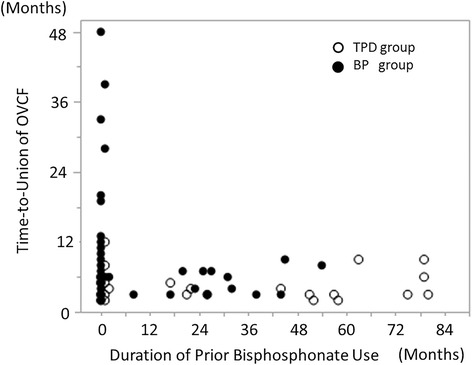
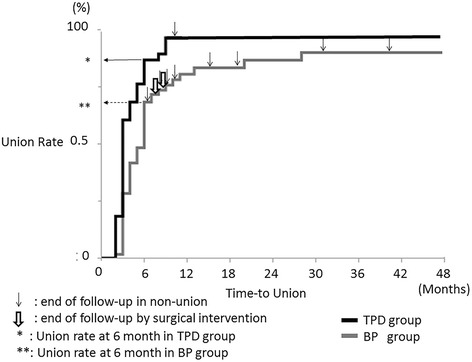
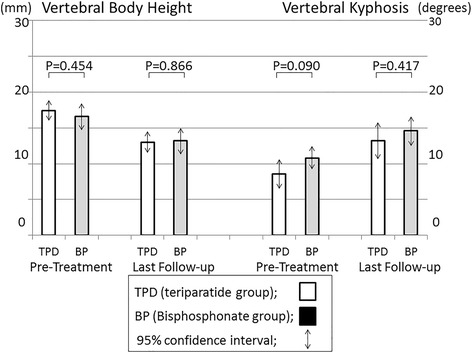
Cox regression analysis showed that TPD reduced the time-to-union (adjusted relative hazard ratio: 1.86, 95% C.I.: 1.21 - 2.83). The union rate at six months after treatment was 89% in the TPD group and 68% in the BP group; the surgical intervention rate was significantly higher in the TPD group (p = 0.026, adjusted odds ratio: 8.15, 95% C.I.: 2.02 - 43.33). The change in local kyphosis was 4.6° in the TPD group and 3.8° in the BP group (p = 0.495, paired t-test). The change of mid-vertebral body height was 4.4 mm in the TPD group and 3.4 mm in the BP group (p = 0.228, paired t-test). Fracture site surgical interventions were not required in the TPD group; however, two patients in the BP group eventually underwent surgical treatment for symptomatic non-union or vertebral collapse.
This retrospective study suggests that teriparatide may enhance fracture healing and improve the union rate in OVCF.
特立帕肽(重组人甲状旁腺激素1-34)越来越多地用于治疗严重骨质疏松症,因为它能刺激骨形成并可能增强骨折愈合。本研究的目的是调查特立帕肽与双膦酸盐在治疗骨质疏松性椎体压缩骨折(OVCF)时对影像学结果的影响。
回顾性分析了98例近期单节段OVCF接受非手术治疗的患者。38例患者接受每日一次皮下注射20微克特立帕肽治疗(TPD组),而60例患者每周接受35毫克阿仑膦酸钠治疗(BP组)。除了这些药物外,两组采用相同的治疗方案。影像学评估包括愈合情况、椎体后凸和椎体中部高度。还比较了两组骨折部位手术干预的发生率。平均随访期为27个月(中位数22.5个月,范围2-75个月)。
Cox回归分析显示,TPD缩短了愈合时间(调整后的相对风险比:1.86,95%置信区间:1.21-2.83)。TPD组治疗后6个月的愈合率为89%,BP组为68%;TPD组的手术干预率显著更高(p=0.026,调整后的优势比:8.15,95%置信区间:2.02-43.33)。TPD组局部后凸的变化为4.6°,BP组为3.8°(p=0.495,配对t检验)。TPD组椎体中部高度的变化为4.4毫米,BP组为3.4毫米(p=0.228,配对t检验)。TPD组无需进行骨折部位手术干预;然而,BP组有两名患者最终因症状性骨不连或椎体塌陷而接受了手术治疗。
这项回顾性研究表明,特立帕肽可能促进OVCF的骨折愈合并提高愈合率。