Valentine Kovalchuk P, Viacheslav Kondratiuk M
Department of Microbiology, Vinnitsa National Medical University, Pirogova str 56, Vinnitsa, 21018, Ukraine.
Military Medical Clinical Center of Central Region, Sverdlova str 185, Vinnitsa, 21018, Ukraine.
BMC Res Notes. 2017 Apr 7;10(1):152. doi: 10.1186/s13104-017-2481-4.
Microbiology of modern war wounds is unique for each military conflict. Climatic and geographical features of the theater of war, contemporary warfare as well as wound management affect the microbial flora of wounds. This study was designed to determine time-specific microbial flora of combat wounds of upper and lower extremities obtained during the war in eastern Ukraine.
The patients enrolled in study had combat wounds of upper or lower extremities which were treated in the Military Medical Clinical Center of Central Region. The wounds were swab-cultured and measured at each surgical debridement. The recovered microorganisms were identified and their antimicrobial resistance profiles were evaluated by disc diffusion method.
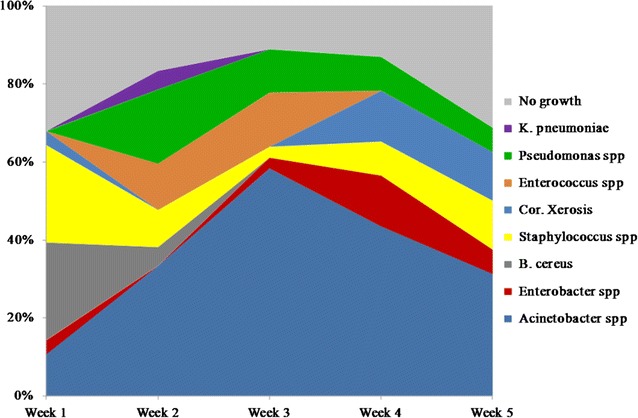
Forty-nine patients with battle-field wounds were enrolled in the study from July to November 2014; all patients were male with a mean Injury Severity Score and arrival APACHE II scores of 16.2 ± 10.7 and 7.4 ± 4.2 respectively. Among 128 swab cultures, 100 swab cultures were positive. Swab cultures were obtained from 57 wounds of 49 patients. The results of the test showed that 87.7% of all positive swab cultures contained a single-organism while the rest of the swab-culture results showed polymicrobial growth. Among the isolated microorganisms 65% (76 strains) were Gram-negative rods, 22.2% (26 strains) of Gram-positive cocci, followed by Gram-positive rods (12.8%, 15 strains). We found that epidemiology of wound infection changes with the time after injury. The most common bacterial isolates cultured during the first week were Gram-positive microbes with low pathogenicity. The number of Gram-negative rods increased during the wound healing process. The incidence of Gram-positive microorganisms' growth fell after the first week and increased after third week. During wound healing, bacterial microflora of wounds changes with increasing number of Gram-negative rods with predominance of Acinetobacter species. Predominant microorganisms in positive swab-cultures after first week were nonfermentative Gram-negative bacilli (68% of swab-cultures), which in 53% of the swab-cultures belonged to the genus Acinetobacter, and in 15% to the genus Pseudomonas. The incidence of polymicrobial wound cultures increased from first week to second post-injury week. The most frequent microbial mixture were Acinetobacter baumannii with Enterobacteriaceae or other nonfermentative Gram negative rods with Enterococcus spp. We observed bacteria recovery from wounds during proliferation phase. These wounds had no pure inflammation signs and were free of devitalized tissues.
Any wound is at some risk of becoming infected. In the event of infection, a wound fails to heal, treatment costs rise, and general wound management practices become more resource demanding. Determining the microorganisms which colonize battle wounds and cause wound infection is paramount. This information can help to treat battle wound infections or even changes infection control strategies. The fact of shifting in wound microbiology in the favor of bacteria responsible for healthcare-associated infections support to the proposition that these changes are nosocomially related [4, 14]. For Ukrainian military medicine this study is the first time-specified assessment of battle wound colonization from the World War II.
现代战争伤口的微生物情况在每场军事冲突中都独具特点。战区的气候和地理特征、当代战争以及伤口处理方式都会影响伤口的微生物群落。本研究旨在确定在乌克兰东部战争期间获取的上下肢战斗伤口特定时间的微生物群落。
纳入研究的患者为上下肢有战斗伤口且在中部地区军事医疗临床中心接受治疗的患者。在每次外科清创时对伤口进行拭子培养和测量。对分离出的微生物进行鉴定,并通过纸片扩散法评估其抗菌药物敏感性。
2014年7月至11月,49例有战场伤口的患者纳入本研究;所有患者均为男性,平均损伤严重程度评分和入院时急性生理与慢性健康状况评分系统(APACHE II)评分分别为16.2±10.7和7.4±4.2。在128次拭子培养中,100次培养结果为阳性。从49例患者的57处伤口获取了拭子培养样本。检测结果显示,所有阳性拭子培养样本中87.7%为单一微生物生长,其余拭子培养结果显示为多种微生物生长。在分离出的微生物中,65%(76株)为革兰氏阴性杆菌,22.2%(26株)为革兰氏阳性球菌,其次为革兰氏阳性杆菌(12.8%,15株)。我们发现伤口感染的流行病学情况随受伤后的时间而变化。伤后第一周培养出的最常见细菌分离株为致病性较低的革兰氏阳性微生物。革兰氏阴性杆菌的数量在伤口愈合过程中增加。革兰氏阳性微生物生长的发生率在第一周后下降,第三周后上升。在伤口愈合过程中,伤口的细菌群落随革兰氏阴性杆菌数量的增加而变化,不动杆菌属占优势。伤后第一周后阳性拭子培养中的主要微生物是非发酵革兰氏阴性杆菌(占拭子培养的68%),其中53%的拭子培养属于不动杆菌属,15%属于假单胞菌属。多种微生物伤口培养的发生率从伤后第一周增加到第二周。最常见的微生物组合是鲍曼不动杆菌与肠杆菌科细菌或其他非发酵革兰氏阴性杆菌与肠球菌属。我们观察到在增殖期伤口中有细菌检出。这些伤口没有单纯的炎症迹象且无失活组织。
任何伤口都有感染的风险。一旦发生感染,伤口无法愈合,治疗成本增加,并且一般的伤口处理措施对资源需求更大。确定在战斗伤口定植并导致伤口感染的微生物至关重要。这些信息有助于治疗战斗伤口感染甚至改变感染控制策略。伤口微生物群落向有利于与医疗保健相关感染的细菌转变这一事实支持了这些变化与医院感染相关的观点[4,14]。对于乌克兰军事医学而言,本研究是自第二次世界大战以来首次对战斗伤口定植进行的特定时间评估。
