Wiechno Paweł J, Kowalska Maria, Kucharz Jakub, Sadowska Małgorzata, Michalski Wojciech, Poniatowska Grażyna, Jońska-Gmyrek Joanna, Rzymkowska Joanna, Nietupski Karol, Demkow Tomasz
Department of Uro-Oncology, Maria Sklodowska-Curie Memorial Cancer Center and Institute of Oncology, Roentgena 5 st., 02-781, Warsaw, Poland.
Laboratory of Tumor Markers, Department of Pathology and Laboratory Diagnostics, Maria Sklodowska-Curie Memorial Cancer Center and Institute of Oncology, Roentgena 5 st., 02-781, Warsaw, Poland.
Med Oncol. 2017 May;34(5):84. doi: 10.1007/s12032-017-0943-0. Epub 2017 Apr 7.
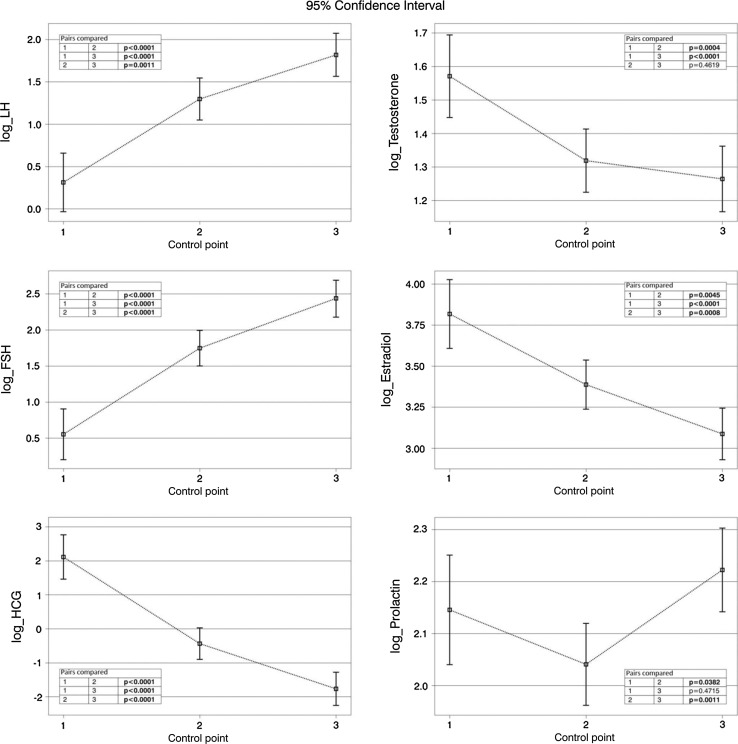
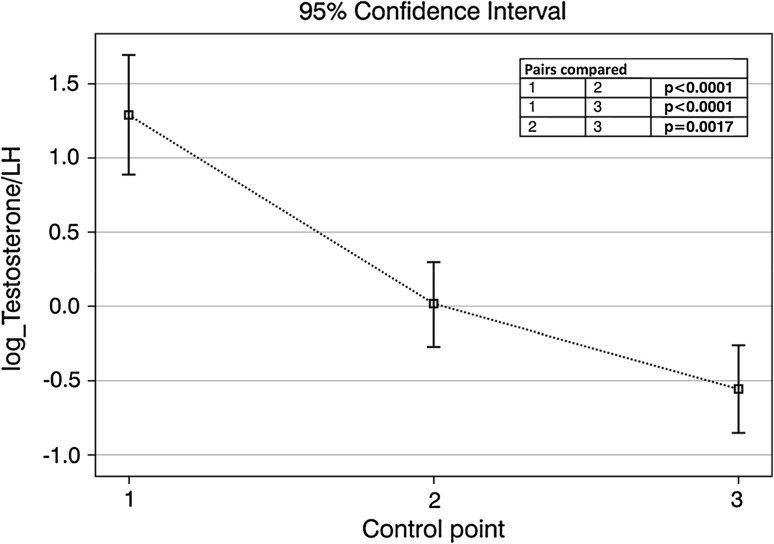
Testicular tumors and their treatment interfere with homeostasis, hormonal status included. The aim of the study was to evaluate hormonal disorders of the pituitary-gonadal axis in men treated for testicular tumors. One hundred twenty-eight men treated for a unilateral testicular tumor at our institution were included. The hormonal status was prospectively evaluated in 62 patients before orchiectomy, 120 patients 1 month after orchiectomy and 110 patients at least 1 year after the treatment. The concentrations of human chorionic gonadotropin (hCG), testosterone (T), estradiol, luteinizing hormone (LH), follicle-stimulating hormone (FSH) and prolactin were measured. The clinically significant testosterone deficiency was defined either as testosterone <2.31 ng/mL or testosterone within the range of 2.31-3.46 ng/mL but simultaneous with T/LH ratio ≤1. Changes in hormone levels were significant: LH and FSH rose in the course of observation, and the concentration of hCG, testosterone, estradiol decreased. PRL concentration was the lowest at 1 month after orchiectomy. In multivariate analysis, the risk of the clinically significant testosterone deficiency was 0.2107 (95% CI 0.1206-0.3419) prior to orchiectomy, 0.3894 (95% CI 0.2983-0.4889) 1 month after surgery and 0.4972 (95% CI 0.3951-0.5995) 1 year after the treatment. The estradiol concentration was elevated in 40% of patients with recently diagnosed testicular cancer and that was correlated with a higher risk of testosterone deficiency after the treatment completion. Hormonal disorders of the pituitary-gonadal axis in men treated for testicular tumors are frequent. The malignant tissue triggers paraneoplastic disorders that additionally disturb the hormonal equilibrium.
睾丸肿瘤及其治疗会干扰体内稳态,包括激素状态。本研究的目的是评估接受睾丸肿瘤治疗的男性垂体 - 性腺轴的激素紊乱情况。纳入了在我们机构接受单侧睾丸肿瘤治疗的128名男性。对62例患者在睾丸切除术前、120例患者在睾丸切除术后1个月以及110例患者在治疗后至少1年进行了前瞻性激素状态评估。测定了人绒毛膜促性腺激素(hCG)、睾酮(T)、雌二醇、黄体生成素(LH)、卵泡刺激素(FSH)和催乳素的浓度。临床上显著的睾酮缺乏定义为睾酮<2.31 ng/mL或睾酮在2.31 - 3.46 ng/mL范围内但同时T/LH比值≤1。激素水平变化显著:在观察过程中LH和FSH升高,hCG、睾酮、雌二醇浓度降低。PRL浓度在睾丸切除术后1个月时最低。在多变量分析中,临床上显著睾酮缺乏的风险在睾丸切除术前为0.2107(95%CI 0.1206 - 0.3419),术后1个月为0.3894(95%CI 0.2983 - 0.4889),治疗后1年为0.4972(95%CI 0.3951 - 0.5995)。40%新诊断的睾丸癌患者雌二醇浓度升高,这与治疗完成后睾酮缺乏的较高风险相关。接受睾丸肿瘤治疗的男性垂体 - 性腺轴激素紊乱很常见。恶性组织引发副肿瘤性疾病,进一步扰乱激素平衡。