Fierro Fernando A, Nolta Jan A, Adamopoulos Iannis E
Stem Cell Program, University of California at Davis, Sacramento, California, USA.
Department of Cell Biology and Human Anatomy, University of California at Davis, Sacramento, California, USA.
Stem Cells. 2017 Jun;35(6):1461-1467. doi: 10.1002/stem.2625. Epub 2017 May 2.
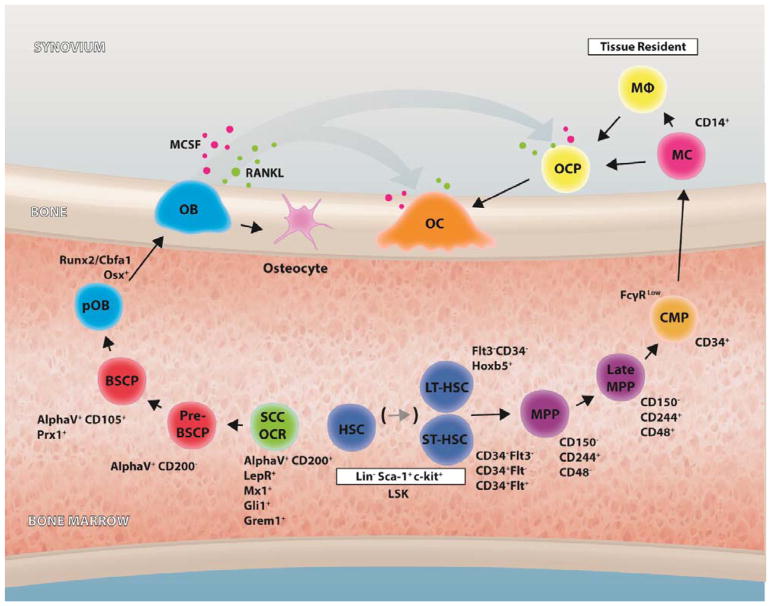
Bone remodeling is a lifelong process in which mature bone tissue is removed from the skeleton by bone resorption and is replenished by new during ossification or bone formation. The remodeling cycle requires both the differentiation and activation of two cell types with opposing functions; the osteoclast, which orchestrates bone resorption, and the osteoblast, which orchestrates bone formation. The differentiation of these cells from their respective precursors is a process which has been overshadowed by enigma, particularly because the precise osteoclast precursor has not been identified and because the identification of skeletal stem cells, which give rise to osteoblasts, is very recent. Latest advances in the area of stem cell biology have enabled us to gain a better understanding of how these differentiation processes occur in physiological and pathological conditions. In this review we postulate that modulation of stem cells during inflammatory conditions is a necessary prerequisite of bone remodeling and therefore an essential new component to the field of osteoimmunology. In this context, we highlight the role of transcription factor nuclear factor of activated T cells cytoplasmic 1 (NFATc1), because it directly links inflammation with differentiation of osteoclasts and osteoblasts. Stem Cells 2017;35:1461-1467.
骨重塑是一个终身过程,在此过程中,成熟的骨组织通过骨吸收从骨骼中被移除,并在骨化或骨形成过程中由新的骨组织补充。重塑周期需要两种具有相反功能的细胞类型进行分化和激活;破骨细胞负责协调骨吸收,成骨细胞负责协调骨形成。这些细胞从各自前体细胞的分化过程一直笼罩在谜团之中,特别是因为尚未确定确切的破骨细胞前体,而且成骨细胞来源的骨骼干细胞的鉴定也是最近才有的。干细胞生物学领域的最新进展使我们能够更好地理解这些分化过程在生理和病理条件下是如何发生的。在这篇综述中,我们假设炎症条件下干细胞的调节是骨重塑的必要前提,因此是骨免疫学领域一个重要的新组成部分。在此背景下,我们强调转录因子活化T细胞核因子细胞质1(NFATc1)的作用,因为它直接将炎症与破骨细胞和成骨细胞的分化联系起来。《干细胞》2017年;35卷:1461 - 1467页