NIHR Wellcome Trust Clinical Research Facility, University Hospital Southampton NHS Foundation Trust, Southampton, UK; Clinical and Experimental Sciences, Faculty of Medicine, University of Southampton, Southampton, UK.
Department of Infection, University Hospital Southampton NHS Foundation Trust, Southampton, UK.
Lancet Respir Med. 2017 May;5(5):401-411. doi: 10.1016/S2213-2600(17)30120-0. Epub 2017 Apr 6.
Respiratory virus infection is a common cause of hospitalisation in adults. Rapid point-of-care testing (POCT) for respiratory viruses might improve clinical care by reducing unnecessary antibiotic use, shortening length of hospital stay, improving influenza detection and treatment, and rationalising isolation facility use; however, insufficient evidence exists to support its use over standard clinical care. We aimed to assess the effect of routine POCT on a broad range of clinical outcomes including antibiotic use.
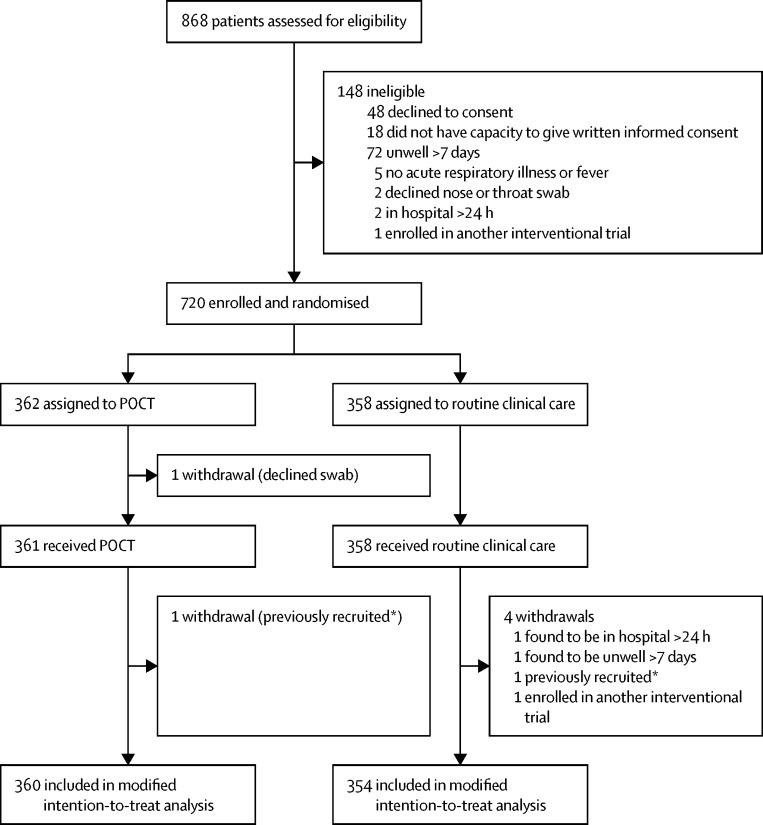
In this pragmatic, parallel-group, open-label, randomised controlled trial, we enrolled adults (aged ≥18 years) within 24 h of presenting to the emergency department or acute medical unit of a large UK hospital with acute respiratory illness or fever higher than 37·5°C (≤7 days duration), or both, over two winter seasons. Patients were randomly assigned (1:1), via an internet-based allocation sequence with random permuted blocks, to have a molecular POC test for respiratory viruses or routine clinical care. The primary outcome was the proportion of patients who received antibiotics while hospitalised (up to 30 days). Secondary outcomes included duration of antibiotics, proportion of patients receiving single doses or brief courses of antibiotics, length of stay, antiviral use, isolation facility use, and safety. Analysis was by modified intention to treat, excluding patients who declined intervention or were withdrawn for protocol violations. This study is registered with ISRCTN, number 90211642, and has been completed.
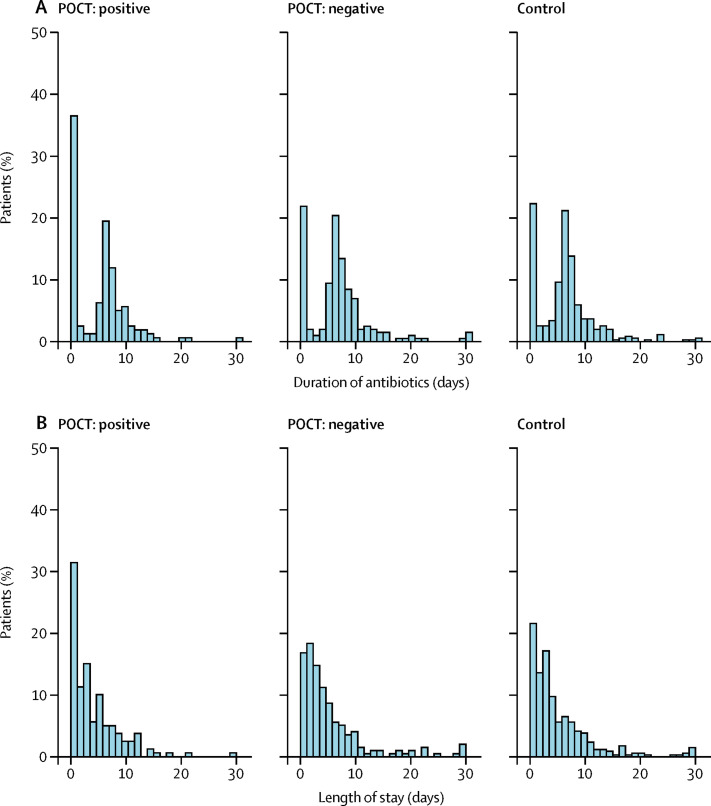
Between Jan 15, 2015, and April 30, 2015, and between Oct 1, 2015, and April 30, 2016, we enrolled 720 patients (362 assigned to POCT and 358 to routine care). Six patients withdrew or had protocol violations. 301 (84%) of 360 patients in the POCT group received antibiotics compared with 294 (83%) of 354 controls (difference 0·6%, 95% CI -4·9 to 6·0; p=0·84). Mean duration of antibiotics did not differ between groups (7·2 days [SD 5·1] in the POCT group vs 7·7 days [4·9] in the control group; difference -0·4, 95% CI -1·2 to 0·4; p=0·32). 50 (17%) of 301 patients treated with antibiotics in the POCT group received single doses or brief courses of antibiotics (<48 h) compared with 26 (9%) of 294 patients in the control group (difference 7·8%, 95% CI 2·5 to 13·1; p=0·0047; number needed to test=13). Mean length of stay was shorter in the POCT group (5·7 days [SD 6·3]) than in the control group (6·8 days [7·7]; difference -1·1, 95% CI -2·2 to -0·3; p=0·0443). Appropriate antiviral treatment of influenza-positive patients was more common in the POCT group (52 [91%] of 57 patients) than in the control group (24 [65%] of 37 patients; difference 26·4%, 95% CI 9·6 to 43·2; p=0·0026; number needed to test=4). We found no differences in adverse outcomes between the groups (77 [21%] of 360 patients in the POCT group vs 88 [25%] of 354 patients in the control group; -3·5%, -9·7 to 2·7; p=0·29).
Routine use of molecular POCT for respiratory viruses did not reduce the proportion of patients treated with antibiotics. However, the primary outcome measure failed to capture differences in antibiotic use because many patients were started on antibiotics before the results of POCT could be made available. Although POCT was not associated with a reduction in the duration of antibiotics overall, more patients in the POCT group received single doses or brief courses of antibiotics than did patients in the control group. POCT was also associated with a reduced length of stay and improved influenza detection and antiviral use, and appeared to be safe.
University of Southampton.
呼吸道病毒感染是成年人住院的常见原因。呼吸道病毒的快速床边即时检测(POCT)可能通过减少不必要的抗生素使用、缩短住院时间、提高流感检测和治疗效果以及合理利用隔离设施来改善临床护理;然而,目前还没有足够的证据支持其在标准临床护理中的应用。我们旨在评估常规 POCT 在广泛的临床结局方面的效果,包括抗生素使用情况。
在这项务实的、平行组、开放性、随机对照试验中,我们在两个冬季季节期间,在英国一家大型医院的急诊部门或急性内科病房内,在 24 小时内招募了患有急性呼吸道疾病或发热(≤7 天)的成年人(年龄≥18 岁),或同时患有这两种疾病。患者通过基于互联网的分配序列以随机排列的区块进行 1:1 随机分组,接受呼吸道病毒的分子 POCT 检测或常规临床护理。主要结局是住院期间接受抗生素治疗的患者比例(最长 30 天)。次要结局包括抗生素使用时间、接受单剂量或短疗程抗生素治疗的患者比例、住院时间、抗病毒药物使用、隔离设施使用情况和安全性。采用意向治疗进行分析,排除拒绝干预或因违反方案而被排除的患者。本研究在 ISRCTN 注册,编号为 90211642,现已完成。
2015 年 1 月 15 日至 4 月 30 日和 2015 年 10 月 1 日至 4 月 30 日期间,我们共招募了 720 名患者(POCT 组 362 名,常规护理组 358 名)。6 名患者退出或违反方案。POCT 组 360 名患者中有 301 名(84%)接受了抗生素治疗,对照组 354 名患者中有 294 名(83%)(差异 0.6%,95%CI -4.9 至 6.0;p=0.84)。两组抗生素使用时间无差异(POCT 组 7.2 天[标准差 5.1],对照组 7.7 天[4.9];差异 -0.4,95%CI -1.2 至 0.4;p=0.32)。POCT 组接受抗生素治疗的 301 名患者中,50 名(17%)接受了单剂量或短疗程(<48 小时)抗生素治疗,对照组 294 名患者中,26 名(9%)接受了这种治疗(差异 7.8%,95%CI 2.5 至 13.1;p=0.0047;需要检测的人数=13)。POCT 组的平均住院时间比对照组更短(5.7 天[标准差 6.3])(6.8 天[7.7];差异 -1.1,95%CI -2.2 至 -0.3;p=0.0443)。POCT 组流感阳性患者的适当抗病毒治疗更为常见(57 名患者中有 52 名[91%]),对照组 37 名患者中有 24 名(65%)(差异 26.4%,95%CI 9.6 至 43.2;p=0.0026;需要检测的人数=4)。两组不良结局无差异(POCT 组 360 名患者中有 77 名[21%],对照组 354 名患者中有 88 名[25%];差异 -3.5%,95%CI -9.7 至 2.7;p=0.29)。
呼吸道病毒的常规 POCT 并未降低接受抗生素治疗的患者比例。然而,主要结局指标未能捕捉到抗生素使用的差异,因为许多患者在 POCT 结果出来之前就开始使用抗生素。尽管 POCT 总体上与抗生素使用时间无差异,但 POCT 组接受单剂量或短疗程抗生素治疗的患者比例高于对照组。POCT 还与缩短住院时间、提高流感检测和抗病毒药物使用效果以及安全性有关。
南安普敦大学。