Ludewig Andreas H, Gimond Clotilde, Judkins Joshua C, Thornton Staci, Pulido Dania C, Micikas Robert J, Döring Frank, Antebi Adam, Braendle Christian, Schroeder Frank C
Molecular Prevention Group, Institute of Human Nutrition and Food Science, Christian-Albrechts-University, Kiel, Germany.
Boyce Thompson Institute and Department of Chemistry and Chemical Biology, Cornell University, Ithaca, NY, United States of Ameirca.
PLoS Genet. 2017 Apr 10;13(4):e1006717. doi: 10.1371/journal.pgen.1006717. eCollection 2017 Apr.
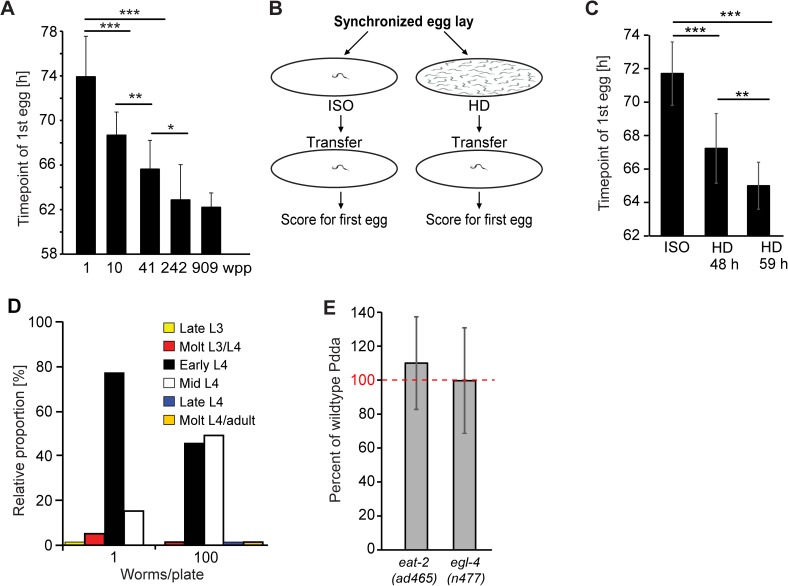
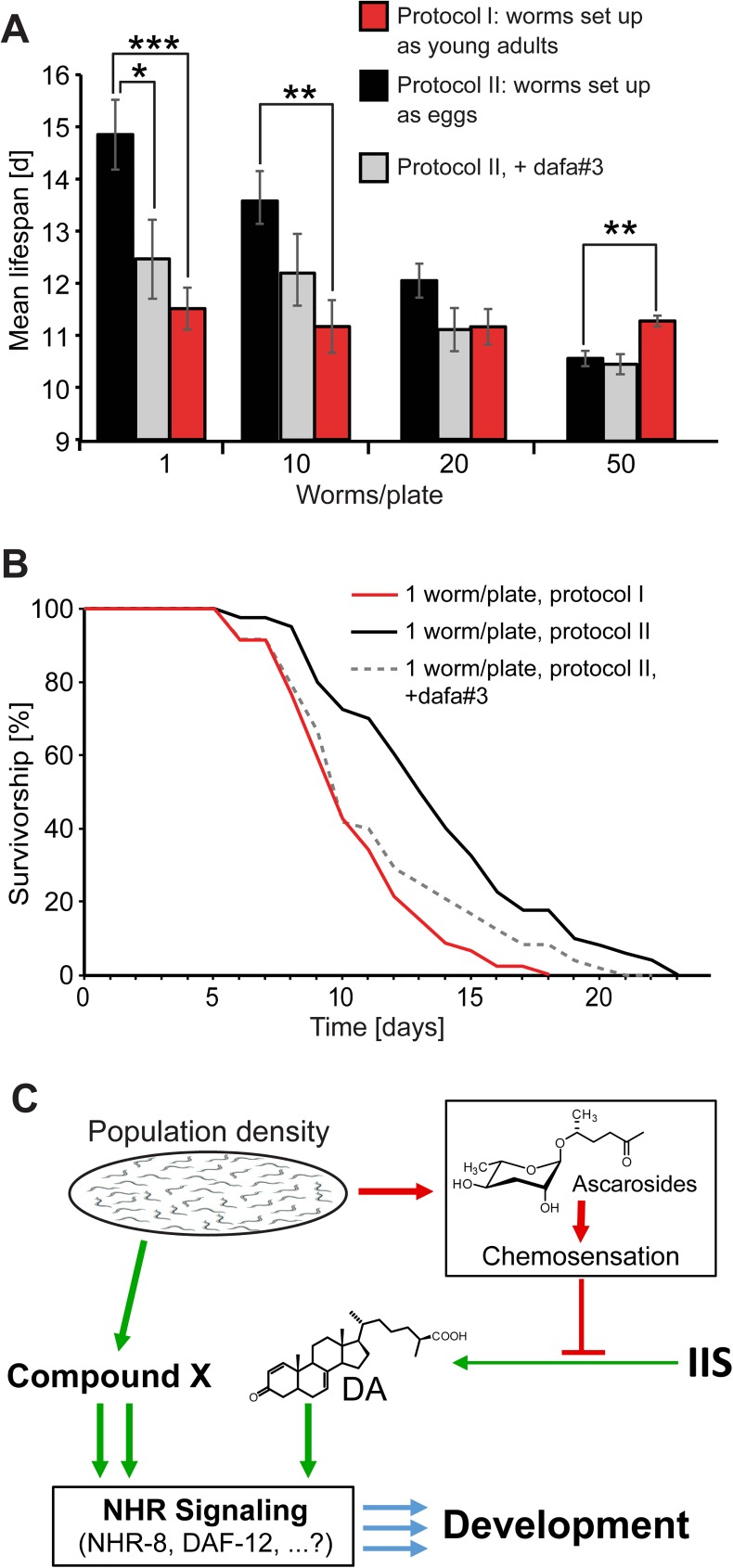
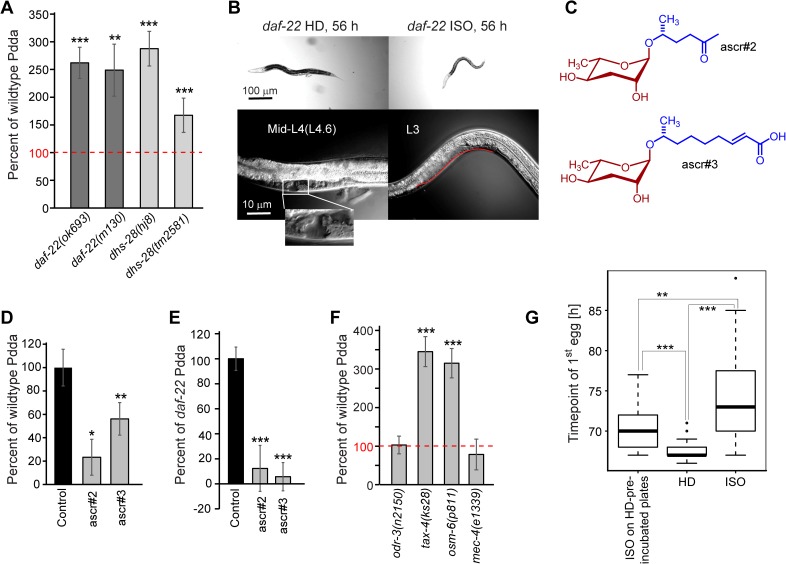
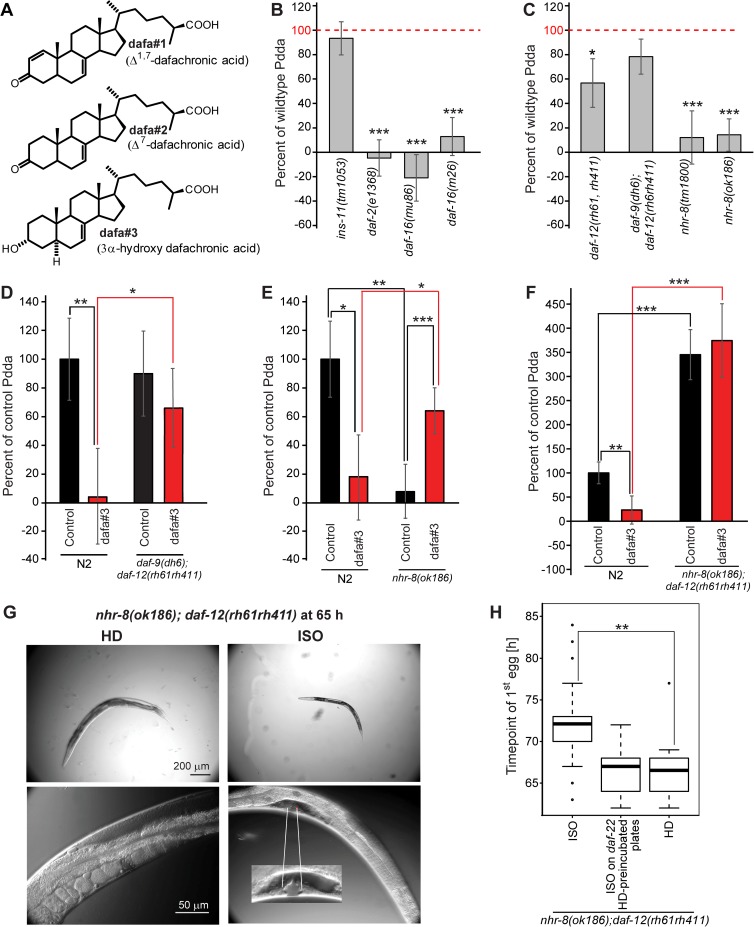
Environmental conditions experienced during animal development are thought to have sustained impact on maturation and adult lifespan. Here we show that in the model organism C. elegans developmental rate and adult lifespan depend on larval population density, and that this effect is mediated by excreted small molecules. By using the time point of first egg laying as a marker for full maturity, we found that wildtype hermaphrodites raised under high density conditions developed significantly faster than animals raised in isolation. Population density-dependent acceleration of development (Pdda) was dramatically enhanced in fatty acid β-oxidation mutants that are defective in the biosynthesis of ascarosides, small-molecule signals that induce developmental diapause. In contrast, Pdda is abolished by synthetic ascarosides and steroidal ligands of the nuclear hormone receptor DAF-12. We show that neither ascarosides nor any known steroid hormones are required for Pdda and that another chemical signal mediates this phenotype, in part via the nuclear hormone receptor NHR-8. Our results demonstrate that C. elegans development is regulated by a push-pull mechanism, based on two antagonistic chemical signals: chemosensation of ascarosides slows down development, whereas population-density dependent accumulation of a different chemical signal accelerates development. We further show that the effects of high larval population density persist through adulthood, as C. elegans larvae raised at high densities exhibit significantly reduced adult lifespan and respond differently to exogenous chemical signals compared to larvae raised at low densities, independent of density during adulthood. Our results demonstrate how inter-organismal signaling during development regulates reproductive maturation and longevity.
动物发育过程中所经历的环境条件被认为会对其成熟和成年后的寿命产生持续影响。在此,我们表明,在模式生物秀丽隐杆线虫中,发育速率和成年寿命取决于幼虫的种群密度,并且这种影响是由分泌的小分子介导的。通过将首次产卵的时间点作为完全成熟的标志,我们发现,在高密度条件下饲养的野生型雌雄同体线虫比单独饲养的线虫发育得明显更快。在脂肪酸β-氧化突变体中,发育的种群密度依赖性加速(Pdda)显著增强,这些突变体在ascarosides(诱导发育滞育的小分子信号)的生物合成方面存在缺陷。相反,合成的ascarosides和核激素受体DAF-12的甾体配体消除了Pdda。我们表明,Pdda既不需要ascarosides也不需要任何已知的甾体激素,并且另一种化学信号部分通过核激素受体NHR-8介导这种表型。我们的结果表明,秀丽隐杆线虫的发育受一种推拉机制调节,该机制基于两种拮抗的化学信号:对ascarosides的化学感应会减缓发育,而不同化学信号的种群密度依赖性积累会加速发育。我们进一步表明,高幼虫种群密度的影响会持续到成年期,因为在高密度下饲养的秀丽隐杆线虫幼虫成年后的寿命显著缩短,并且与在低密度下饲养的幼虫相比,它们对外源化学信号的反应不同,这与成年期的密度无关。我们的结果证明了发育过程中的生物体间信号传导如何调节生殖成熟和寿命。