de Gooijer Mark C, van den Top Arnout, Bockaj Irena, Beijnen Jos H, Würdinger Thomas, van Tellingen Olaf
Division of Pharmacology/Mouse Cancer Clinic The Netherlands Cancer Institute Amsterdam The Netherlands.
Department of Pharmacy and Pharmacology The Netherlands Cancer Institute/Slotervaart Hospital Amsterdam The Netherlands; Division of Drug Toxicology Faculty of Pharmacy Utrecht University The Netherlands; Division of Biomedical Analysis Faculty of Science Utrecht University The Netherlands.
FEBS Open Bio. 2017 Mar 4;7(4):439-455. doi: 10.1002/2211-5463.12206. eCollection 2017 Apr.
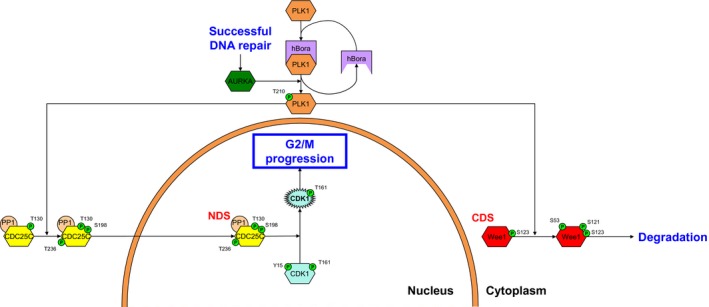
Tight regulation of the eukaryotic cell cycle is paramount to ensure genomic integrity throughout life. Cell cycle checkpoints are present in each phase of the cell cycle and prevent cell cycle progression when genomic integrity is compromised. The G2 checkpoint is an intricate signaling network that regulates the progression of G2 to mitosis (M). We propose here a node-based model of G2 checkpoint regulation, in which the action of the central CDK1-cyclin B1 node is determined by the concerted but opposing activities of the Wee1 and cell division control protein 25C (CDC25C) nodes. Phosphorylation of both Wee1 and CDC25C at specific sites determines their subcellular localization, driving them either toward activity within the nucleus or to the cytoplasm and subsequent ubiquitin-mediated proteasomal degradation. In turn, this subcellular balance of the Wee1 and CDC25C nodes is directed by the action of the PLK1 and CHK1 nodes via what we have termed the 'nuclear and cytoplasmic decision states' of Wee1 and CDC25C. The proposed node-based model provides an intelligible structure of the complex interactions that govern the decision to delay or continue G2/M progression. The model may also aid in predicting the effects of agents that target these G2 checkpoint nodes.
真核细胞周期的严格调控对于确保整个生命过程中的基因组完整性至关重要。细胞周期检查点存在于细胞周期的每个阶段,当基因组完整性受到损害时,会阻止细胞周期的进程。G2检查点是一个复杂的信号网络,它调节从G2期到有丝分裂(M期)的进程。我们在此提出一种基于节点的G2检查点调控模型,其中核心的细胞周期蛋白依赖性激酶1(CDK1)-细胞周期蛋白B1节点的作用由Wee1和细胞分裂控制蛋白25C(CDC25C)节点协同但相反的活性决定。Wee1和CDC25C在特定位点的磷酸化决定了它们的亚细胞定位,促使它们要么在细胞核内发挥活性,要么进入细胞质并随后被泛素介导的蛋白酶体降解。反过来,Wee1和CDC25C节点的这种亚细胞平衡是由PLK1和CHK1节点通过我们所称的Wee1和CDC25C的“核质决策状态”的作用来指导的。所提出的基于节点的模型为控制延迟或继续G2/M进程决策的复杂相互作用提供了一个清晰易懂的结构。该模型还可能有助于预测靶向这些G2检查点节点的药物的效果。