Hlavatý Juraj, Tonar Zbyněk, Renner Matthias, Panitz Sylvia, Petznek Helga, Schweizer Matthias, Schüle Silke, Kloke Björn-Philipp, Moldzio Rudolf, Witter Kirsti
Department of Pathobiology, Institute of Anatomy, Histology and Embryology, University of Veterinary Medicine Vienna, Veterinärplatz 1, 1210, Vienna, Austria.
Faculty of Applied Sciences, European Centre of Excellence NTIS, University of West Bohemia in Pilsen, Univerzitní 8, 306 14, Pilsen, Czech Republic.
Histochem Cell Biol. 2017 Sep;148(3):313-329. doi: 10.1007/s00418-017-1569-1. Epub 2017 Apr 10.
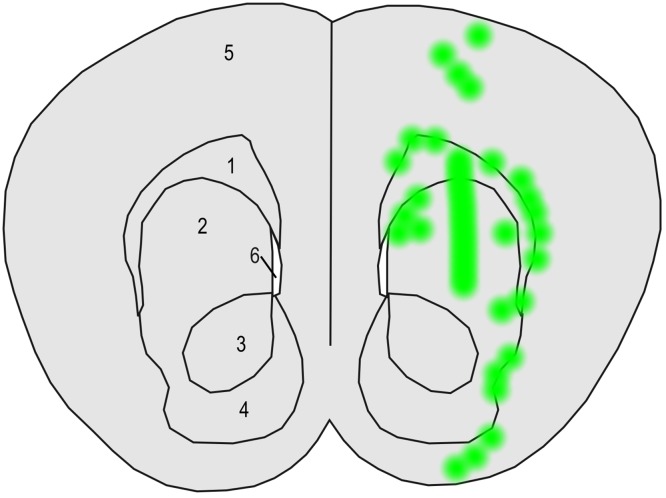
Lentiviruses are suitable to transfer potential therapeutic genes into non-replicating cells such as neurons, but systematic in vivo studies on transduction of neural cells within the complete brain are missing. We analysed the distribution of transduced cells with respect to brain structure, virus tropism, numbers of transduced neurons per brain, and influence of the Vpx or Vpr accessory proteins after injection of vectors based on SIVsmmPBj, HIV-2, and HIV-1 lentiviruses into the right striatum of the mouse brain. Transduced cells were found ipsilaterally around the injection canal, in corpus striatum and along corpus callosum, irrespective of the vector type. All vectors except HIV-2SEW transduced also single cells in the olfactory bulb, hippocampus, and cerebellum. Vector HIV-2SEW was the most neuron specific. However, vectors PBjSEW and HIV-1SEW transduced more neurons per brain (means 41,299 and 32,309) than HIV-2SEW (16,102). In the presence of Vpx/Vpr proteins, HIV-2SEW(Vpx) and HIV-1SEW(Vpr) showed higher overall transduction efficiencies (30,696 and 27,947 neurons per brain) than PBjSEW(Vpx) (6636). The distances of transduced cells from the injection canal did not differ among the viruses but correlated positively with the numbers of transduced neurons. The presence of Vpx/Vpr did not increase the numbers of transduced neurons. Parental virus type and the vector equipment seem to influence cellular tropism and transduction efficiency. Thus, precision of injection and choice of virus pseudotype are not sufficient when targeted lentiviral vector transduction of a defined brain cell population is required.
慢病毒适合将潜在的治疗基因导入非复制细胞,如神经元,但目前尚缺乏对全脑内神经细胞转导的系统性体内研究。我们分析了基于猴免疫缺陷病毒(SIVsmmPBj)、HIV-2和HIV-1慢病毒的载体注射到小鼠脑右侧纹状体后,转导细胞在脑结构、病毒嗜性、每脑转导神经元数量以及Vpx或Vpr辅助蛋白影响方面的分布情况。无论载体类型如何,在注射通道同侧的注射管周围、纹状体以及胼胝体中均发现了转导细胞。除HIV-2SEW外,所有载体还在嗅球、海马体和小脑中转导了单个细胞。载体HIV-2SEW对神经元的特异性最强。然而,与HIV-2SEW(16,102个)相比,载体PBjSEW和HIV-1SEW每脑转导的神经元更多(分别为41,299个和32,309个)。在存在Vpx/Vpr蛋白的情况下,HIV-2SEW(Vpx)和HIV-1SEW(Vpr)的总体转导效率更高(每脑分别为30,696个和27,947个神经元),高于PBjSEW(Vpx)(6636个)。不同病毒转导细胞与注射通道的距离并无差异,但与转导神经元的数量呈正相关。Vpx/Vpr的存在并未增加转导神经元的数量。亲本病毒类型和载体配置似乎会影响细胞嗜性和转导效率。因此,当需要对特定脑区细胞群体进行靶向慢病毒载体转导时,注射精度和病毒假型的选择并不足够。